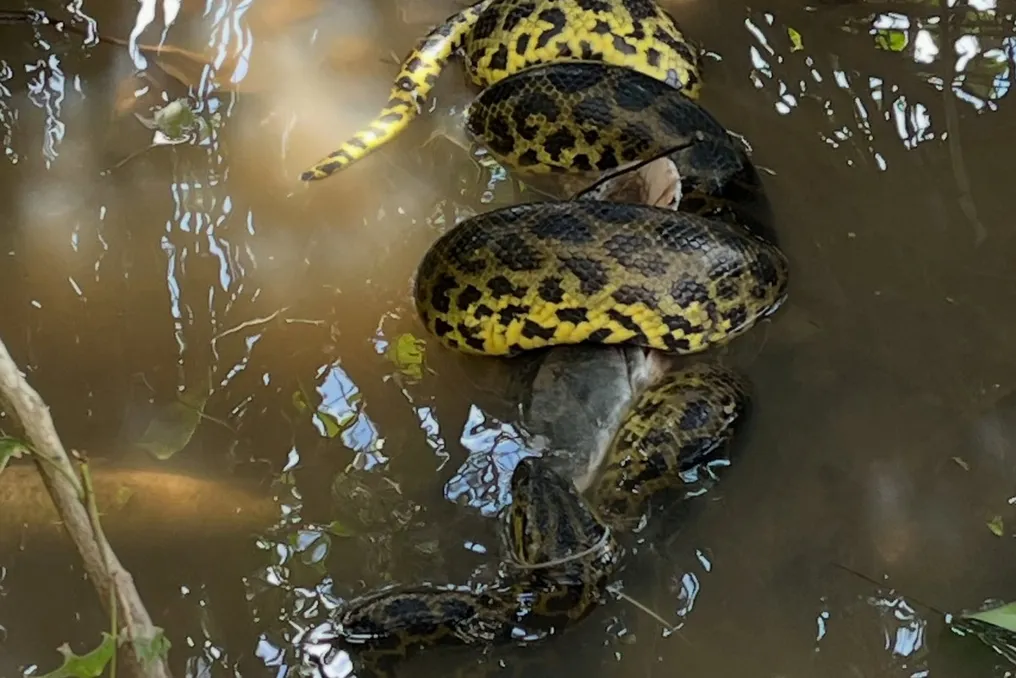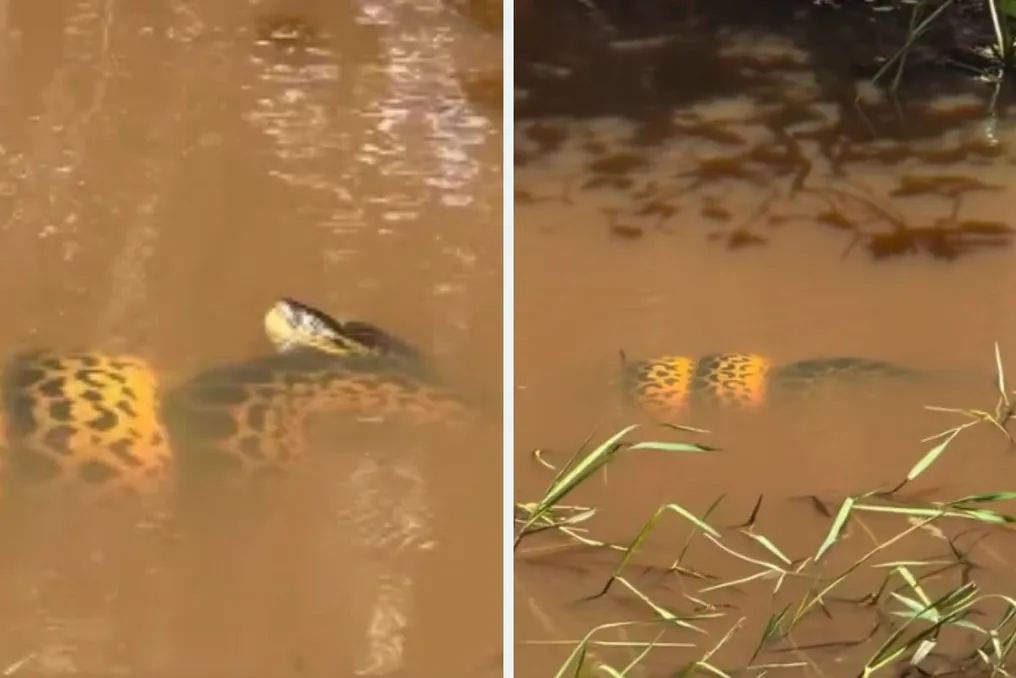
During a safari near the Cayman area in the Pantanal of Mato Grosso do Sul state, in the city of Miranda (MS), a yellow anaconda was spotted coiled around a crocodile underwater. This footage was captured by agricultural specialist Adriel Abreu, who was accompanying a group of tourists when he discovered the snake constricting the crocodile in the lake.
The video shows the anaconda wrapping its body around the crocodile in the dark water zone. According to Adriel, the snake had already caught its prey by the time the group arrived. During the observation, the animal also lifted its head above the water to breathe.
Adriel told the publication g1 that observing a snake catching prey during excursions is rare. He explained that the snake can spend hours constricting the animal before beginning to swallow it. 'We rarely find it in this strangulation process. It was in the lake, with slightly dark water, so many details are not visible,' he noted.
According to Adriel, the scene attracted the attention of tourists who were able to observe the snake's behavior up close. He also determined that it was an adult anaconda, judging by the thickness of its body. 'It was impressive because you see it so close, you can see this scene, how it moves, the moments when it lifts its head to breathe. It is truly an incredible scene that we only see on television,' he said. The group was unable to film the moment the snake began swallowing the crocodile.
Yellow Anaconda
Anacondas capture their prey by constriction, wrapping their bodies around the animal and pressing until blood circulation is disrupted. After this, they are capable of swallowing prey larger than their own heads due to jaw mobility. This species of snake is non-venomous and kills victims by suffocation, coiling around the victim and squeezing its body until asphyxia. It can reach lengths from 2.4 to 4.6 meters and weigh an average of 30 kilograms, sometimes reaching 40 kilograms. Females are usually larger than males.
The species inhabits wetlands and swamps primarily, but is also found in forest areas and even caves. Its diet includes birds, eggs, fish, reptiles, and small mammals. In some cases, it is also capable of catching larger animals such as deer, kites, and capybaras.