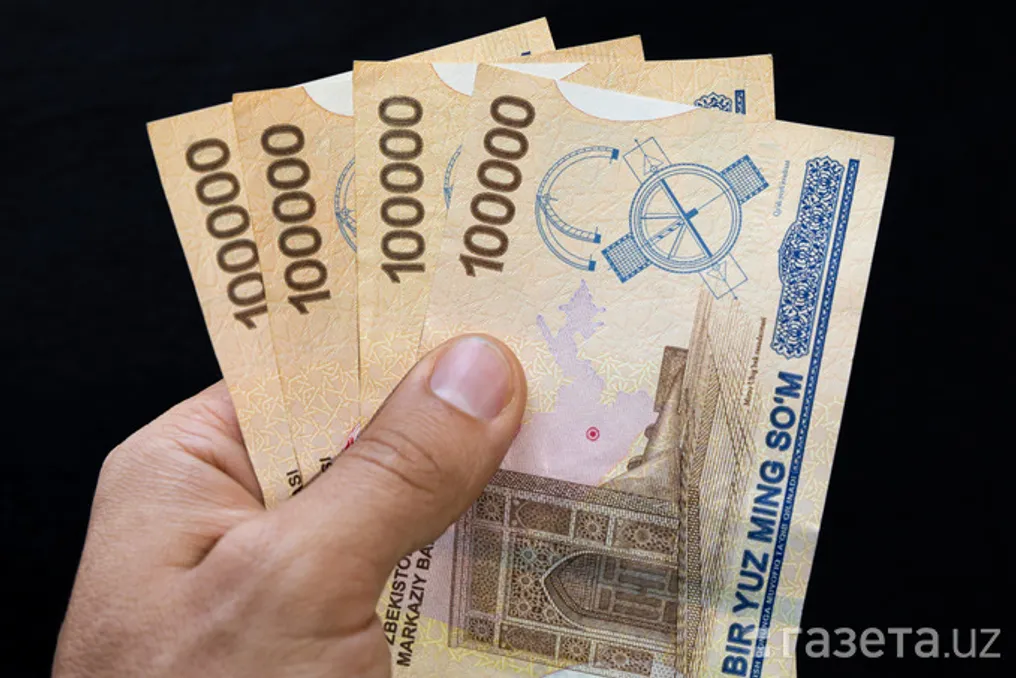
The average monthly nominal accrued wage in Uzbekistan for the period from January to September 2026 was 7.274 million soums. This figure showed an 18% increase compared to the same period last year, when it was 6.17 million soums. This information was presented in a press release by the National Committee on Statistics on October 27.
It should be noted that data from small, micro-enterprises, and agricultural enterprises were not included in the statistics, so the published figure does not reflect the wages of all working citizens of the republic. For comparison, in January-September 2025, wage growth reached 19.2% with an annual inflation rate of 8%.
Salary situation in Tashkent and other regions
The highest level of average salary is still recorded in Tashkent, where it reached 12.3 million soums, representing an increase of 18.3% over the year. This figure is about one and a half times higher than the average across the entire republic. Navoi region ranks second in terms of salaries with 8.82 million soums, and Tashkent region is third with 6.89 million soums.
The lowest average salaries were registered in Kashkadarya (4.97 million soums) and Surkhandarya regions (4.99 million soums). The difference between Tashkent and Kashkadarya region approaches two and a half times.
Analysis of wage growth rates by region showed that they grew fastest in Namangan region (by 20.3%), followed by Jizzakh (by 19.8%) and Tashkent (by 19.1%). The slowest growth rate was recorded in Samarkand region—11.5%.
Differences in labor remuneration by industry
By industry, the highest wages remain in the banking, insurance, leasing, and credit sectors, where the average income is 19.71 million soums, which is 17.8% higher than the previous year. The second place is held by the information and communication sphere with a level of 17.01 million soums (growth of 13%). In particular, the average salary in computer programming, consulting, and related services reached 22.28 million soums.
Third place is taken by transportation and storage with a figure of 11.27 million soums, demonstrating the highest growth rate among the industries considered (19.8%).
The lowest level of pay among the represented sectors is observed in healthcare and social services—4.45 million soums, despite an 18.2% increase. In education, the average salary was 5.02 million soums (growth of 19.6%). However, there are significant discrepancies within the education sector: the average salary in higher education is 11.52 million soums, in technical and vocational education—5.35 million soums, in general secondary education—4.79 million soums, and in preschool education—only 2.85 million soums.
Thus, the wage in the financial sector is approximately 4.4 times higher than the figure in healthcare, and in higher education, it is four times higher than in preschool education. School workers continue to lag behind the national average: for January-September, the average accrued salary in general secondary education was 4.79 million soums, which accounts for 65.9% of the national average (7.27 million soums). A year ago, this ratio was 67.1%, when the average salary in schools reached 4.14 million soums against a national average of 6.17 million soums. Consequently, over the year, wages in general secondary education grew by 15.8%, while nationwide growth was 18%, leading to an increase in the gap and a decrease in the relative level of teachers' pay by 1.2 percentage points.
Median salary amounted to 4.17 million soums
The National Committee on Statistics presented the results of experimental calculations of the median salary for the first time. For the period from January to August 2026, it amounted to 4.166 million soums. Regionally, the highest median salary was recorded in Tashkent—6.79 million soums. Next follow Navoi region (6.21 million) and Tashkent region (4.32 million).
The lowest median salary was recorded in Syrdarya region (3 million soums). In Kashkadarya and Namangan regions, the median was 3.03 million soums. Significant differences are also visible in industries: the highest median salary was recorded in the financial sector—11.36 million soums, in the information and communication sphere—8.75 million soums, and in transportation and storage—8.30 million soums.
In industry, the median salary reached 5.86 million soums, in trade—4.65 million soums, and in construction—3.94 million soums. In education, the median was 3.21 million soums, in healthcare and social services—3.27 million soums, and in accommodation and catering services—2.86 million soums.
It is incorrect to directly compare the average (7.27 million) and median (4.17 million) salaries, as the former is calculated for January-September, and the latter for January-August, because income data for September has not yet been fully compiled. The department explained the difference using an example of five employees with incomes of 3, 4, 5, 6, and 22 million soums: the average salary would be 8 million soums, while the median would be 5 million soums, as it is in the middle of the series.
Nascomstat emphasized that the average salary helps assess the overall level and dynamics of labor remuneration, while the median reflects the midpoint of the distribution and is less affected by very high incomes of individual employees. The department recommended analyzing both indicators to gain a more complete picture of the level of labor remuneration in Uzbekistan.
How is the median salary calculated?
To determine the median salary, administrative data on employee income before income tax deduction are used, and the indicator is calculated based on average monthly incomes for eight months. When distributing data by region, employees of enterprises with branches are accounted for according to the official registration address of the legal entity, not the actual place of work. It should be noted that the calculation of the median salary is currently experimental and is not part of the annual state program of official statistics. As with the average salary, this data does not include small enterprises, micro-enterprises, and agricultural enterprises.
