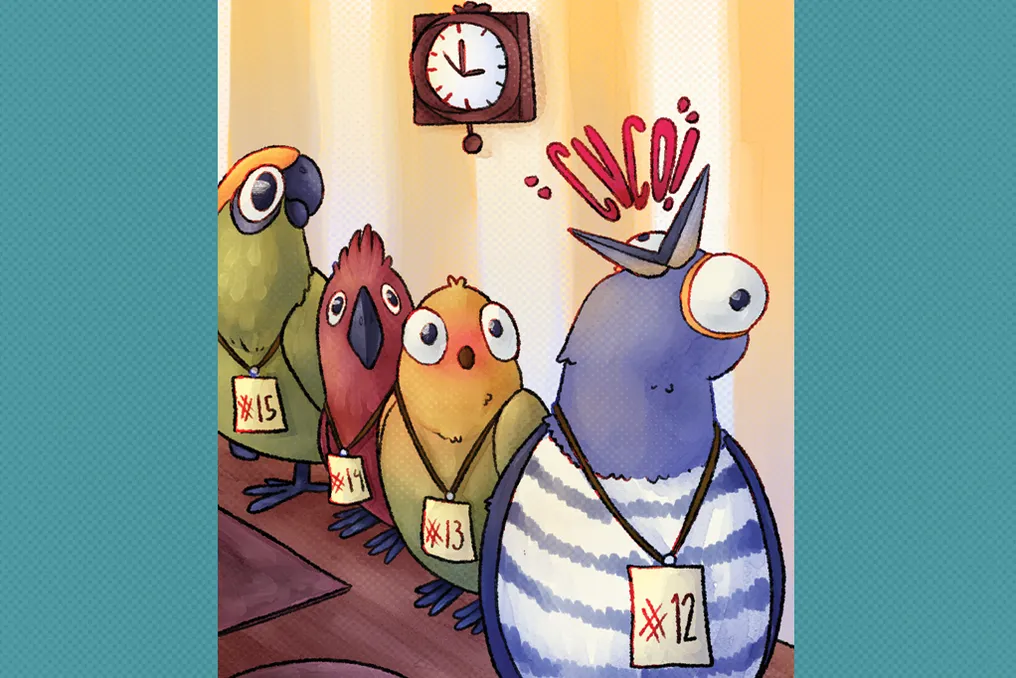
Explanation of the choice of the cuckoo as the traditional bird of clocks
Read more
Super Abril
super.abril.com.br

Explanation of the choice of the cuckoo as the traditional bird of clocks

The selection of the cuckoo as the representative bird for clocks has several reasons. An important factor is the presence of this species in the area where clocks originated. The term 'cuckoo' generally refers to birds of the Cuculidae family, which includes over 140 different types. Among them, the common cuckoo (Cuculus canorus) stands out, known for emitting the characteristic 'cuckoo' sound and inspiring cuckoo clocks.

The common cuckoo is a migratory bird that can be found in Europe, Asia, and parts of Africa. It is particularly frequent in the Black Forest, a region of Germany where cuckoo clocks were developed. This bird migrates away during the German winter and returns in the warmer months, establishing a link between its song and the arrival of spring.

Another relevant aspect is the simple nature of the cuckoo's song. Its sound consists of only two notes: a higher one followed by a lower one. This simplicity facilitates the mechanical replication of this sound, as occurs in clocks. Traditional models use a bellows mechanism that directs air through wooden whistles, generating these two distinctive notes.

Although the precise origin of cuckoo clocks remains uncertain, it is known that their production and commercialization became popular in the mid-18th century, serving as an additional source of income for artisan peasants in the Black Forest. Clockmaker Franz Anton Ketterer is cited as one of the possible inventors of the cuckoo clock, although this hypothesis has not been confirmed.

In summary, the song of the cuckoo bird combines desirable elements in a sound that marks time: it is easy to mechanically replicate, is linked to the passage of time, and has a short and simple duration, avoiding auditory boredom.


Similar stories

Recipe for Crispy Green Lentil Puri for a Festive Table
Read more
www.aajtak.in

Recipe for Crispy Green Lentil Puri for a Festive Table

During the holiday season, many different dishes are inevitably prepared, and in such an atmosphere, one wants to try something special that is different from ordinary everyday puri. If you are striving to cook something tasty and crispy, green lentil puri is an excellent choice.

These puris are not only very tasty but also nutritious. They have a flavor reminiscent of kachori and will appeal to both children and adults, adding a special aroma to the festive table.

For preparation, you will need: half a cup of green lentils (soaked for 2 hours), 2 cups of wheat flour, 2 teaspoons of dry grain or legume flour (to add crispiness), half a teaspoon of ajwain, 1 teaspoon of cardamom powder, a pinch of asafoetida, turmeric, and red pepper powder to taste, salt to taste, as well as oil or ghee for kneading the dough and frying.

First, you need to prepare the lentils: completely drain the water from the soaked green lentils, and then grind them in a blender without adding water or adding just a little to form a coarse mass.

Next, in a large bowl, mix the wheat flour, dry grain or legume flour, and all the spices: ajwain, cardamom, asafoetida, turmeric, red pepper, and salt. Add the ground lentils and one tablespoon of oil, mixing thoroughly. Then, gradually adding water, knead a stiff dough, similar to puri dough. Let the dough rest for 15 minutes.

After this, divide the dough into small balls. Lightly brush each ball with oil and roll it into a round or oval shape, trying not to make them too thin. Heat oil in a deep pan to medium-high heat. Carefully drop the rolled puris into the hot oil and gently press with a spatula so that they rise like balloons. Fry on both sides until golden and crispy.

Serve the hot and crispy green lentil puris with vegetable curry, raita, or your favorite sauce.

Oxford University research reveals that long journeys alter the biological clock of birds, causing an effect similar to human jet lag
Read more
olhardigital.com.br

Oxford University research reveals that long journeys alter the biological clock of birds, causing an effect similar to human jet lag

A study conducted by Oxford University, and recently published in the journal Science, demonstrated that birds suffer from a phenomenon analogous to the jet lag experienced by humans.

According to the research, when these birds travel large expanses of the Atlantic Ocean at high speed, their biological clock becomes misaligned with the local solar time. To be able to orient themselves using the sun as a reference, birds require an accurate internal clock, which must be adjusted daily to sunrise to correctly interpret the star's position throughout the day.

When traveling east or west, crossing lines of longitude—which correspond to time zones—the animal's internal time becomes out of sync with the solar time of its arrival point, potentially suffering a delay of up to one hour.

This discovery was made through the analysis of twenty years of GPS tracking data collected from 1,045 individuals of the Little Pied Bat (Puffinus puffinus), a species that nests on islands in the United Kingdom and Ireland. The team of biologists monitored 3,688 foraging journeys, during which the birds frequently travel up to a thousand kilometers west before returning to their nesting sites.

The researchers observed that upon returning eastward, where the sun rises earlier, the birds exhibited a systematic clockwise deviation compared to the predicted route. This dependence on the sun-based navigation system was so prominent that the animals maintained these deviations even when flying parallel to the coastline, where there would be visible geographical landmarks to guide them.

In the examined adults, the practical impact of this deviation was relatively small; an average deviation of seven degrees resulted in an increase of approximately five kilometers over a thousand-kilometer journey. However, scientists warn that this effect can be extremely serious for young birds during their first migration, as uncorrected navigational errors can cause them to deviate from their final destination by hundreds of kilometers.

Patrick Lewin, the study's principal investigator, stated in a release that the findings indicate that the animals experience the same internal clock mismatch that occurs during human jet lag. He added that the next focus of investigation will be to understand how this affects them, questioning whether they exhibit critical behaviors at inappropriate times, if they have physiological side effects similar to humans, and if this misalignment is as detrimental to health as jet lag is for us.

Tim Guilford, co-author of the article, emphasized that the ability to accurately measure the natural movements of animals allows for the revelation of deep cognitive and behavioral mechanisms that were previously considered difficult to study in the natural environment. Scientists believe that understanding how these birds manage long-distance travel may assist medicine in developing treatments to mitigate the negative effects of jet lag on human health.

Clocks will be moved back by one hour in the UK on October 25th; explanation of this change
Read more
www.aajtak.in

Clocks will be moved back by one hour in the UK on October 25th; explanation of this change

On October 25th, clocks in the United Kingdom will be moved back by one hour. This means that when the clock shows 2 AM, it will revert to 1 AM. Consequently, British Summer Time (BST) will end, and the country will return to Greenwich Mean Time (GMT).

Throughout the year, time is changed twice in the UK: clocks are moved forward by an hour in the summer, and back by an hour on the last Sunday of October. On the night of October 25th, when it is 2 AM in the country, the clocks will show 1 AM again, allowing people to gain an extra hour of sleep. It is important to note that this change only affects the time on the clocks and does not add an extra hour to the daytime.

The main reason for the time change is related to the duration of daylight. There is a significant difference in day length between summer and winter in the UK. Because days are longer in the summer, clocks are moved forward by an hour to maximize daylight hours. This period is called British Summer Time. In October, however, clocks are moved back by an hour, leading to an earlier sunrise but also an earlier sunset. The goal of this change is to adapt people's routines to the natural cycle of sunlight, not simply to change the time.

After the time zone change, people in the UK will feel darkness setting in earlier in the evening. This may affect the daily routines of those returning from work, taking walks, or spending time outdoors. However, those traveling to school or work in the morning may find light available earlier than before. Most modern devices, such as mobile phones, laptops, and internet equipment, will automatically adjust their time, but older devices, wall clocks, and car clocks may require manual adjustment.

Residents of India will not need to change their clocks, but the time difference between India and the UK will change. While BST is in effect in the UK, India is ahead by four and a half hours. After the time change in the UK on October 25th, the difference will increase to five and a half hours. For example, if it is noon in the UK, it will be 5:30 PM in India. This may be particularly relevant for those communicating with relatives or working with companies from the UK.

India does not have a system like the one in the UK. A single standard time applies across the country—Indian Standard Time (IST). Regardless of the season, the time on clocks in India is not adjusted according to the weather. Thus, while one night in the UK might give you an extra hour, Sunday in India will pass as usual.

Popular