The Hunter's Moon illuminated the skies of various nations last weekend, generating numerous images of the event globally.
The peak moment of the full moon occurred at 1:12 AM on Monday, the 26th, according to data provided by NASA, the United States space agency, using the Brasília time zone. The phenomenon could also be observed in Brazil, provided local weather conditions permitted.
Despite its specific name, the Hunter's Moon does not represent a distinct astronomical phenomenon from a common full moon. Its nomenclature derives from ancient traditions of the Northern Hemisphere, where October coincides with the beginning of autumn.
In this season, after the harvest, fields become more open, and moonlight aided hunters in locating animals and storing provisions for winter. Additionally, the Hunter's Moon is notable for appearing at similar times on several consecutive nights during the Northern Hemisphere's autumn, which extends the period of natural illumination after sunset.
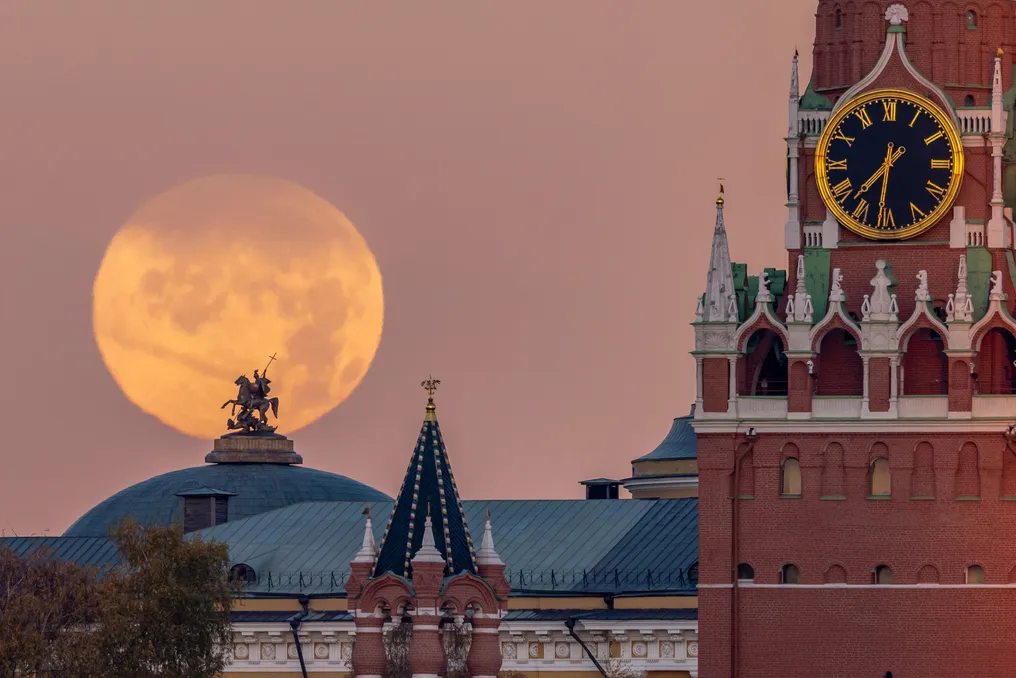
Various photos recorded the Hunter's Moon in different locations. In Moscow, Russia, it was seen setting behind the Kremlin and St. Basil's Cathedral, as well as behind the Spasskaya Tower, on Monday (26). Another record shows the moon, near the full phase known as the Hunter's Moon, appearing over the wing of Air Force One during a flight of Donald Trump back to Washington on Sunday (25).
In Rome, Italy, images were captured of the full moon rising behind a statue atop a column in Piazza Venezia, both on Monday (26) and on other occasions, as well as appearing between two columns in the same location. A moment was also recorded when the full moon appeared while the reflection of the sunset was visible on a glass panel in Piazza Venezia, on the same date.