When rainfall ceases, the soil acts as the farm's first line of defense. With the return of El Niño, agricultural scientists, including Dr. Lehlogonolo Mathelele, Sitembiso Fakude, Adolph Malatji, Nompumelelo Ngejane, and Humble Sirakalaala, emphasize the critical importance of building organic matter in the soil and improving the soil's water retention capacity for survival during dry periods.
While farmers often look to the sky awaiting rain, the real battle may be happening right under their feet. Soil functions as the farm's primary reservoir, accumulating water, retaining nutrients, supporting roots, and providing the biological foundation for crop growth. Healthy soil significantly increases the chances of a harvest surviving drought, whereas degraded soil can turn even a short period without precipitation into a crisis.
Therefore, the return of El Niño should be viewed not only as a weather phenomenon but also as a soil fertility issue. El Niño is a natural climatic event caused by abnormally warm surface water in the central and eastern Pacific Ocean. Although it originates thousands of kilometers from Africa, it is capable of disrupting temperature and precipitation patterns worldwide. While the consequences vary by region, South Africa has historically faced reduced rainfall during certain periods of the main growing season during El Niño events.
In 2026, farmers have another reason to pay attention to this situation. The Food and Agriculture Organization of the United Nations (FAO) reports the formation of a new El Niño phase, with risks of agricultural drought being particularly high in some areas of Southern Africa and other vulnerable regions. FAO has identified certain agricultural and pastoral zones where the probability of drought exceeds 50%.
It is easy to mistakenly believe that soil fertility is solely about the amount of fertilizer applied to the field. However, the concept of fertility is much broader. FAO defines soil fertility as the soil's ability to support plant growth by supplying necessary nutrients while providing suitable physical, chemical, and biological conditions for plants.
Fertile, healthy soil performs an extremely valuable function during drought: it helps crops use available water more efficiently. Organic matter, good soil structure, biological activity, and adequate nutrient availability collectively contribute to soil productivity. Soil with good structure allows water to infiltrate rather than simply run off the field, and it stores water in zones accessible to plant roots.
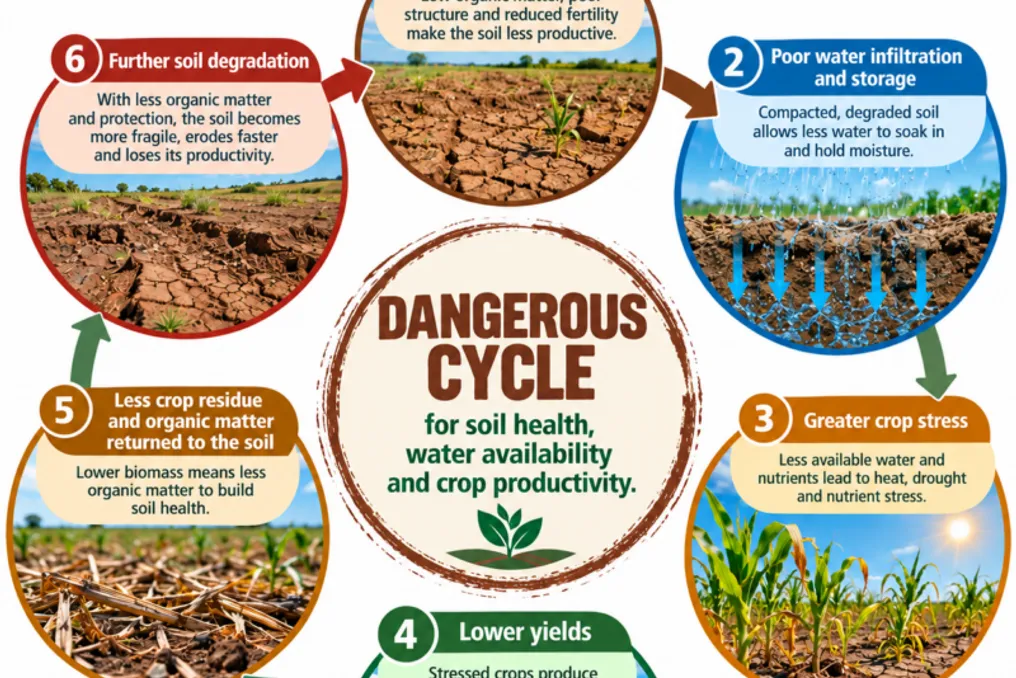
Conversely, degraded soil can form a crust, become compacted, or lose organic matter. Rainwater can quickly run off, carrying away valuable topsoil and nutrients. When a dry spell arrives, the crop is left with fewer water reserves and weaker root development, creating a dangerous cycle that can be exacerbated by El Niño.
When farmers hear an El Niño warning, their initial concern is naturally related to the amount of rainfall. However, drought also affects the movement and availability of nutrients. Plants require elements such as nitrogen, phosphorus, potassium, sulfur, calcium, and magnesium, as well as several micronutrients. Nevertheless, nutrients are only beneficial to the crop if the plant can absorb them.
Under severe dryness, root growth and nutrient uptake can be restricted. Consequently, the crop can suffer simultaneously from both water stress and nutrient stress. This explains why simply increasing fertilizer application is not always the solution for an El Niño season. Farmers need to adopt an efficient nutrient management approach: applying the right element in the right quantity, in the right place, and at the right time, while simultaneously improving the soil's ability to retain water and support roots.
Farmers cannot control the amount of rainfall, but they can influence what portion of that rainfall remains available for the harvest. This is where soil health practices become particularly important. Retaining crop residues on the soil surface, increasing organic matter, reducing unnecessary soil disturbance, controlling erosion, crop rotation, and incorporating legumes—all these contribute to better soil management. Integrated soil fertility management can combine organic resources, appropriate fertilizers, crop rotation, and other methods to maintain productivity while reducing nutrient losses.
For example, manure and well-composted material can replenish organic matter and nutrients. Legumes promote biological nitrogen fixation. Crop residues protect the soil surface from heat and erosion, helping to maintain soil organic matter with proper management. The goal is not just to make the soil 'rich'; the goal is to create soil capable of retaining water, preserving nutrients, and supporting root function in challenging conditions.
The best time to prepare for drought is before the drought itself. Firstly, farmers must closely monitor climate and weather warnings, utilizing seasonal forecasts, local meteorological information, and advice from agronomic services. FAO notes that El Niño can often be predicted months in advance, giving farmers the opportunity to adjust decisions before planting. It is important to understand that a global El Niño forecast should not automatically be interpreted as a prediction for every farm; local conditions are crucial.
Secondly, careful selection of crops and varieties is necessary. An El Niño season may not be the right time to take undue risks with varieties requiring a long and reliable growing period. Where locally recommended options are available, farmers can consider drought-tolerant, heat-tolerant, or shorter-duration varieties. It is also advisable to change the sowing date if seasonal forecasts indicate a delay or reduction in rainfall. FAO guidance also emphasizes drought-tolerant crops, short-cycle crops, and adjusting planting times as potential preemptive measures.
Thirdly, farmers must protect every drop of rain. Water runoff from the field is unavailable to the crop. Therefore, methods that slow runoff, reduce erosion, and improve infiltration should be implemented. Depending on the farming system, this may include maintaining ground cover, contour farming, mulching, conservation agriculture practices, terracing, or other local water harvesting techniques. The basic principle is simple: do not wait for the rain; prepare the soil so it can receive it.
Fourthly, organic matter must be built up in the soil. Returning appropriate crop residues, using manure or compost, crop rotation, and incorporating legumes help improve soil structure and nutrient cycling. This is especially important in arid regions where the soil's ability to retain and supply water can determine whether a crop survives the drought or perishes. FAO points out that maintaining soil texture and fertility can increase crop water productivity, highlighting integrated soil fertility management, manure application, crop rotation, legumes, and agroforestry as approaches that promote nutrient recovery and enhance resilience.
Fifthly, fertilizers should not be abandoned, but used more wisely. A drought warning should not automatically mean abandoning fertilizers. Poor nutrition can exacerbate drought stress, as an undernourished crop may have limited growth and reduced ability to efficiently use available water. However, decisions on fertilizer application must be based on soil condition, crop needs, expected yield potential, available moisture, and professional agronomic advice. The goal is nutrient use efficiency, not simply increasing application rates. Whenever possible, farmers should conduct soil tests to identify nutrient deficiencies and avoid wasting scarce resources on non-limiting elements.
Sixthly, livestock must be cared for alongside crops. For mixed farmers, El Niño is not just a crop problem. Reduced rainfall means less pasture, lower grazing quality, and a shortage of drinking water. Therefore, farmers should consider herd size, pasture availability, feed reserves, and water sources before conditions become critical. FAO recommends measures such as feed storage and ensuring water sources as part of early actions in areas susceptible to El Niño-related agricultural drought.
One should not wait for the first poor harvest. One of the main lessons from past El Niño events is that agricultural damage can continue long after the rains return. A failed harvest leads to reduced food, lower income, decreased resources for purchasing seeds and fertilizers, and potential reductions in animal stock for the next production cycle. FAO's analysis of the consequences of the El Niño shock in 2015/16 in Zambia showed that households affected by drought experienced a significant decline in maize yields and income. It also found that strategies such as income diversification and livestock farming, as well as agroforestry, helped mitigate some of the consequences.
El Niño is a warning, but healthy soil is a long-term investment. Farmers should not view El Niño as an isolated catastrophe that happens every few years and disappears. A more serious issue is that El Niño occurs against a backdrop of a warming climate. FAO notes that global warming can amplify the impact of El Niño by raising the baseline temperature and increasing the potential severity of heat and drought in vulnerable regions. This changes the conversation. The question is no longer: 'How do I survive this El Niño?', but rather: 'How do I make my farm more resilient to the next ten El Niño seasons and the changing climate around them?' The answer starts with the soil.
A farmer cannot summon rain, but they can improve the soil's ability to capture precipitation, retain moisture, cycle nutrients, and support strong roots. This means protecting the soil from erosion, returning organic matter, managing nutrients carefully, diversifying crops, using appropriate varieties, conserving water, monitoring weather information, and planning livestock numbers, as well as, where possible, combining farm income with other livelihoods to reduce dependence on a single harvest.
The best defense for a farmer may lie right under their feet. El Niño reminds us that agriculture is ultimately a partnership with nature. The farmer sows, but the weather decides how much rain will come. The farmer applies nutrients, but the soil determines how effectively they will be stored and made available. The farmer can install irrigation, but the water still needs to be managed wisely. Healthy soil unites these elements: it serves as a reservoir during the rain, a nutrient bank during crop growth, and a buffer when the weather is against the farmer.