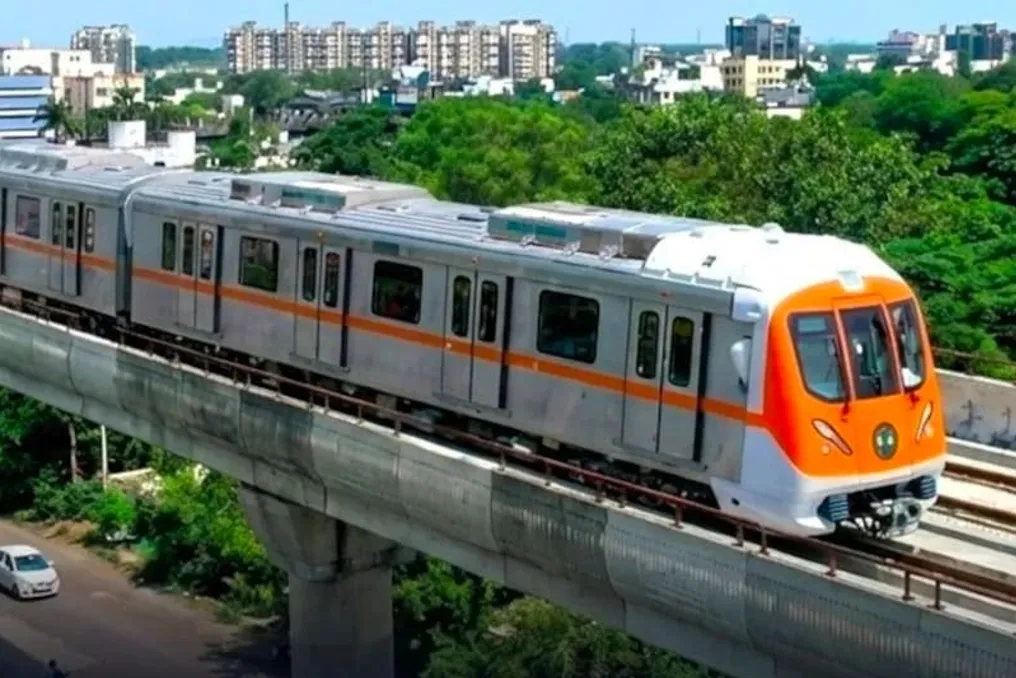
Despite visible progress in the city of Bopal, statistics on passenger flow and revenue for the Bopal Metro raise questions regarding its efficiency. This modern transport system, launched with the hope of changing city traffic, is currently operating with a limited number of passengers.
Daily operational costs amount to approximately 500 thousand rupees, while monthly revenue from ticket sales reaches only 400-500 thousand rupees. This means that covering one day's operating expenses requires a full month of fundraising.
Metro services began operating on a priority corridor spanning about seven kilometers between AIIMS and Subhash Nagar in December 2025. Initially, it was expected that the metro would help redirect traffic flow and alleviate the city's congestion problem. However, on this route, which covers eight stations, the number of passengers has not increased as anticipated.
According to available data, the metro serves approximately 13-15 thousand passengers per month. The limited network prevents the metro from directly connecting large parts of the city, negatively affecting both its utility and its income.
The operational costs for the metro are around five hundred thousand rupees daily, leading to monthly expenses of approximately one and a half crore rupees. Meanwhile, the income from passenger fares for the entire month amounts to only about 400-500 thousand rupees. This significant gap clearly demonstrates the financial difficulties facing the metropolitan railway. It is important to note that this calculation is based only on operational expenses and ticket revenue; income from advertising and other commercial activities is separate and requires consideration for a complete assessment of receipts.
Regarding the large discrepancy between expenses and revenue, Diraj Shukla, the metro's public relations representative, stated that Bopal Metro is constantly working to improve passenger conditions. He confirmed that daily operating expenses are about five hundred thousand rupees, and 13-15 thousand passengers are transported per month, generating revenue of approximately 400-500 thousand rupees.
Diraj Shukla emphasized that the metro is a mode of public transport and cannot be judged solely by current revenue. Network expansion is currently underway. He expressed hope that as the metro reaches different parts of the city, the increase in passengers will lead to higher revenues. It was noted that special attention is being paid to passenger convenience, and continuous efforts are being made to enhance the metro's usefulness for a larger number of people.
In addition to limited ticket revenue, metro management is working to find alternative sources of income. These include providing spaces inside the metro for events such as birthdays, kitty parties, and pre-wedding photoshoots. Furthermore, attempts are being made to generate income through advertising placement. Management believes that such activities can contribute to increasing the metro's profit. Nevertheless, detailed data on the additional income generated from these channels has not yet been presented.
One of the main reasons cited for the low passenger flow is not only the limited route but also the last-mile problem. The success of any metro service depends on how easily passengers can get from their homes to the station and from the station to their final destination. If supplementary buses, rickshaws, or other means of transport are not sufficiently accessible for station access, people may prefer private vehicles or traditional public transport.
Moreover, the metro will only become a convenient option for daily commutes of office workers, students, and other regular passengers if its network is well-connected to the city's main business, educational, and residential areas.
The expansion of the Bopal Metro network offers hope for increased passenger flow in the future, but until then, the management faces a serious challenge in balancing operational costs against limited income. Improved connectivity, convenient schemes for regular passengers, access to stations, and advertising revenue could play a key role in mitigating this issue.
Currently, the Bopal Metro faces not only the question of train speed but also when the number of users will increase. Management expects the situation to change once the network spreads throughout the city. However, the current state of affairs shows that the metro must earn the trust of residents to become an integral part of the city's daily life. It remains to be seen whether the expansion plan can transform the metro from a system with empty seats into a preferred choice for the general public.