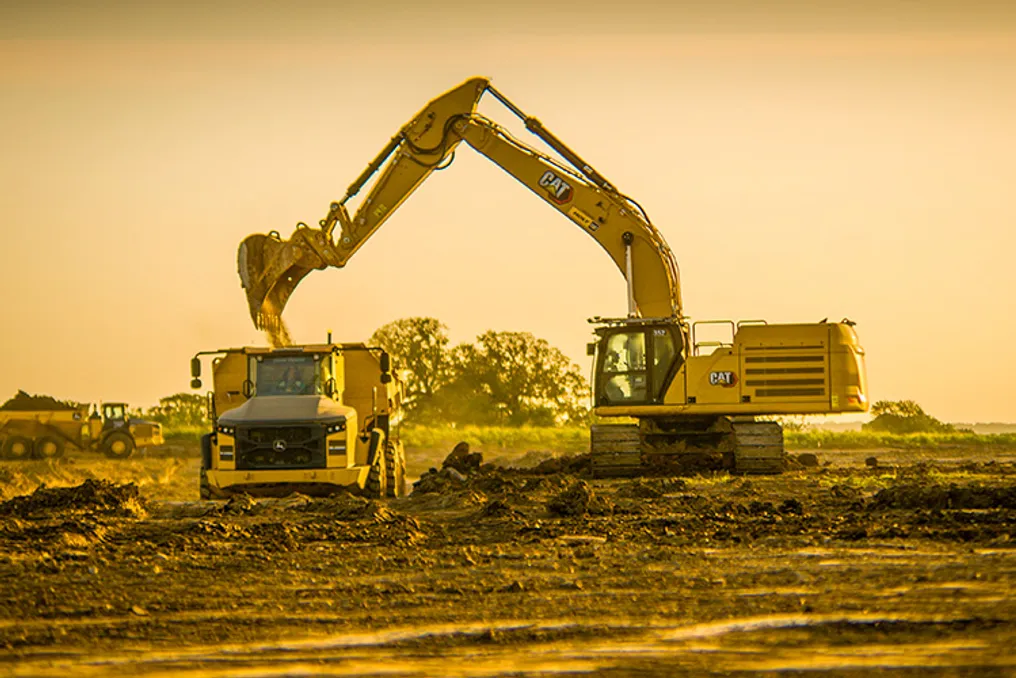
Bedrock Robotics raises $600 million amid growing demand for autonomous heavy equipment
Read more
Ventureburn
ventureburn.com

Bedrock Robotics raises $600 million amid growing demand for autonomous heavy equipment

Bedrock Robotics has raised $600 million in a Series C round, valuing the San Francisco-based company at $4.1 billion. The investment round was co-led by CapitalG and Emergence Capital.

This growth is significant because just eight months ago, the startup was valued at $1.75 billion after raising $270 million. The reason for this jump is that Bedrock's machines have stopped being mere demonstrations and have started generating revenue.

Bedrock does not manufacture fully automated excavators; instead, the company creates an autonomous driving kit that is installed on existing contractor equipment. Since mid-August 2026, excavators equipped with Bedrock hardware have been performing paid work at real commercial sites.

Examples of such projects include a water treatment plant site in Nevada, earthworks conducted by Champion Site Prep in Texas, and a civil project of 1.2 million cubic yards involving Zachry Construction. A new partner, Arizona contractor Haydon, has joined. The company plans to use Bedrock-equipped machinery at data center, medical facility, and water supply sites. Additionally, regional partners in Minnesota, Florida, Georgia, Missouri, and Virginia have also joined the collaboration.

CEO Boris Sofman told The Robot Report that demand from new clients is 'very high.' Sofman previously led the self-driving truck program at Waymo and co-founded Anki, the company behind the Cozmo robot. According to Bedrock, mastering excavator operation takes five years or more, but Associated Builders and Contractors predicts that over 40% of construction workers will retire within five years.

Furthermore, 87% of firms report having open vacancies for skilled workers. Sofman provided a simple example demonstrating the financial benefit: if a project is completed two months earlier due to 24/7 machine operation, a developer paying 9% interest on a $400 million loan will save about $6 million. Applying this logic to thousands of projects explains the interest of players like Bessemer, Temasek, and Nvidia.

The initial use of the raised capital will allow for an increase in the number of machines across various sites. Bedrock aims to reach a three-digit number of autonomous machines across the US by 2027. The second priority is strengthening technical support. Since a breakdown of a robotic excavator costs contractors money every hour, the startup is focused on scaling its operations, equipment, and supply chains. Amy Jones Satrom, formerly of Amazon, Nuro, and Uber, was hired as Vice President of Operations, and Lando Huarez, former head of the legal department of Uber's autonomous division, took the position of General Counsel.

The third point is developing new equipment. Haydon will conduct autonomous trenching tests, after which bulldozers, articulated dump trucks, and wheel loaders will be the focus. In the long term, Bedrock is looking at mining and agriculture sectors. This funding round demonstrates that investors are now interested in artificial intelligence that moves dirt, not just generates text. For contractors, autonomy is becoming a practical tool, not science fiction.


Similar stories

Mach9 raises $34 million to develop AI-based software for civil engineering
Read more
ventureburn.com

Mach9 raises $34 million to develop AI-based software for civil engineering

Mach9 has successfully raised $34 million in a Series A funding round to expand its artificial intelligence-based civil engineering software. The round was led by First Round Capital and Bessemer Venture Partners, with participation from existing investor Quiet Capital.

The San Francisco-based company develops automated design software used in topographic surveys and infrastructure projects. Its technology converts three-dimensional scans into digital blueprints for engineering teams, and Mach9 claims its software can perform this task ten times faster and at one-fifth the cost.

The company originated from a hardware-focused startup founded in 2021. Co-founder and CEO Alex Baykovitz initially aimed to improve visual inspection technologies, but client interactions revealed a more significant problem.

A large portion of America's infrastructure is nearing the end of its service life. Roads, utility poles, and power lines require replacement or maintenance. The Infrastructure Investment and Jobs Act allocated $1.2 trillion for these purposes.

Accurate reports on the current condition of assets prevent costly rework and allow engineers to plan changes. Surveys capturing the real state are used to gather this data using increasingly sophisticated tools. The manual process of overlaying these scans onto engineering drawings takes weeks or even months.

Mach9 handles a significant part of this work. Clients provide the platform with 3D scans of roads, construction sites, and utility networks. The platform's artificial intelligence detects physical objects such as curbs, signposts, poles, lane markings, and wires. The software then generates initial blueprints with a claimed accuracy of up to a centimeter.

Mach9's clients include civil engineering firms, transportation agencies, and infrastructure operators. Among the company's clients are WSP, HNTB, and NV5. Public sector users include Caltrans, the Minnesota Department of Transportation, and the Maryland State Highway Administration.

In San Diego, Caltrans uses Mach9 to inventory road safety features along Interstate 8. This work involves mapping noise barriers and identifying improvement opportunities. Accurate inventories help engineers assess road conditions and plan maintenance.

In San Francisco, the company Kier + Wright uses the platform to support pedestrian safety near schools. Meanwhile, Fibersmith from Louisiana uses this technology to plan broadband infrastructure, aiming to connect 125,000 homes and businesses.

Mach9's application extends beyond transportation projects. The same core technology can help document utility and telecommunications networks, opening up opportunities for the company across all infrastructure sectors facing complex surveying requirements.

First Round Capital partner Bill Trenchard described the software as a way to transform physical infrastructure into actionable information. The firm believes that such tools can modernize methods of surveying, designing, and maintaining infrastructure.

Mach9 plans to use the raised capital to enhance its software and expand its team. The company also intends to strengthen its capabilities for serving civil engineering and topographic clients. The long-term goal is to improve the transition process of infrastructure projects from data collection to design.

The market still presents significant challenges. Engineering drawings require high precision, and AI-generated results need thorough verification. Professional users must be confident that automated results meet project requirements. Furthermore, Mach9 competes with established CAD software providers, and adoption will depend on the effective integration of its tools into existing workflows. Demonstrating consistent accuracy across various conditions will be crucial.

Indian Automotive Technology Companies Attracted $1.3 Billion in 97 Funding Rounds in 2026
Read more
business-standard.com

Indian Automotive Technology Companies Attracted $1.3 Billion in 97 Funding Rounds in 2026

According to a report from the analytical platform Tracxn, Indian automotive technology companies attracted a total of $1.3 billion USD across 97 funding rounds in 2026.

The leaders in terms of funds raised were the taxi service company Rapido, which secured $240 million. This was followed by electric two-wheeler manufacturer Simple Energy, which raised $180 million, and the company River, which attracted $102 million.

The report, titled India Auto Tech - 2026 YTD, notes that in 2026, Indian automotive technology companies raised $1.3 billion in 97 rounds, contrasting with the $2.1 billion raised in 195 rounds in 2025. All stated amounts represent equity financing in USD and exclude debt, grant, post-IPO, and ICO financing.

Sotefin, a provider of automated parking solutions, showed the highest market capitalization upon IPO with an valuation of $35 million. This was followed by Victory EV India with $11 million and the accessory specialist company AutoFurnish with $6 million.

During the reporting period, 10 rounds exceeding $34 million each took place, totaling $900 million, which accounts for approximately 70 percent of the total $1.3 billion raised. The remaining 87 rounds attracted about $400 million.

Late-stage funding reached $810 million, with eight out of ten major deals belonging to Series C and subsequent rounds.

Several acquisitions occurred in the used car retail sector: Cars24 acquired CarInfo for $44.4 million in January of this year, and subsequently acquired Vehicleinfo in March. Additionally, Roadzen bought VehicleCare, and 91trucks acquired MotorFloor in March.

Popular