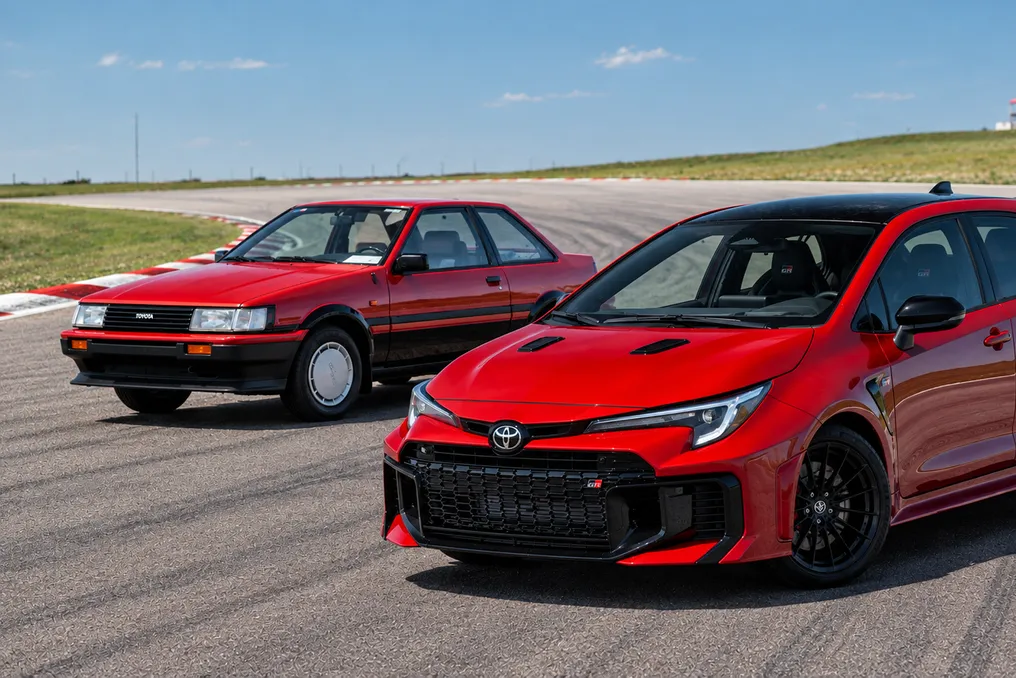
In 2026, the Toyota Corolla will complete six decades of existence. Although often associated with the stereotype of a conservative vehicle, nicknamed 'Vovorolla' and seen as a safe and reliable option, the Corolla has a rich history of sports versions that challenge this reputation.
Launched in Japan in November 1966, the Corolla took less than ten years to achieve global annual sales leadership in 1974. In 1997, it surpassed the Volkswagen Beetle, becoming the best-selling car of all time, accumulating over 57 million units across its 12 generations.
However, behind the image of predictability and tranquility, Toyota has always offered notable sports editions. These versions, often overlooked by enthusiasts, demonstrate that the Corolla has always had the potential to be a performance-oriented car, starting from the 1960s.
Corolla Sprinter (E10 – 1968)
In the context of the peak of the Japanese economic miracle in 1966, the Corolla emerged focused on excellence, thanks to engineer Tatsuo Hasegawa, the project chief. Its design philosophy was based on an 'over 80 points' evaluation system, aiming for an overall balance above 90 in all aspects of the vehicle.
The initial launch in 1966 presented the model as a sedan and wagon, but it already included sporty touches, such as the 1.1-liter K engine, a four-speed floor shifter, and dashboard details. The suspension, while not revolutionary, was well-tuned, providing a pleasant ride.
A year and a half after the sedan, in May 1968, the Corolla Sprinter (E10 generation / KE15 chassis code) was introduced, a fastback coupe variant with smooth lines and a younger interior. The top-spec version, the Sprinter SL, used the K-B engine, fed by two carburetors, boosting power to 73 hp at 6,600 rpm. This rear-wheel-drive coupe, weighing about 730 kg, was extremely competitive for the time, costing only 30,000 yen more than the sedan.
This first Sprinter was not just a commercial success; it established the starting point for the line's sports division, proving to Toyota management the demand for a daily driver with weekend entertainment capability.
Corolla Levin TE27/Trueno (E20 – 1972)
The second generation of the Corolla (E20), launched in 1970, capitalized on the growth of the Japanese market and incorporated Toyota's Kaizen philosophy, adding comfort, a 45-liter tank, and luxury items like air conditioning and AM/FM radio.
The significant shift for enthusiasts occurred in March 1972, with the birth of the Corolla Levin (meaning 'lightning') and its twin, the Sprinter Trueno ('thunder'), both homologated as street sports cars for tracks and rallies. The TE27 chassis code featured a fastback coupe with a more aggressive stance, characterized by riveted black fender flares.
The technical differentiator lay in the mechanics: the Levin inherited the 2T-G engine from the Celica 1600GT, a 1.6-liter four-cylinder with an iron block and aluminum head with dual overhead camshafts (DOHC), developed in collaboration with Yamaha. Fueled by two dual Solex/Mikuni carburetors, the 2T-G generated 115 hp at 6,400 rpm. For a car weighing only 855 kg, this resulted in an excellent power-to-weight ratio for the early 1970s.
The engineering focused on the purist aspect, offering more direct steering and firm suspension. Furthermore, in the Twin Cam versions, Toyota eliminated power steering, requiring the driver to control braking purely with their foot, which was marketed as a sporty attribute. This setup allowed the Levin TE27 to win rally competitions, such as the Lake 1000 Rally in 1975, driven by Hannu Mikkola.
Due to high demand, Toyota launched the 'Levin J' (Junior) in 1973, an entry-level version with the 2T-B engine with in-block camshafts and 105 hp, making the line more accessible. With production limited to about 5,000 units annually, the TE27 solidified the Levin's legacy.
Corolla Levin/Sprinter Trueno AE86 (E80 – 1983)
We arrive at the iconic AE86. In the fifth generation, in 1983, Toyota changed the family line to front-wheel drive with a transverse engine to gain space and efficiency. However, the manufacturer exclusively maintained the rear-wheel-drive platform with a longitudinal engine for the two-door coupe and liftback variants, creating the Corolla Levin (with fixed headlights) and the Sprinter Trueno (with pop-up headlights).
Under the AE86 chassis code, the pinnacle of light and cheap rear-wheel-drive sports cars of that era was created. Its heart was the legendary 4A-GE 1.6 16V engine, a DOHC four-cylinder with an iron block and aluminum head, also developed with Yamaha. Equipped with electronic fuel injection and the T-VIS variable intake system, it produced 130 hp at 6,600 rpm in Japanese specifications.
Although modest today, for a car weighing only 920 kg with a near 50:50 weight distribution and four-wheel disc brakes, this power was more than sufficient. The 4A-GE proved to be a revered blank canvas in tuning, accepting extreme modifications, from aggressive camshafts to turbo setups, with tuners like TRD, Tomei, and HKS exceeding 200 hp naturally aspirated and surpassing 300 hp when turbocharged.
On the tracks, the AE86 dominated global touring championships, such as the Japanese JTCC and the British BSCC, thanks to its agility. However, its immortality came on mountain roads, the famous touge. Driven by Keiichi Tsuchiya, known as the eternal Drift King, the Hachi-Roku became a symbol of controlled drifting culture and the protagonist of the manga and anime Initial D.
The AE86 became a legend not for being the fastest in a straight line, but for the ideal combination of low weight, rear-wheel drive, and a high-revving engine. It marked the peak of rear-wheel drive at Toyota, but this does not diminish subsequent Corolla sports cars; it merely differentiates them.