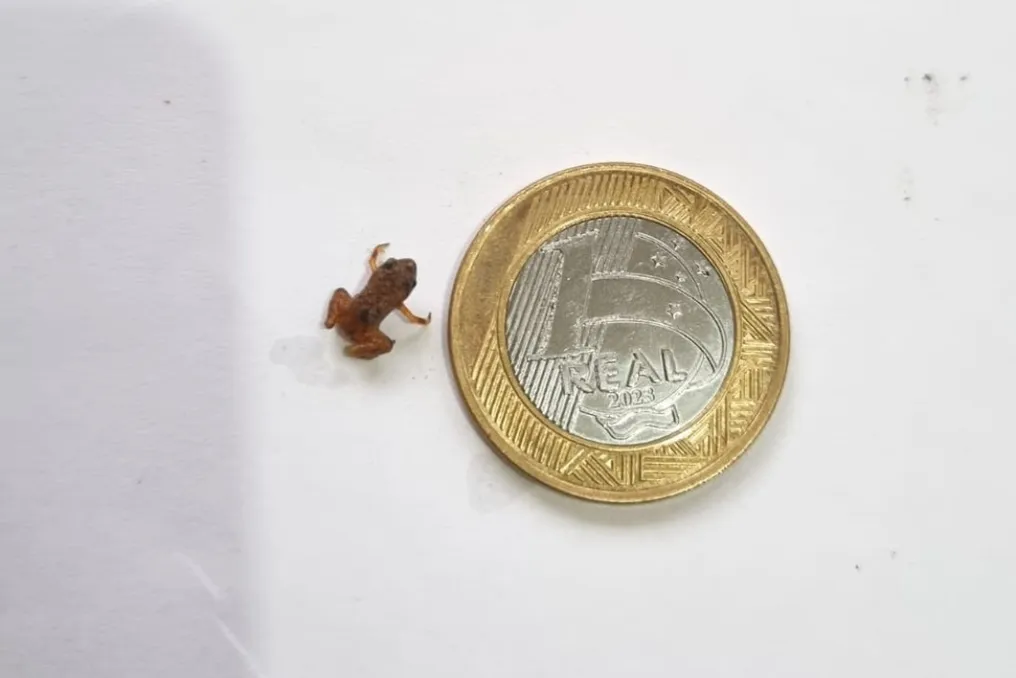
Biology students from the State University of Rio de Janeiro (UERJ) located a rare species of frog, measuring less than 1.1 centimeters, during a field activity carried out in Nova Friburgo, in the mountainous region of the state of Rio de Janeiro. This new record contributes to expanding the known distribution area of this amphibian.
The flea frog, identified as *Brachycephalus clarissae*, was found by UERJ students in collaboration with teams from the Institute of Biosciences (Instituto CiênciasBio), specifically in the Private Natural Heritage Reserve (RPPN) Alto da Figueira. This reserve is located within the Macaé de Cima Environmental Protection Area (APA), which is managed by the State Environmental Institute (Inea).
Four years after its first record, the species was sighted again. Previously documented only in the municipality of Cachoeiras de Macacu (RJ), its area of occurrence now also includes Nova Friburgo.
Due to its tiny size, smaller than a R$ 1 coin, the flea frog is notoriously difficult to find in the natural environment, and the characteristics of its habitat also complicate its location.
Difficulty in observing the frog
Marcelo Stéfano Bellini Lucas, a herpetologist specializing in reptiles and amphibians, commented on the rarity of the species, stating that it has a possibly very limited distribution. He attributed this to living at altitudes between 970 and 1200 meters, combined with its small size and the scarcity of samples in the region, as there are no records elsewhere.
According to information provided by Inea, the flea frog remains camouflaged in the leaf litter, which is the layer of dead organic matter covering the forest floor, composed of leaves, branches, and trunk fragments. Its body coloration also makes visual identification difficult, requiring searches to be conducted with methods attentive to the observation of the ground and the sounds emitted by the animal during vocalization periods.
Inea also clarifies that species belonging to the genus *Brachycephalus*, to which the flea frog belongs, have evolved in isolation on mountain peaks and slopes. Since these populations cannot cross hot and dry valleys, they tend to be naturally small and confined to specific altitudes.
The distribution of the flea frog is still poorly understood. For this reason, researchers Izenita Brum and Miguel Relvas Ugalde are dedicated to investigating the biogeography of these regions and the factors that can aid both the occurrence and preservation of this species.
Details about the species
The flea frog (*Brachycephalus clarissae*) has a length of less than 1.1 centimeters. Males reach approximately 9.6 millimeters, while females can measure up to 10.9 millimeters. Its body is predominantly yellow, featuring reddish spots on the abdomen, a dark lateral band, and an X-shaped mark on its back. The skin also exhibits small reliefs.
According to herpetologist Marcelo Stéfano Bellini Lucas, a notable characteristic of this amphibian is its direct development, meaning it bypasses the tadpole stage. The young emerge from the eggs already with all limbs developed and a appearance similar to adults, albeit on a reduced scale.
Environmental protection areas are crucial for the survival of the flea frog, as it depends on very specific environmental conditions. Therefore, the conservation of these ecosystems, along with increasing knowledge about the frog's habitat and distribution, is essential to ensure the protection of this amphibian.