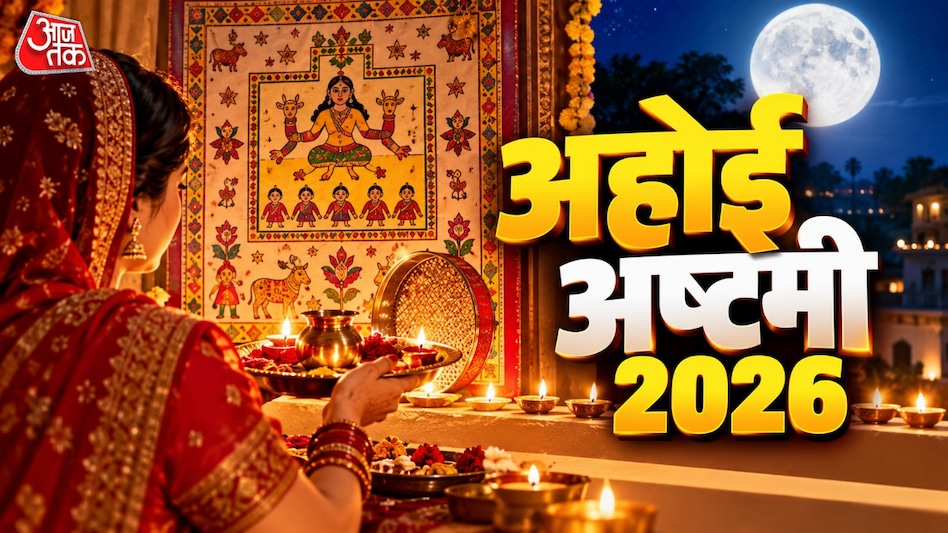
Ahoy Ashtami Date 2026: Information on the Date, Auspicious Time, and Legend
Read more
Aaj Tak
www.aajtak.in

Ahoy Ashtami Date 2026: Information on the Date, Auspicious Time, and Legend

Every year, the Ahoy Ashtami fast is observed on the eighth day of the dark month of Kartik. On this day, women pray for the longevity, good health, and well-being of their children. The tradition includes worshipping Mother Ahoy and offering water to the stars.

This year, there has been confusion regarding the date of Ahoy Ashtami: some indicate November 1st, while others state November 2nd. Below is the exact date of this festival.

According to the Hindu Panchang, the eighth day of the dark month of Kartik will be observed from November 1, 2026, at 14:51 until November 2 at 13:10. Astrologer Pravin Mishra asserts that the observation of the Moon and stars will take place on November 1st, so the fast will be observed on Sunday, November 1st.

According to religious beliefs, the Ahoy Ashtami fast is observed for the protection of children, their longevity, and the happiness of the entire family. It is believed that worshipping Mother Ahoy promotes prosperity in the offspring's life. Women observing the fast on this day pray for the strong health and bright future of their children. Mother Ahoy is revered as a form of Goddess Durga. During the fast, it is customary to listen to or read the legend of Ahoy Ashtami, in addition to worshipping the mother.

The day begins with a morning bath, followed by worship in the home temple and a decision about fasting. An image of Mother Ahoy must be placed in the home temple; one may also worship at a local temple of Mother Ahoy. Prayers are offered using offerings such as turmeric, rice, flowers, and sweets. It is also advisable to read or listen to the Ahoy Ashtami legend, wishing longevity, health, and well-being to the family. In the evening, an offering is made to the stars after their observation, and then, according to tradition, the Paraayan (prayer) is recited.

According to a common legend, a merchant had seven sons, seven daughters-in-law, and one daughter. Before Diwali, the family went to collect clay for house repairs. During the digging, the merchant's daughter, Sekhu, and her children accidentally died. Sekhu, enraged, cursed her. Then the youngest daughter-in-law voluntarily agreed to accept this curse. After this, her children began to die successively. When the family was immersed in grief, a pandit advised caring for a cow. The youngest daughter-in-law started caring for the cow, and it was pleased, having received her help. Subsequently, Sekhu lifted the curse, and the youngest daughter-in-law found happiness in the form of offspring. The main meaning of this story is related to repentance for unintentional mistakes, as well as the importance of service and righteous deeds.

Similar stories

Sharad Purnima Date in 2026: Expert Determines Exact Date Based on Panchang
Read more
www.aajtak.in

Sharad Purnima Date in 2026: Expert Determines Exact Date Based on Panchang

The festival of Sharad Purnima is celebrated annually on the day of the full moon in the Ashwin month. There is a belief that on this day, the rays of the Moon shower nectar, so consuming kheer left under this light brings great blessings. However, confusion arose among people regarding the date this time: some indicated October 25th, while others pointed to October 26th.

Astrologer Pravin Mishra, after studying the Panchang, determined the exact date. According to the Panchang, the full moon period will be effective from 11:55 AM on October 25th until 9:41 AM on October 26th. In Pravin Mishra's opinion, since worshiping the Moon and leaving kheer is traditionally done on the night of Sharad Purnima, the fast should be observed on October 25th. On this day, it is recommended to listen to the story of Lord Satyanarayan and worship Goddess Lakshmi.

According to the astrologer, the Brahma Muhurta on October 26th will occur from 4:46 AM to 5:38 AM. Pilgrims taking a bath in the sacred river can do so during this period, and after bathing, they can worship God and engage in charity.

There is a tradition of preparing kheer on the night of Sharad Purnima and leaving it outdoors. According to religious beliefs, nectar flows from the Moon's rays on this night, and this effect is transferred to the kheer. The next day, the kheer is offered to Gods Vishnu and Goddess Lakshmi, and then consumed as prasad. The astrologer advised that when leaving the kheer outdoors, it can be covered with a thin cotton cloth. After the kheer is offered to the Gods in the morning, there is a tradition of sharing the prasad with family members and loved ones. In religious views, this prasad is associated with positivity, health, and the grace of the deities.

According to religious beliefs, on the night of Sharad Purnima, the Moon becomes full, possessing sixteen states. In astrology, the Moon is considered the planet governing the mind. Therefore, special importance is given to worshipping the Moon, reciting mantras, singing hymns, and vigils on this night. It is believed that this brings peace to the mind and increases positivity. In religious scriptures, Lord Shri Rama is described as having twelve states, and Lord Shri Krishna as a complete incarnation with sixteen states. The sixteen states of the Moon include Amrita, Manda, Pushpa, Pushti, Tushti, Dhriti, Shisini, Chandrika, Kanti, Jotsna, Shri, Preti, Angda, Purna, and Purnamrit, which are related to different phases of the Moon and religious beliefs.

Popular