Despite having a fractured leg, the retired woman Cecília Prado, 70 years old, managed to exercise her right to vote at the State School Brasil, located in Limeira, in the state of São Paulo. It is important to note that the educational unit does not have ramps for access to its interior, presenting only stairs.
To manage to go up and down the necessary steps to vote, Cecília Prado needed assistance from other people. She reported the difficulty, stating: 'I broke my leg and it's hard to climb. Luckily I found an acquaintance.'
Generations Meet
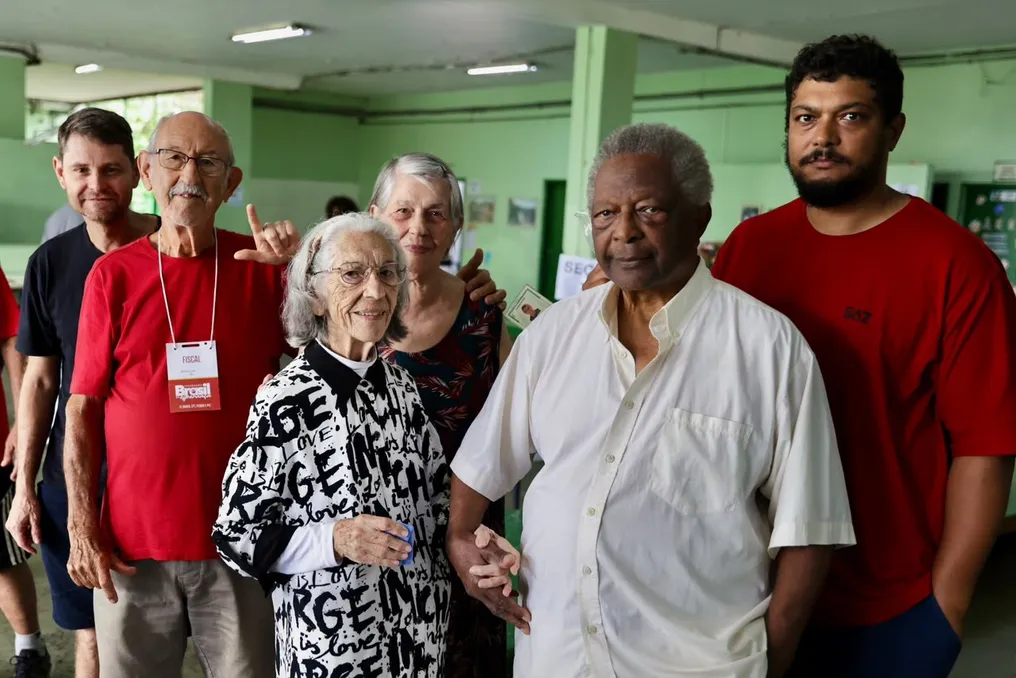
In another spot, Marina, who is 96 years old, attended the polling place accompanied by friends and family, including Venicio Gonçalves, 86 years old, José Maria Teixeira, 88 years old, Clementina, 85 years old, and her grandson, Thiago Teixeira, 42 years old.
Observations on Voting Day
Maria Vieira, a 73-year-old voter with emphysema, went to the State School 'Professor Willian Silva' in Limeira (SP) to vote in the second round of the elections this Sunday (2). Despite her health condition, she attended the location. She observed that the movement was very calm, describing the environment as completely empty, which contrasted with the perceived crowding on previous occasions, questioning the reason for this tranquility.
Context of the 2026 Elections
The electoral disputes include Senator Flávio Bolsonaro (PL) and President Luiz Inácio Lula da Silva (PT), who seeks re-election. In the first round, held on October 4th, Flávio obtained 47.03% of the votes, surpassing the 45.16% registered by Lula.
For checking polling locations, the Superior Electoral Court (TSE) advises voters to use its website, filling in data such as CPF or voter registration number, date of birth, and mother's name. This will reveal the electoral domicile, specifying zone, section, address, and municipality.
Documents Required to Vote
It is mandatory to present an official photo ID to prove identity and gain access to the voting machine, in addition to signing the ballot and receiving the voting receipt. Although not mandatory, the voter registration card helps the citizen by indicating the electoral section. Accepted documents include RG, social identity card, work card, driver's license (CNH), passport or legal equivalent, and professional category cards recognized by law. Documents may be expired, as long as the voter's identification is possible; birth and marriage certificates are not valid because they do not have a photo.
The voter can also carry a paper with the electoral code, containing their candidates' numbers. The TSE strictly prohibits the use of cell phones, tablets, radio communicators, cameras, or other electronic devices inside the voting booth to record or disclose the choice. However, the device can be used to display the e-Title, which must be given to the poll worker at the time of voting; it is illegal to photograph or film one's own or others' electoral process.
Voting Procedure
The process consists of typing the desired candidate's number into the electronic voting machine and verifying that the name and photo are correct. If there is an error, the 'correct' key allows entering the correct number. Upon pressing 'confirm', the machine emits a confirmation sound, making subsequent alteration impossible. If the voter chooses not to vote for anyone, they can select 'blank' and then 'confirm'; a blank vote is not counted as valid, serving only for statistics. There is also the null vote, which occurs when a number that does not correspond to any candidate or party is entered and confirmed.