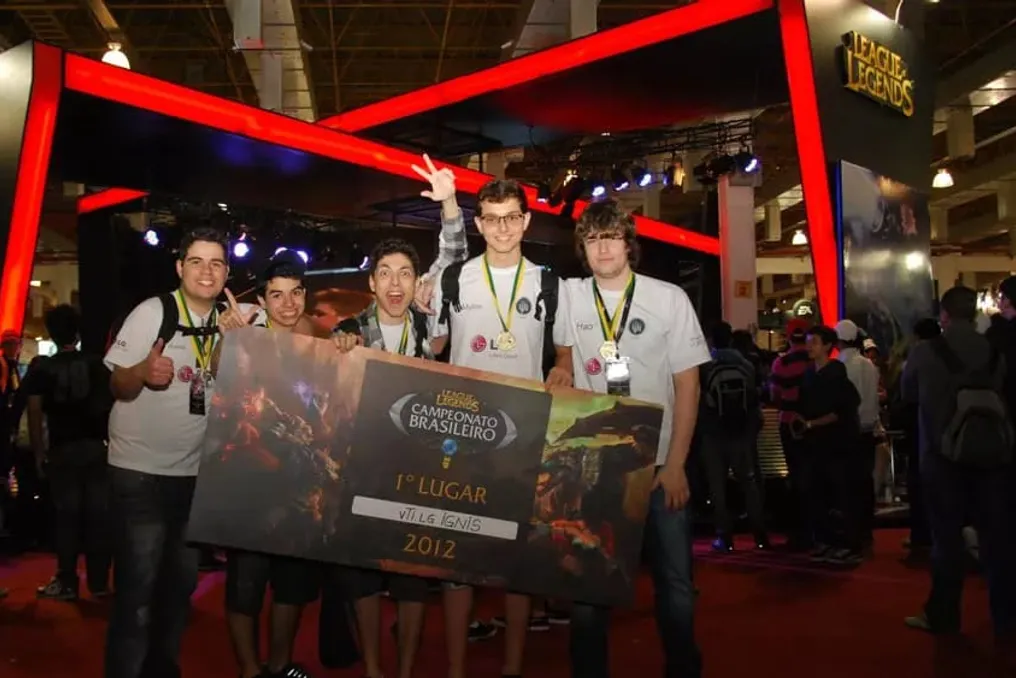
The trajectory of CBLOL, the main League of Legends league in Brazil, demonstrates a notable evolution, moving from a tournament held at game fairs to grand events at the Olympic Park. On April 20, 2024, the CBLOL final between LOUD and paiN concluded a split that reached its highest historical peak of 459.8 thousand simultaneous viewers, totaling 24.9 million watched hours. This ascent contrasts with the championship's beginning, which took place at a game fair twelve years ago.
The first CBLOL was held in 2012, coinciding with the official launch of League of Legends in Brazil, during the Brasil Game Show. Initially, the event took place in smaller venues, such as BGS, where, in 2012, the final occurred on the last day, October 14, with vTi Ignis defeating vTi Nox 2 to 0.
The Evolution of the Event
In 2014, the championship gained a Regional Stage and held its final at the Maracanãzinho Gymnasium, which was won by KaBuM!. In 2017, the first stage was hosted in Recife, facing Red Canids and Keyd Stars, a moment when the audience almost doubled compared to the previous year. Roberto Iervolino, General Manager of Riot Brazil, informed Jovem Nerd News, via DOL, that the choice of Recife was due to practical reasons, given the scarcity of suitable venues in the country, most of which were open. In the same year, the partnership with Globosat guaranteed the broadcast of the championship on SporTV.
On September 7, 2019, the Jeunesse Arena in Rio hosted the match between Flamengo and INTZ, attracting over 8 thousand people. The online broadcast reached 316 thousand simultaneous viewers, an increase of over 40% compared to the previous year's final, with Flamengo winning 3 to 2.
Significant structural changes occurred in 2020, when Riot announced the viability of the franchise model in Brazil, eliminating the relegation system, and Mastercard joined as a new sponsor. However, the pandemic suspended in-person attendance; in September, INTZ defeated paiN in a crowdless final held in a building in São Paulo, registering a peak of 396 thousand and an average of 342 thousand viewers.
The franchise model was implemented in 2021, requiring each of the ten teams to invest approximately R$ 4 million to participate. The final on September 4 returned to Rio, although still under health protocols and without an audience, where RED Canids defeated Rensga 3 to 1 at Morro da Urca.
In September 2023, the final in Recife gathered about 8 thousand people at Geraldão, complemented by 12 CBLOL Fests distributed across the national territory, with a peak of 327,691 viewers. This milestone was surpassed seven months later, in 2024.
The transformation in viewership also involved media: while there were three official broadcast channels in 2023, this number expanded to over 35 in 2024, including content creators. The Baiano channel reached over 116 thousand viewers at its peak on Twitch, although official channels saw a decline, with the peak dropping by about 17.7% on YouTube and over 63% on Twitch.
The Record
The 2024 viewership record was not solely due to the support of the winning team, but rather to how the public consumed the content. The previous record, from the Split 1 final of 2021, was approximately 416 thousand viewers, surpassed by more than 40 thousand, despite having occurred during the pandemic, a period when the public spent more time at home.
In 2025, CBLOL ceased its denomination, transforming into the LTA South conference, alongside LCS and LLA, resulting in a reduction of Brazilian teams from 10 to 6. Viewership also declined; in Split 1 of 2024, the average number of simultaneous viewers was 171.6 thousand, and in LTA South, this average dropped from 162.2 thousand to 122 thousand across the splits.
However, on September 28, during the LTA final, Riot Games announced the return of CBLOL and the independence of the CBLOL and LCS leagues in 2026, maintaining historical brands, three annual stages, and a dedicated final. After a year of merger, the brand was restored.
The return was vigorous. The CBLOL Cup saw LOUD as champion against RED Canids, reaching a peak of 443,217 viewers, the second highest in CBLOL history, only behind Split 1 of 2024. Among top leagues, CBLOL ranks third, behind LEC and LCK.
However, the subsequent Split 1 did not replicate the success of the Cup. Split 2 showed recovery, with the October 10 final reaching 295,890 viewers, representing an 83.8% increase compared to the Split 1 final, which featured the same two teams. Although the average viewership was 88,827 and the 9.18 million watched hours were 2.2% and 4.5% below Split 1, the event took place at Arena Carioca 1, in the Olympic Park, with a capacity of up to 6 thousand people, occupying about 75% of the 8 thousand available seats. This was the first decision made in Rio since 2021.
LOS defeated FURIA 3 to 2, in the fifth map, in a rematch of the Split 1 final, which FURIA had won 3 to 1 on June 6. This was LOS's first title with this name (the organization integrated Team oNe, the 2017 champion, in 2022) and FURIA's first runner-up finish in the tournament. For the first time, CBLOL qualified two teams for Worlds. LOS advanced directly to the Swiss stage, starting on October 23 in Allen, Texas. FURIA entered via the Play-In, eliminated Cloud9, but was defeated by MVK 3 to 1, missing out on the World Championship.
The growth of CBLOL is the result of a series of strategic decisions: the partnership with Globosat in 2017 brought the championship to SporTV; in 2020, Riot introduced the franchise model, abolishing relegation starting in 2021, and Mastercard became a sponsor; in 2021, each of the ten teams paid about R$ 4 million to enter. Finals migrated from fairs to gyms and arenas in Rio and Recife, and in 2023 were supplemented by 12 CBLOL Fests nationwide. In 2024, broadcasting jumped from 3 to over 35 channels, driven by content creators, which contributed to the viewership record.