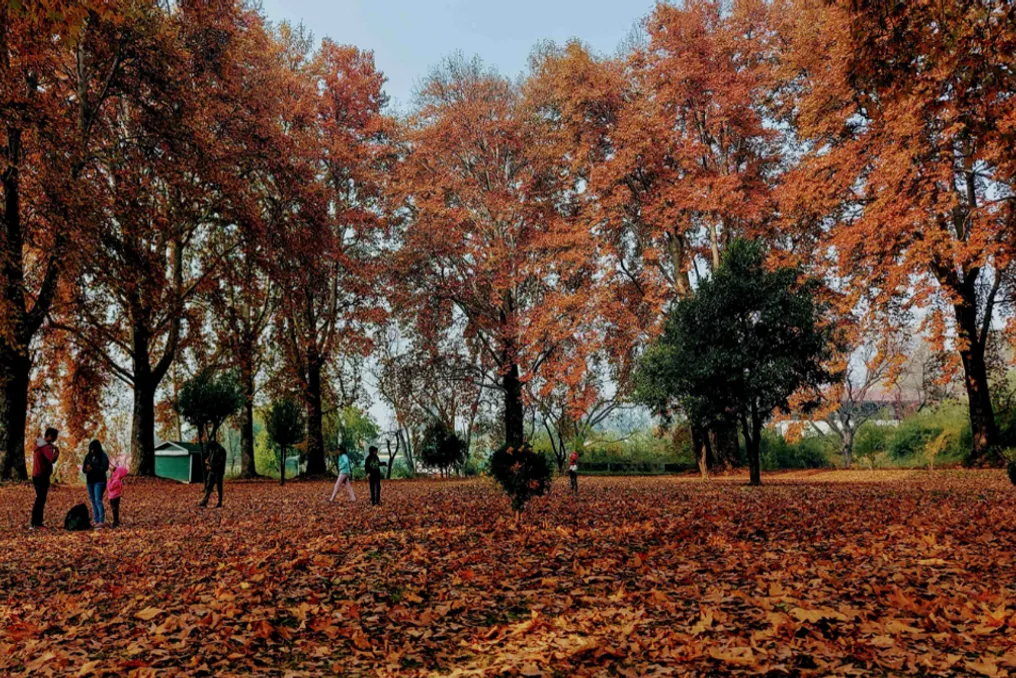
Every October, an amazing natural phenomenon begins in Kashmir. The broad green leaves of the plane trees gradually turn yellow, and then shades of orange and red appear. By November, entire trees seem to glow in the autumn light, their branches covered with leaves ranging from golden-yellow to deep crimson.
For the residents of Kashmir, this is a familiar sign of winter approaching. The Chinar (Platanus orientalis), known locally as Boen or Buen, is the state tree of Jammu and Kashmir. Its extensive canopy provides shade in the summer, and the change in color has become one of the most recognizable autumnal sights of the valley.
However, a question arises: why do the chinar trees turn such beautiful red tones, while many trees in warmer regions of India remain green? The answer lies within a single leaf.
What happens to the leaf as winter approaches?
Throughout spring and summer, the chinar leaves actively produce food for the tree. Their green color is due to chlorophyll—a natural substance that helps the leaves absorb sunlight. Using this energy, the leaves convert water and carbon dioxide into sugars that promote tree growth.
But as autumn arrives, the days in Kashmir get shorter, and the temperature begins to drop. The tree senses the coming cold and starts preparing for a harsher period. Before shedding its leaves, it extracts useful nutrients that can be stored and used in the spring. As a result of the gradual breakdown of green chlorophyll, hidden colors appear.
Interestingly, researchers Mohammad Imran Kozgar and Samiullah Khan explained in a February 2011 article in Science Reporter how the drop in temperature and the breakdown of chlorophyll reveal two types of pigments—carotenoids and xanthophylls. These pigments are responsible for the yellow and orange hues; essentially, the colors were already present in the leaves, but the green was masking them.
But where does this beautiful red color come from?
Red leaves have their own interesting history. In many trees that change color in autumn, reddish and purple hues are formed by pigments called anthocyanins. Unlike yellow and orange pigments, they can be synthesized as autumn progresses. Their formation depends on the amount of sunlight, temperature, and sugar levels in the leaves.
Nevertheless, scientists have not yet precisely determined which specific pigments create each shade of crimson observed in Kashmiri chinar trees. The 2011 article focuses exclusively on the appearance of yellow and orange pigments.
The climate of Kashmir plays a significant role in this seasonal transformation. Chinar trees are deciduous, meaning they shed their leaves before winter. Shorter autumn days and falling temperatures in the Valley contribute to the initiation of this process. In warmer parts of India, many trees follow different seasonal cycles: some remain green year-round, while others shed their leaves during the dry season.
For chinar trees, the change in color signifies a natural process of preparation for winter and resource conservation for the next growing season.
Why is Kashmir working to preserve these trees?
The significance of the chinar in Kashmir goes far beyond its autumn beauty. These trees were planted by Mughal rulers throughout the Valley, including the famous Nishat Bagh in Srinagar, located near Dal Lake. Their characteristic leaves continue to be used in Kashmiri embroidery, carpets, and papier-mâché.
However, the trees face threats related to damage, neglect, and illegal logging. In January 2025, The Indian Express reported on the 'Tree Aadhaar' initiative in Jammu and Kashmir, which assigns a unique identifier to each chinar to help authorities protect these trees.
The project coordinator, Dr. Syed Tariq, stated that at that time, 28,560 trees had been geo-tagged. Their records contain information about location, age, size, health status, and potential threats, allowing authorities to track individual specimens.
As the Kashmiri chinar trees prepare to shed their leaves every winter, efforts to protect them carry a simple hope: that future generations will be able to continue walking under their shade in the summer and watch their leaves turn golden and crimson every autumn.