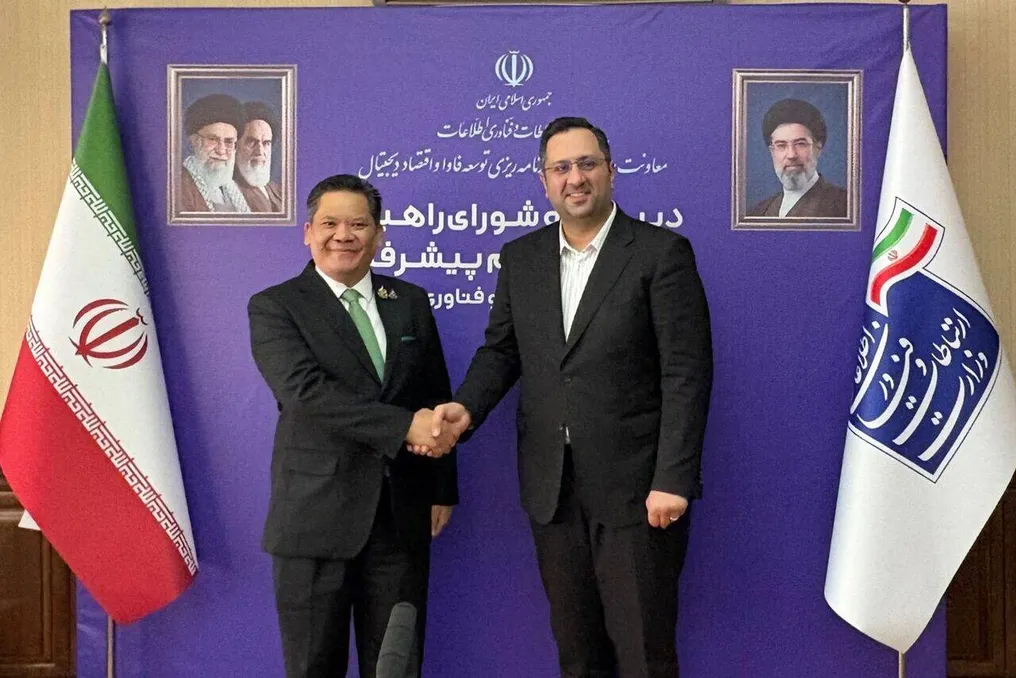
Officials from Iran and Thailand stressed the necessity of strengthening joint efforts in the field of information and communication technologies (ICT), which will promote regional and international interaction, as well as the signing of a memorandum of understanding between the two sides.
As reported by the IRNA agency, a meeting took place between Mohammad-Hafiz Hakimi, Deputy Minister of ICT, and Sake Noptaisong, the Thai Ambassador to Iran. Noptaisong, emphasizing the long-standing partnership between Iran and Thailand, called for the continuation of bilateral cooperation.
The Thai Ambassador noted that since his appointment in Tehran, he has shown interest in studying Iran's achievements and potential in various fields such as artificial intelligence, digital transformation, and new technologies.
For his part, Hakimi indicated that since the headquarters of the Asia-Pacific Telecommunity (APT) is in Bangkok, Thailand plays a significant role in enhancing technological cooperation in the region. He proposed utilizing the opportunities of both countries to develop interaction.
Both sides agreed that it is necessary to develop and sign a memorandum of understanding to stimulate technological and bilateral cooperation.
Global Innovation Index 2026: Tehran Enters Top 100 Science and Technology Clusters
According to a report published by the World Intellectual Property Organization of the UN (WIPO), Tehran ranked 65th among the world's largest science and technology (S&T) clusters this year. Annually, the GII identifies and ranks the 100 leading innovation clusters globally.
This index uses a data-driven, bottom-up approach that transcends administrative and political borders, identifying geographical areas with a high concentration of inventors, scientific authors, and venture capital (VC). These clusters often cover multiple municipalities or subnational regions and sometimes extend across two or more countries.
Three criteria determine the composition of the top 100: the location of inventors listed in patent applications filed under the WIPO Patent Cooperation Treaty (PCT); the affiliation of authors of published scientific articles; and the location of companies receiving venture capital funding.
The GII 2026, themed 'Supporting Entrepreneurs at the Forefront of Science,' analyzes how scientific breakthroughs are turning into deep science startups and spin-offs.
Besides China and India, six other middle-income economies have clusters in the top 100, including Brazil (1 cluster), Islamic Republic of Iran (1), Egypt (1), Malaysia (2), Mexico (1), and Turkey (1).
Tehran is the only cluster in Iran to make the top 100 innovation clusters in 2026. In 2026, Tehran filed 405 PCT applications, had 58,732 scientific publications, and 107 venture capital deals, with global PCT application share at 0.0%, global scientific publication share at 0.7%, and global venture capital deal share at 0.0%. This allowed it to rank 65th among the largest innovation clusters and 88th in innovation intensity, which is lower than in 2025 (63rd and 85th, respectively).
According to IRNA, the estimated population of the city cluster is 7,852,733 people, with a PCT application rate per capita of 52, and a scientific publication rate per capita of 7,497. The pre-round venture deal metric per capita is estimated at approximately 14, and the overall innovation intensity per capita is 0.097.
In patent registrations, medical technologies ranked first (with a share of 19%), followed by computer technologies, civil engineering, and pharmaceuticals.
Among the leading publishing organizations in Tehran, Tehran University stands out with 5,232 articles, Islamic Azad University with 4,081 articles, and Iran University of Science and Technology with 3,725 articles. Most published works relate to engineering fields.
In the recent StartupBlink Global Ranking 2026, Tehran's position improved by 20 places, rising to 348th among the most innovative cities in the world.
Tehran is home to 96 startups, accounting for 81% of the total number of startups in the country. The city has about one startup per 100,000 people. In 2025, the ecosystem demonstrated annual growth of over 36%. Currently, the city ranks 1st in the strength of the startup ecosystem in Iran, maintaining this position since 2025. Regionally, Tehran ranks 11th in West Asia, moving up 2 positions from 2025.
According to Iran Innovation Zone, this success is attributed to the strengthening of innovative infrastructure and the development of links between various sectors operating in the knowledge-based economy, as reported by the Mehr agency.
The StartupBlink report highlighted the role of Pardis Technology Park, the country's largest technology and innovation center, as one of the driving forces of Iran's knowledge-based economy. The park hosts hundreds of technology and knowledge companies, creating infrastructure for business development and providing a platform to improve collaboration between startups, investors, major industries, and institutions.
Furthermore, the annual hosting of the International Exhibition of Innovations and Technologies (INOTEX) by Pardis Technology Park plays a key role in establishing contacts and uniting experts in the innovation ecosystem. According to the report, thanks to the capabilities of Pardis Technology Parks, Iran's startup ecosystem ranks 95th globally.
Other key players contributing to the development of Iran's innovation ecosystem include the Innovation Fund and MCI (Hamrah Aval – Iran's first mobile operator) Ventures. Iran ranks 58th globally in the 'Corporate Interaction' indicator, which reflects effective interaction between large industry and innovative and technological companies.
Fintech, a leading industry in Iran, ranks 72nd globally and 5th in the Middle East, indicating the country's high potential in developing financial technologies. The Iranian fintech industry comprises 23 startups, making up 19% of all startups in Iran.
In the Global Startup Ecosystem Index 2026, Iran's startup ecosystem ranked 103rd globally, remaining at the same level compared to the previous year. The Iranian startup ecosystem ranks 10th in West Asia, consistently holding this position since 2025. It follows Oman and surpasses Iraq.
There are 118 registered startups in the country, accounting for one percent of all startups in the Middle East. This is equivalent to approximately one startup per 100,000 people. Over the last year, the ecosystem grew by 54.4%.