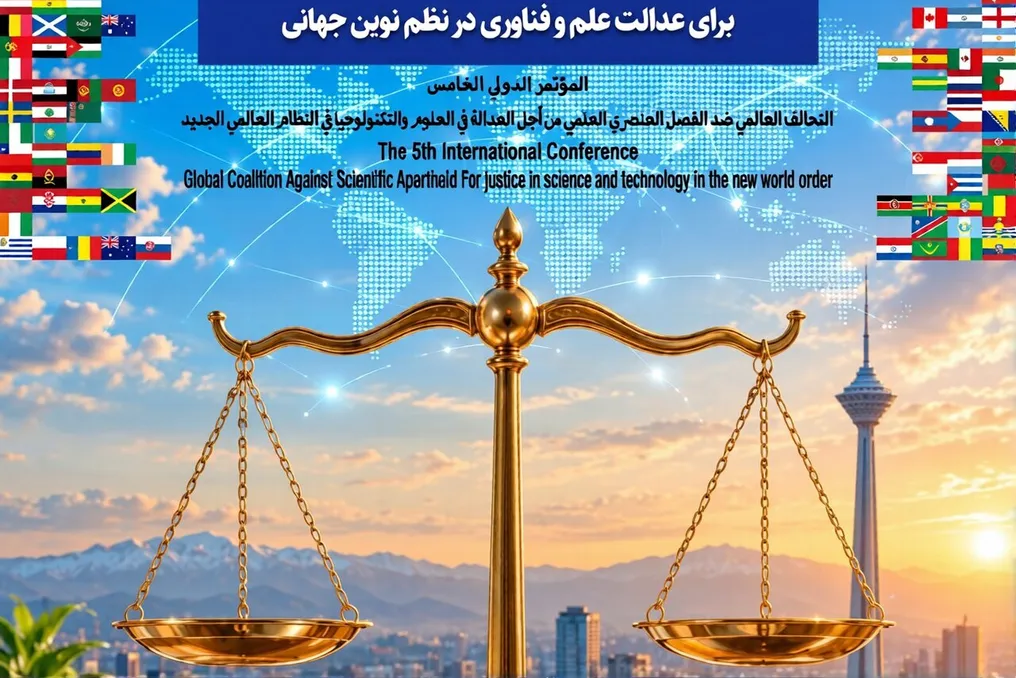
The Fifth International Conference of the Global Coalition Against Scientific Apartheid is scheduled for November 10th in Tehran. The event aims to promote justice in science and technology within the framework of a new world order, as well as to commemorate scientists who died during the conflict between the US and Israel against this country.
The conference is organized by the World Islamic Forum for Peace and the Islamic Azad University. Key objectives include promoting scientific justice as a prerequisite for global peace and justice, studying the state of scientific justice in the current and future world order, identifying cases of scientific apartheid, analyzing the killing of scientists and the imposition of technological sanctions, and strengthening coalitions among experts and scientific institutions worldwide.
The event focuses on five key themes: intellectual and philosophical foundations of scientific justice and overcoming apartheid in science and technology; unilateralism, scientific and technological hegemony, and the future of the world order; examples of scientific and technological apartheid and ways to counteract it; scientific justice, a just world, and development; and forming a global coalition for justice in science and technology: from discourse to action.
Sanctions Contradict UNESCO's Open Access Policy
In April, Minister of Science Hossein Simai-Sarraf condemned the sanctions imposed on the country's scientific sector, stating that they contradict UNESCO's Open Access Policy.
Speaking at the Global Ministerial Dialogue on Scientific Diplomacy, held at the UNESCO headquarters in Paris, France, on March 25 and 26, the minister stated that according to UN Security Council Resolution 2231, imposing sanctions on scientific activities has no legal force, as reported by IRNA.
The two-day event was held under the slogan 'Scientific Diplomacy in a Changing World: Building a World in the Minds of Men and Women.' Simai-Sarraf outlined Iran's positions and views on issues such as modern scientific diplomacy for solving 21st-century problems, the role of scientific diplomacy in ensuring the security of science and promoting open access to scientific research, and its role in fostering fair cooperation for the development and responsible use of new and emerging technologies.
In parallel with the event, the official held meetings with UNESCO Deputy Director-General Xin Ji, Assistant Director-General for Natural Sciences Lydia Arthur Brito, Assistant Director-General for Education Stephanie Giannini, and Assistant Director-General for External Relations Firmin Eduardo Matoko. Furthermore, Simai-Sarraf met with the Ministers of Science of Sri Lanka and Colombia, as well as with the Deputy Ministers of Science of Iraq and Switzerland.
In a meeting with Iranian professors residing in France and Germany, Simai-Sarraf invited them to help strengthen cooperation with the country. The official also emphasized the need to amend legislation and eliminate existing gaps to utilize the scientific potential of Iranians living abroad. It was decided that 20 prominent Iranian professors residing in Europe would travel to Iran this summer to give speeches and conduct scientific and educational seminars in various fields such as artificial intelligence and renewable energy.
The Global Ministerial Dialogue on Scientific Diplomacy, as part of the International Decade of Sustainable Science, aims to develop international dialogue on creating a new global structure for scientific diplomacy that meets the current needs of society. The dialogue seeks to promote high commitment to scientific diplomacy as a tool for advancing dialogue and peace; to study innovative initiatives in scientific diplomacy through exchanges of views among ministers, scientists, diplomats, and experts to promote peacebuilding and human rights protection; to agree on a common framework for achieving common goals through scientific diplomacy; and to highlight current initiatives and opportunities in this field.