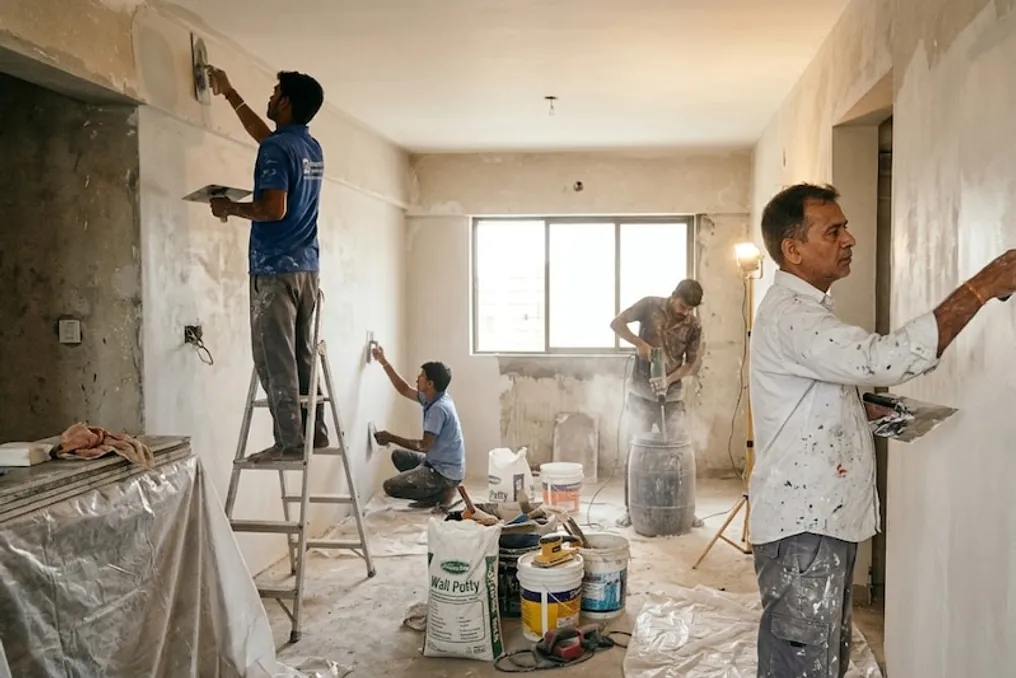
With the celebration of Diwali, painting work has begun, and people have many questions, such as whether to apply POP or plaster to an old wall first. Answers to these questions are presented below.
POP, which stands for gypsum, and wall putty are both used to prepare walls for painting, but their base, purpose, and strength differ fundamentally.
Simply put, the main function of POP is to level curved walls and create decorative patterns. Meanwhile, the task of plastering is to give the wall a smooth and durable surface suitable for applying paint.
POP is made from gypsum. Its application is limited to interior spaces and ceilings. The thickness of the POP layer is usually from 3 to 10 mm. Upon contact with water or moisture, it begins to deteriorate or peel off.
On the other hand, plaster is made from white cement. It can be used not only on interior walls but also on exterior ones. The thickness of the plaster coating should be a thin layer—from 1 to 2 mm. It is designed to fill small cracks and create a smooth surface for paint. Plaster is resistant to moisture and gives walls strength.
It is important to know the correct order of using these materials before painting. To level the walls, POP should be used first, followed by applying plaster for the final finish. First of all, all old flakes, dust, and grease from the wall surface must be thoroughly cleaned using sandpaper. If the wall is severely curved or has large holes, a layer of POP is applied. After the POP dries, two layers of wall putty are applied, followed by priming and painting.
When working with old walls, using wall putty is the most reliable and safest option. Old walls are often exposed to moisture and have small cracks, and plaster easily handles these problems. If POP is applied, moisture exposure may lead to signs of dampness.