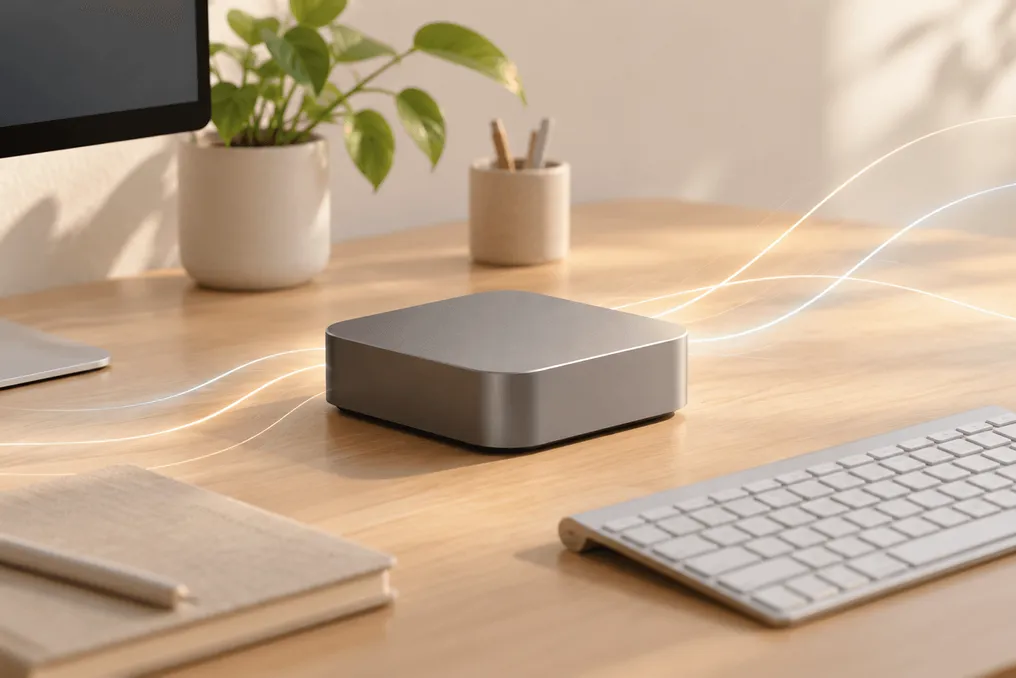
Lenovo demonstrated the preliminary model of its AI Host P7 device at the CSDN's 2026 1024 Programmers' Day and AI Builders Conference on October 24. Additionally, an early access program was launched, inviting initial users to test the device in real coding and office tasks before its general release. Previously, the concept of this portable AI host was presented by Lenovo in May, and this preliminary version includes more detailed technical specifications and software features.
The device weighs about 300 grams and is built on two domestic chips. The first is the in-memory computing inference chip Houmo AI M50, which, according to Houmo, provides 160 TOPS performance while consuming 10 watts. The second chip is the agent SoC from CIX Technology P1, manufactured using a 6nm process and equipped with a 12-core Armv9.2 processor and a 30 TOPS NPU, enabling 45 TOPS in heterogeneous computing.
According to CIX, the P1 chip is responsible for system management, task execution, and planning, and it can interact with external accelerators to run a 122-billion parameter model with a 128K context at a speed of 50 tokens per second. Lenovo claims that the preliminary P7 version is capable of locally processing models with up to 125 billion parameters and a 256K context.
The device comes with a local model library that includes Qwen3.8-Flash-Next, Qwen3.8-27B, and Qwen3.6-35B-A3B, as well as models for speech recognition, speech synthesis, document processing, and image design. Lenovo reports that its internal AI computing architecture, which uses mixed INT4 and INT8 quantization, achieves an average of 98.3% of the baseline BF16 with full precision across four benchmarks. It should be noted that these figures are company data and have not undergone independent testing.
Lenovo positions the P7 as a personal token hub. The token manager function allows users to direct coding tools and agent applications to local models via an API address, thereby saving routine model calls on the device instead of using paid cloud quotas. The task execution mode operates around the clock, and progress can be tracked from phones, tablets, and PCs. The built-in Tianxi AI has an Auto mode that distributes requests between local and cloud models depending on their complexity.
Sun Ke, Head of AI Hosts, emphasized that true productivity should not start with counting token costs. Lenovo has not yet disclosed the price or release date, only stating that the P7 will be available soon.