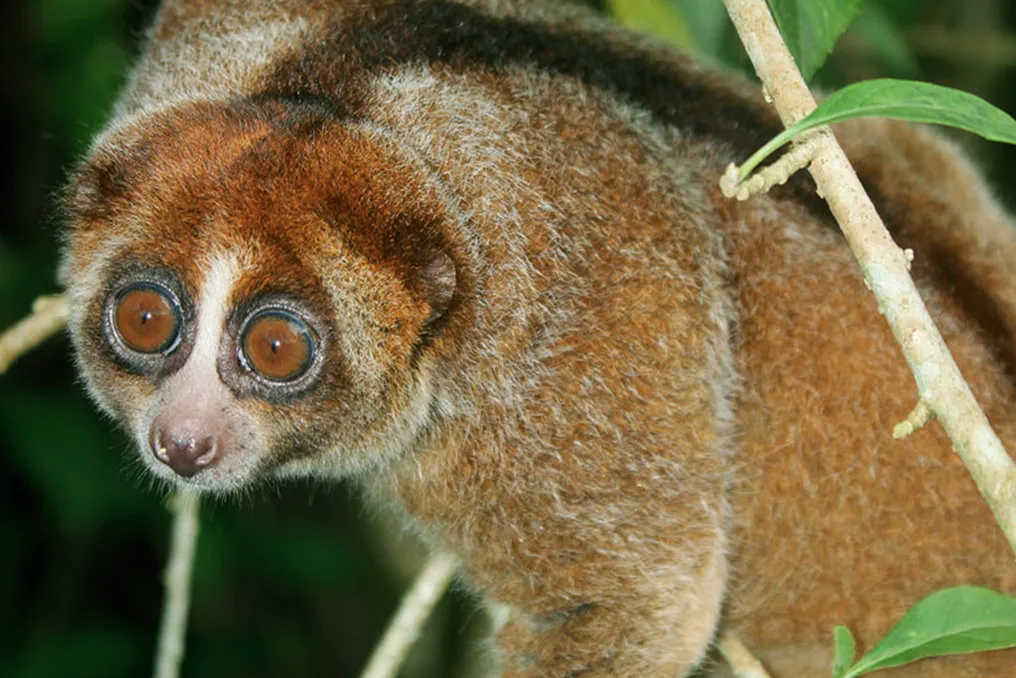
The Bangka slow loris, a primate capable of producing venom, has been scientifically recorded again after being classified as practically extinct for almost a hundred years. Although it went unnoticed by the international scientific community, the animal had not completely disappeared.
On the island of Bangka, Indonesia, local inhabitants observed the animal in various locations, such as yards, near roads, and even crossing under power lines.
Researchers reported in a recent article that local residents requested assistance from the Alobi Wildlife Rescue Center. According to testimonies, more than 90 individuals of the Bangka slow loris circulated in the area in recent years and were recovered by the rescue organization.
Many animals were saved unharmed in homes, gardens, plantations, or public roads, while others suffered serious injuries, mainly due to contact with electrical wiring, resulting in deaths even after treatment. Of those that recovered, 86 were returned to appropriate natural environments.
The rescued animals come from different areas of the island of Bangka. For scientists, this fact demonstrates the species' resilience despite the vast destruction of its habitat and decades of scientific disinterest. Habitat reduction is attributed to tin mining activity and deforestation in palm oil plantations in the region.
The Bangka slow loris (Nycticebus bancanus) is described as a small and adorable nocturnal primate, characterized by reddish-brown fur and prominent eyes. Unlike other arboreal primates, such as monkeys and lemurs, it moves slowly through the trees, almost in a parade.
The last scientific records of this primate date back to the early 1930s. Subsequently, there was no new information about its presence on the island, leading the International Union for Conservation of Nature (IUCN) to classify it as critically endangered and potentially extinct in 2020.
Timon Glaw, the author of the article, stated in a press release that 'bringing the Bangka slow loris back to the scientific radar is only the first step.' He emphasized the urgent need for a long-term conservation strategy based on population surveys, genetic studies, and crucially, the protection of its remaining habitat. Glaw added that the next goal is to ensure the species does not become extinct.
The island of Bangka has over one million inhabitants. The study points out that human settlements, roads, and power transmission lines represent considerable risks to the species. Additionally, slow lorises are targeted by the illegal pet trade in Asia.
The study authors suggest implementing a conservation program in Bangka aimed at protecting habitats and following up with monitored care. Future steps include conducting population censuses, genetic investigations, and monitoring the species' reintroduction into the natural environment.
In the evolutionary lineage of primates, the Bangka slow loris shares a closer kinship with Madagascan lemurs and African galagos than with monkeys or great apes. Like other slow loris species, it is venomous, an uncommon characteristic among mammals.
This implies that they produce toxins and use specialized structures to inject venom into prey or predators. These secretions are stored internally in their arms. When threatened, they raise their arms and lick the glands before biting their adversaries. This ability is primarily used in confrontations between slow lorises, although it can serve as defense against predators and parasites. Attacks on humans are rare, but the venom can cause severe allergic reactions, with potential fatality.
According to Glaw, the diet of these animals is not yet fully understood. Currently, researchers conjecture that, like other slow loris species, they feed on insects, tree resins, nectar, and other plant parts. The description of the species and the rescue report were published in the journal Spixiana.