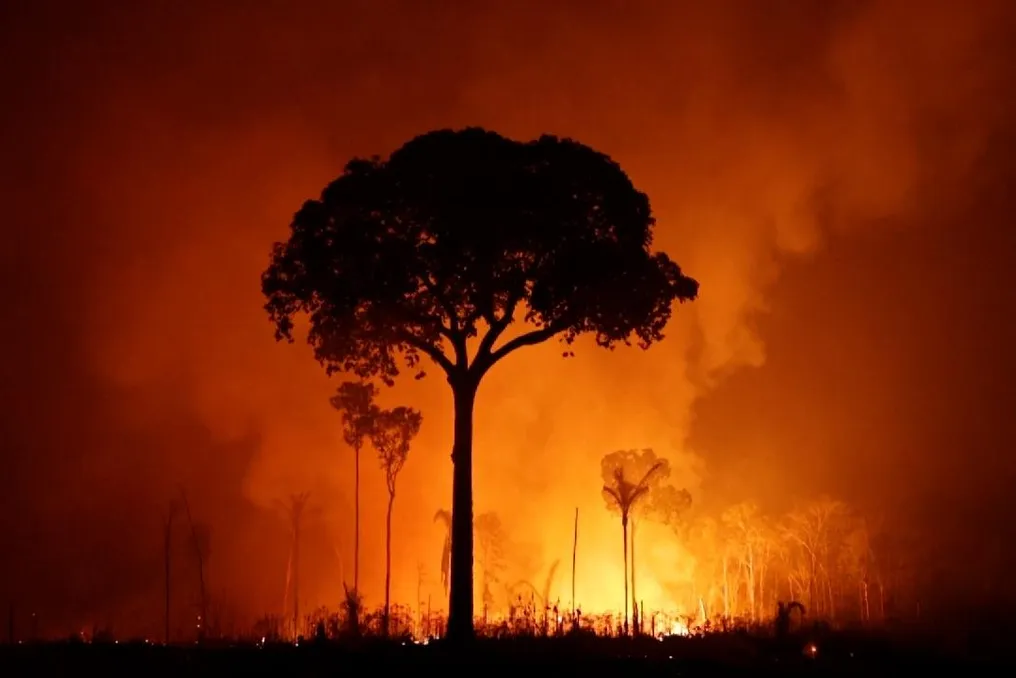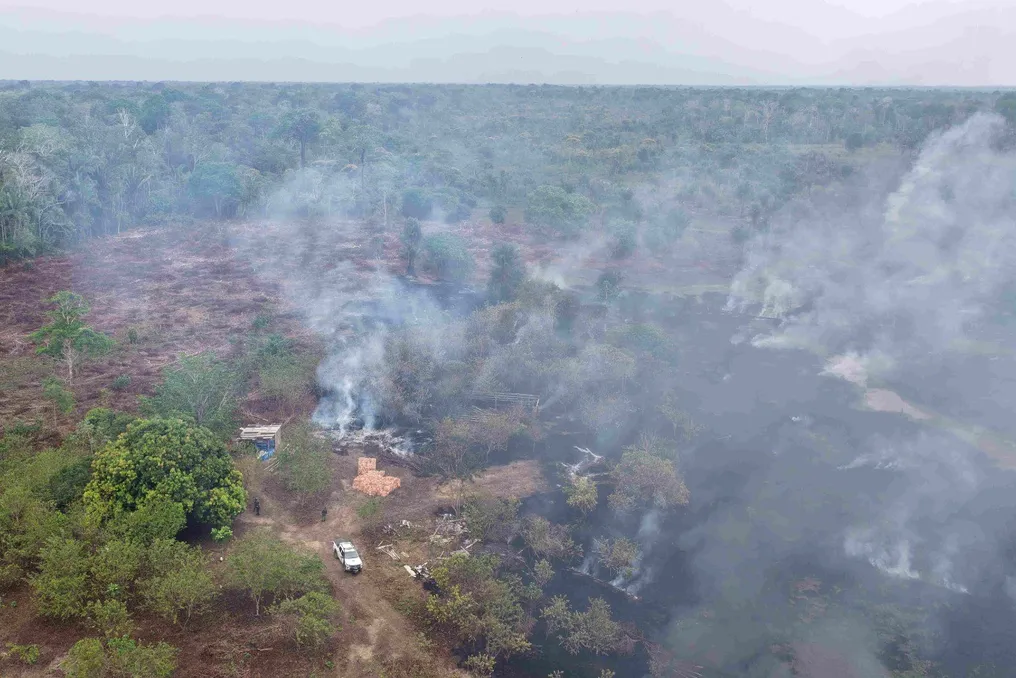
The municipality of Humaitá, located in the interior of Amazonas, recorded the highest volume of fines and the largest area of embargoed land due to improper fire use during the period between September and October 22, 2026. According to data provided by the Environmental Protection Institute of Amazonas (Ipaam), Humaitá accumulated eight infraction notices, totaling R$ 4.36 million, in addition to four areas under embargo, covering 280.85 hectares.
At the state level, Ipaam imposed 32 infraction notices across seven Amazonian cities during the same interval, resulting in fines totaling R$ 25.6 million. Additionally, 15 embargo terms were issued, covering a total area of 724.1 hectares, which is equivalent to approximately over a thousand soccer fields.
Inspection activities were conducted through the Alerta Fogo, Tamoiotatá, and Manaus Metropolitan Region operations. These actions were intensified following the publication of State Decree No. 55,339, dated September 9, 2026, which prohibited the use of fire throughout Amazonas for a period of 120 days, respecting the exceptions and conditions stipulated in the regulation.
Other municipalities also registered significant sanctions: Manaus had an infraction notice valued at R$ 5.01 million, while Careiro da Várzea received six sanctions, totaling R$ 702.4 thousand. Manaquiri registered two notices valued at R$ 827.95 thousand. One notice was also documented in Manacapuru, worth R$ 2.5 million, and another in Tapauá, corresponding to R$ 65.79 thousand. The total amount of fines applied in these seven municipalities reached R$ 25,607,911.
Embargoed Areas
Regarding embargoes, Humaitá maintained the lead with 280.85 hectares affected. In Careiro, five embargo terms covered 199.29 hectares, and in Careiro da Várzea, two terms affected 156.8 hectares. Manaquiri had two embargoes totaling 82.79 hectares, and Tapauá registered one embargo of 4.38 hectares. In Manaus, although one embargo term was issued, no area was accounted for. Overall, the 15 embargo terms totaled 724.1 hectares.
An embargo is an administrative measure intended to prevent the continuation of an irregular activity, aiming to prevent the worsening of environmental damage. Specifically in cases related to improper fire use, this determination limits the use of the area that was the target of the infraction detected by inspection.
The funds collected from the fines are destined for the State Environmental Fund (Fema), which is managed by the State Secretariat of the Environment (Sema).
How Inspection Works
Inspection teams concentrated their actions in regions with the highest concentration of heat spots. The operations received support from the Military Police, through the Environmental Policing Battalion (BPAmb), the Civil Police, and the Deputy Executive Secretariat of Intelligence (Seaint). Furthermore, agents used drones and vehicles equipped with Starlink satellite connectivity to assist in monitoring and field inspections.
Gustavo Picanço, president-director of Ipaam, clarified that heat spot alerts help direct teams but are not sufficient on their own to justify a fine. It is essential to conduct an on-site verification and collect evidence proving the infraction and identifying the responsible party.
Picanço detailed: 'It is not the heat spot itself that generates a sanction. The team goes to the location, checks the area's situation, looks for the responsible party, and seeks to identify the origin of the fire. Based on this field assessment, when elements characterizing the irregular use of fire and linking the conduct to the responsible party are found, the infraction notice is issued.'
Environmental Responsibility
The link between an individual's conduct and the identified infraction is called the causal link. In practice, this implies proving that some action or omission by the responsible party is directly linked to the observed environmental irregularity.
Federal Law No. 9,605/1998, known as the Environmental Crimes Law, establishes both infractions and administrative environmental sanctions. Its Article 70 determines that such infractions must be investigated through an administrative process.
In the state of Amazonas, State Decree No. 51,355/2025 regulates matters related to administrative environmental infractions. Marcelo Barroncas, Environmental Inspection Manager at Ipaam, emphasized that the mere existence of fire on a property does not automatically imply the application of a fine to the owner. Inspectors must analyze the circumstances, determine the origin of the fire, and gather proof pointing to who caused the event.
Barroncas explained: 'When the team arrives at the location, they check what is happening, look for the owner or responsible party, and try to identify how the fire started. The fact that the fire occurred within a property does not mean the owner caused the burning. It is necessary to evaluate the circumstances and gather elements that prove responsibility for the infraction before applying the penalty.'