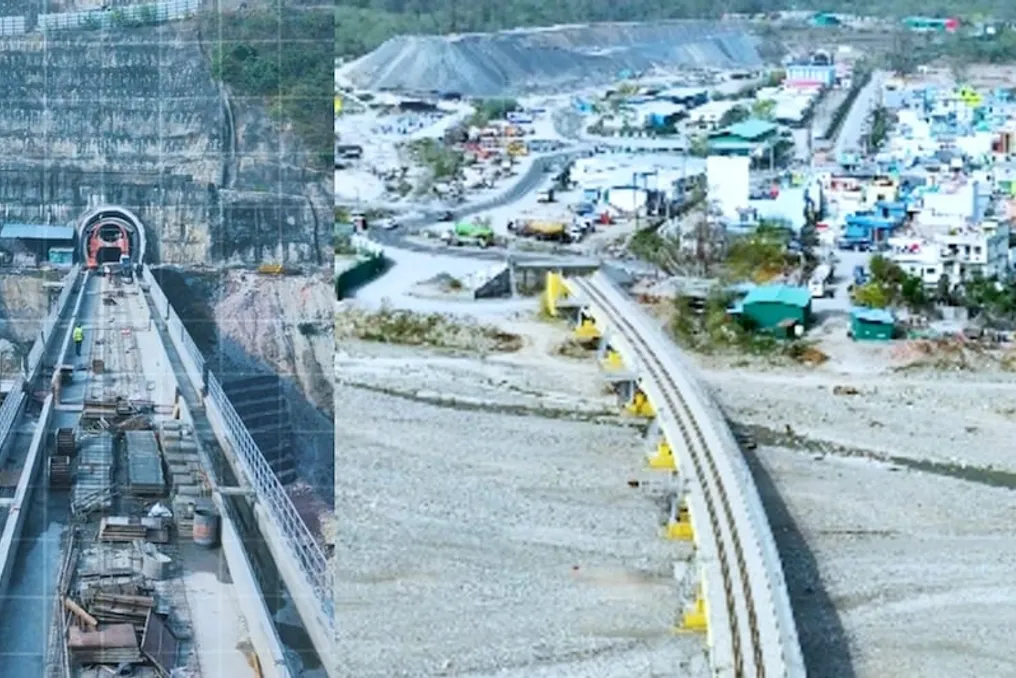
Rishikesh-Carnaprayag Railway Line Construction: 83% of the Route Will Pass Through Tunnels
Read more
Aaj Tak
www.aajtak.in

Rishikesh-Carnaprayag Railway Line Construction: 83% of the Route Will Pass Through Tunnels

Work is underway in the state of Uttarakhand on the Rishikesh-Carnaprayag railway line project, aimed at improving rail accessibility in mountainous regions. This route, approximately 125 kilometers long, will facilitate movement in the Gadwal region and support pilgrims traveling to important shrines such as Kedarnath and Badrinath. Furthermore, the project is significant for strengthening access to strategically important areas near the Chinese border.

The Rishikesh-Carnaprayag railway line will connect Rishikesh with Carnaprayag via 12 stations, thereby expanding the railway network into the mountainous areas. The implementation of this project is expected to promote religious tourism, job creation, and a positive impact on the local economy.

Carnaprayag is the proposed terminus of this line. According to project data, it is located approximately 123 kilometers from the Chinese border, although the railway itself does not directly reach the international border. The main goal of the project is to strengthen the transport network in the Himalayan region.

Building railways in the Himalayas presents a complex challenge due to potentially weak rock formations and the risk of ground changes. In many places, tunnel construction is complicated by water-saturated geological layers. This is why a large proportion of tunnels is provided for in this project. It is planned that about 83 percent of the railway track will pass through tunnels, along with 28 main and emergency tunnels, and 57 major and minor bridges.

During tunnel construction, engineers face issues such as soil strength, rock mass condition, and groundwater. Weak soil can change its shape during excavation work, putting pressure on the tunnel walls. In such cases, special methods are required to reinforce the tunnel and stabilize the soil. Considering these difficulties, railway engineers conducted a geological survey before installing Tunnel Boring Machines (TBMs). It was also necessary to select a tunnel construction method appropriate for different types of rock and soil.

The Himalayan region between India and China is a sensitive border. High mountains, adverse weather conditions, and limited transport infrastructure can hinder movement here. Under these conditions, strengthening road, bridge, and railway networks is crucial. Access to the interior areas of the Gadwal Himalayas may improve thanks to the railway network stretching from Rishikesh to Carnaprayag. This will provide passengers with an alternative to rail transport for trips from plains to mountains.

The strategic importance of this project lies in enhancing transport infrastructure in the region. Improved connectivity will aid the movement of ordinary people, workers, goods, and essential supplies. Moreover, reaching remote areas will become easier through road and rail networks. Thus, the Rishikesh-Carnaprayag railway line is an important project that strengthens the transport network in the Himalayan regions alongside the development of religious tourism and regional growth.
Similar stories

Survey begins for railway line between Mathura and Aligarh after 79 years without direct connection
Read more
www.aajtak.in

Survey begins for railway line between Mathura and Aligarh after 79 years without direct connection

Mathura and Aligarh are two significant cities in the state of Uttar Pradesh. Mathura is known for its religious tourism appeal, while Aligarh is renowned for education, business, and industrial activity. The distance between these cities is about 60 kilometers, but the lack of a direct railway connection creates inconvenience for passengers.

Although the main railway line passes through Mathura, direct rail access to Aligarh is still missing, which poses a problem for travelers. Even 79 years after gaining independence, the shortage of railway infrastructure remains the primary reason for this distance. In response to this issue, the railway has taken steps to address it.

Work has commenced on the Final Location Survey (FLS) for the proposed new railway line between Mathura and Aligarh. Additionally, the possibility of extending the Vande Bharat Agra-Varanasi express to Mathura is being considered. If both proposals receive approval, residents of Mathura and its surroundings may gain new options for rail travel.

Despite the main railway line passing through Mathura, the absence of a direct rail link to Aligarh has long been a serious concern for passengers. The goal of the proposed new railway line is to bridge this gap, providing convenience for people traveling between the two cities. The railway has begun conducting the FLS for the prospective rail link. This is an important step in advancing the plan to build a new railway line.

During the survey, the proposed trajectory and associated technical aspects will be evaluated. According to the plan, this railway line will connect Mathura with Aligarh via Medu station on the Mathura-Kasanj East-North Railway section. However, the start of the survey does not mean the project has received final construction approval; further decisions await project sanctioning, commencement of construction, and service start dates.

Mathura MLA Hema Malini had previously raised the issue of the need for a direct railway connection between the two cities. On September 14, she sent a letter to the General Manager of Central Railway Uttar Madhya, urging attention to this proposal. Following this, discussions took place between railway officials and MPs representing the Agra constituency regarding railway services and connectivity. Hema Malini emphasized that even 79 years after independence, there is no direct rail link between the two neighboring cities, causing daily difficulties for thousands of passengers. She stated that building a new line would simplify journeys and reduce travel time.

Alongside the proposal for a new railway line, another request for Mathura passengers is under discussion: considering the possibility of extending the Vande Bharat Agra-Varanasi express to Mathura. This would allow Mathura residents to utilize semi-high-speed train services. However, railway officials noted that sufficient servicing facilities must be developed at Mathura station for this extension. According to railway representatives, the proposal can only be considered further after these facilities are ensured. Currently, there is no set date for the approval or launch of the train extension.

Popular