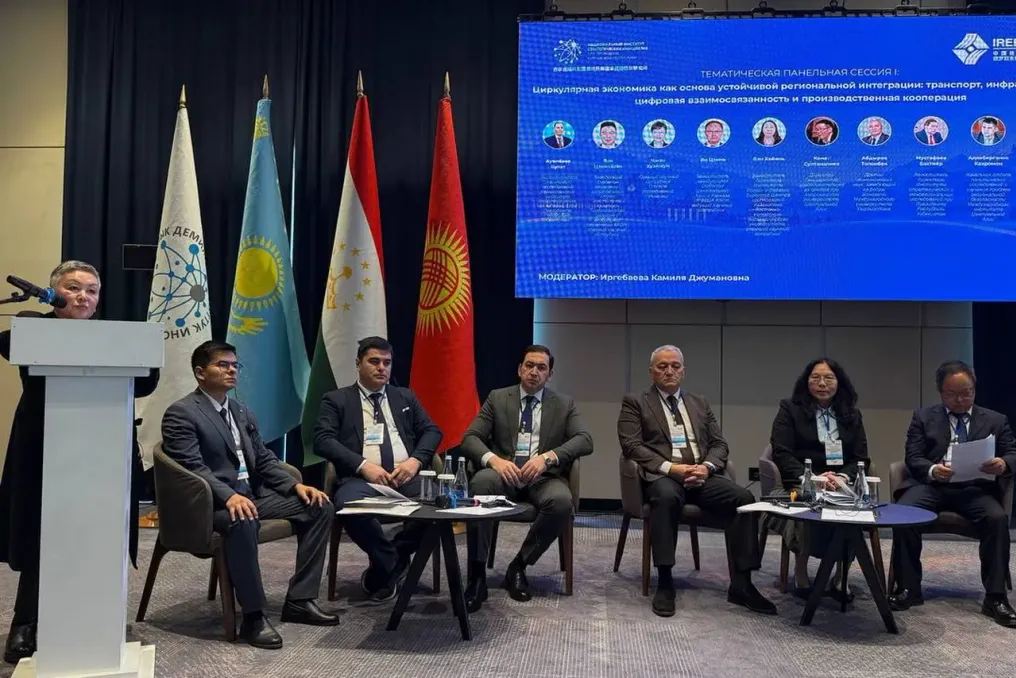
The development of the circular economy presents new prospects for technological interaction between Uzbekistan, China, and other Central Asian countries, according to Bakhtiyor Mustafayev, Deputy Director of the Institute of Strategic and Regional Studies under the President of Uzbekistan (ISRS).
Mustafayev presented these opportunities at the Sixth Forum of Think Tanks of China and Central Asia, which took place in Bishkek on October 22–23, 2026, under the theme 'High-Quality Development and Joint Modernization.' The event was organized by the Institute of Russia, Eastern Europe and Central Asia of the Chinese Academy of Social Sciences and the National Institute of Strategic Initiatives under the President of Kyrgyzstan. Representatives from leading research centers in China and five Central Asian countries participated in the forum.
The delegation from Uzbekistan included experts from ISRS, the Academy of Public Policy and Administration under the President of Uzbekistan, and the International Institute of Central Asia. Participants discussed prospects for joint modernization, transport and digital connectivity, deepening industrial cooperation, and the implementation of artificial intelligence. Furthermore, they addressed issues of human capital development and expanding humanitarian cooperation.
Speaking at a panel discussion on the circular economy, Mustafayev emphasized the potential for cooperation between Central Asia and China in waste recycling and resource reuse. He noted that creating joint recycling facilities could add extra value and create new jobs in the region.
He stressed that Uzbekistan is already taking steps to strengthen partnership in this area: a specialized body has been established, private sector participation in waste management is growing, and a portfolio of projects for building 11 waste-to-energy plants is being developed. Chinese technology companies are key partners in these projects.
Addressing the broader regional context, Mustafayev reported that Central Asia produces about 25 million tons of municipal solid waste annually. However, the relatively small size of national markets makes it difficult for each country to establish a complete recycling cycle for all types of complex waste.
He highlighted cross-border value chains as a promising solution. According to this approach, the collection and primary processing of recyclable materials in Central Asian countries can be supplemented by advanced processing at specialized technological centers.
According to Mustafayev, combining the resource base of Central Asia with the technologies and experience of China can promote such cooperation.
He identified three priority areas for advancing this initiative. The first is increasing the export of standardized secondary raw materials from Central Asia to China. Mustafayev specified that this refers to processed materials that meet Chinese requirements. The growing use of electric vehicles, batteries, and digital equipment in the region makes the development of recycling capacities and the establishment of reliable sales channels for recovered materials critically important.
The second priority is the creation of joint enterprises for the recycling and processing of renewable energy equipment. Mustafayev noted that the rapid expansion of solar and wind energy production requires advance preparation for the disposal and recycling of equipment at the end of its service life. Cooperation with Chinese partners can help recover silicon, silver, and polymers from decommissioned solar panels for further use in production.
The third priority is the development of joint educational programs to train specialists in the field of circular economy. He mentioned that a potential partner for Uzbekistan could be the 'Green University,' the Central Asian University of Environment and Climate Change, which offers a specialized master's program in this field. Mustafayev emphasized that training qualified personnel will help provide necessary staff for new facilities and lay the foundation for long-term cooperation in this sector.