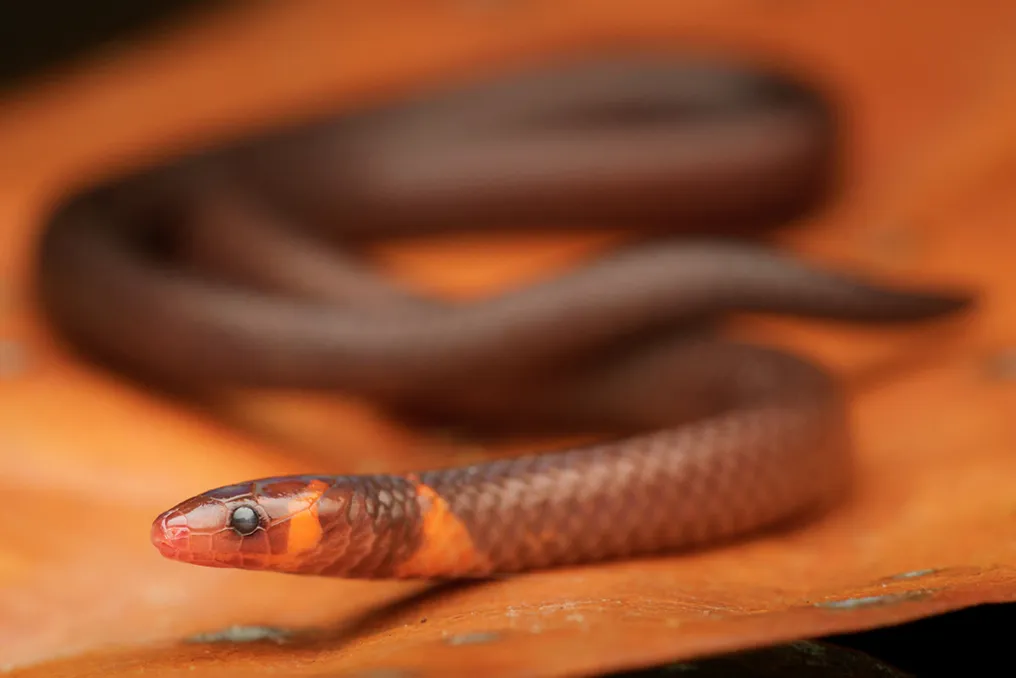
Snakes of the genus Pseudorabdion are small and timid creatures that are not venomous. Because of this, when faced with any predator, they usually have limited options: either hide or, in extreme necessity, flee. The ideal way to avoid mortal danger is by performing acrobatic maneuvers.
These snakes, which inhabit Southeast Asia, are known for their rare escape method when threatened: instead of gliding along the ground, they throw themselves into a series of rolls, spinning forward in a circle at a speed four times greater than normal crawling speed.
Essentially, they use their body as a wheel, while somehow keeping their head stable and pointed forward. Thanks to this, species that do not reach 30 centimeters can move at speeds exceeding 2 meters per second, moving perfectly straight.
A recent study aimed to precisely explain what happens during these pirouettes. In a paper published on Monday (19) in the journal Current Biology, researchers from Tohoku University in Japan were able to describe the physiology of this movement in detail. To do this, they filmed the snakes from different angles using high-speed cameras and analyzed their acrobatic displays in slow motion.
According to the analysis, the snake's rotation consists of a sequence of 'taps' against the ground. During the movement, the snake bends its body, forming a wheel shape, and rolls along the ground until it flies into the air, keeping its head fixed and pointing forward. At the next moment, flying over the ground, the body rises above the head and is thrown forward, tracing an arc over the snake's head. Following this arc, the snake then throws its body back down, to the side of the head, making another 'impact' with the ground. Upon contact with the surface, the snake rolls again, starting a new cycle.
All of this happens in fractions of a second. In the scientists' experiments, the snakes reached speeds from 1.72 to 3.69 m/s.
This mechanism allows them to bypass a fundamental anatomical limitation that prevents most animals from rolling quickly: the lack of a fixed axis. A car's wheels, for example, are separate parts that rotate only around their own axis, while the rest of the vehicle and the driver maintain the same orientation. In the case of an animal, however, the entire body must rotate as a single unit, including the head and all sensory organs. This makes any sense of orientation difficult—using an analogy, it is like if the car driver were rotating along with the wheel.
Pseudorabdion overcomes this problem by keeping the head stable while the rest of the body moves. In other words, the snakes use their head as the axis around which the rest of the body rotates. Thus, they can orient themselves in space even during vigorous movement. As the study showed, even while rolling at high speeds, the snakes are capable of traveling straight along a track only 20 cm wide without much effort.