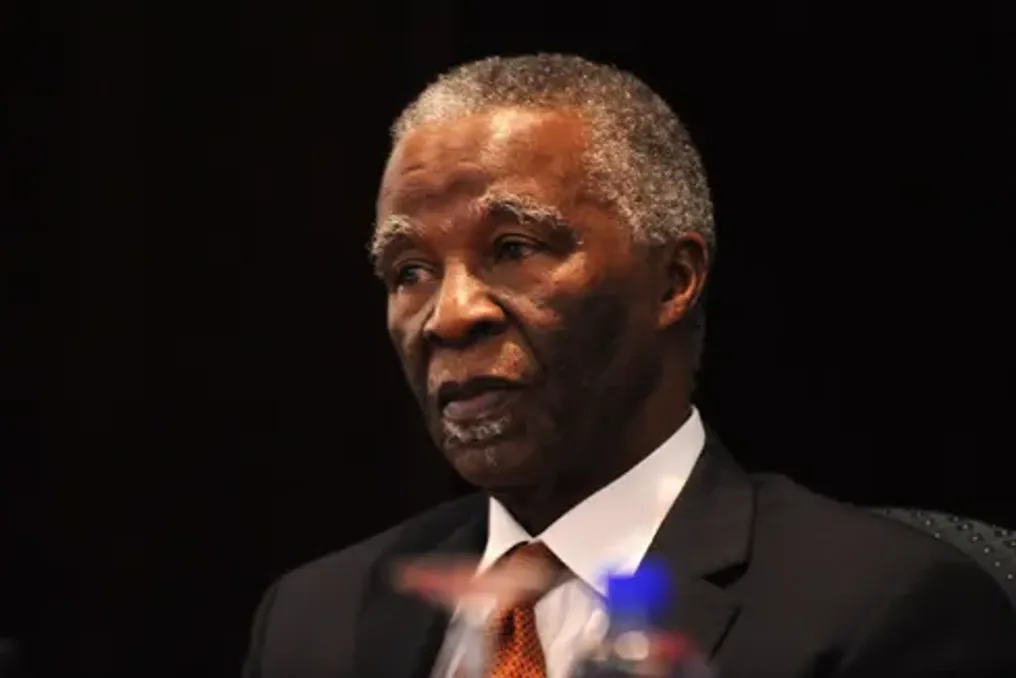
Former President Thabo Mbeki missed an opportunity to educate the nation and diaspora by not addressing the problem of racial prejudice in South Africa with sufficient rigor, instead softening it.
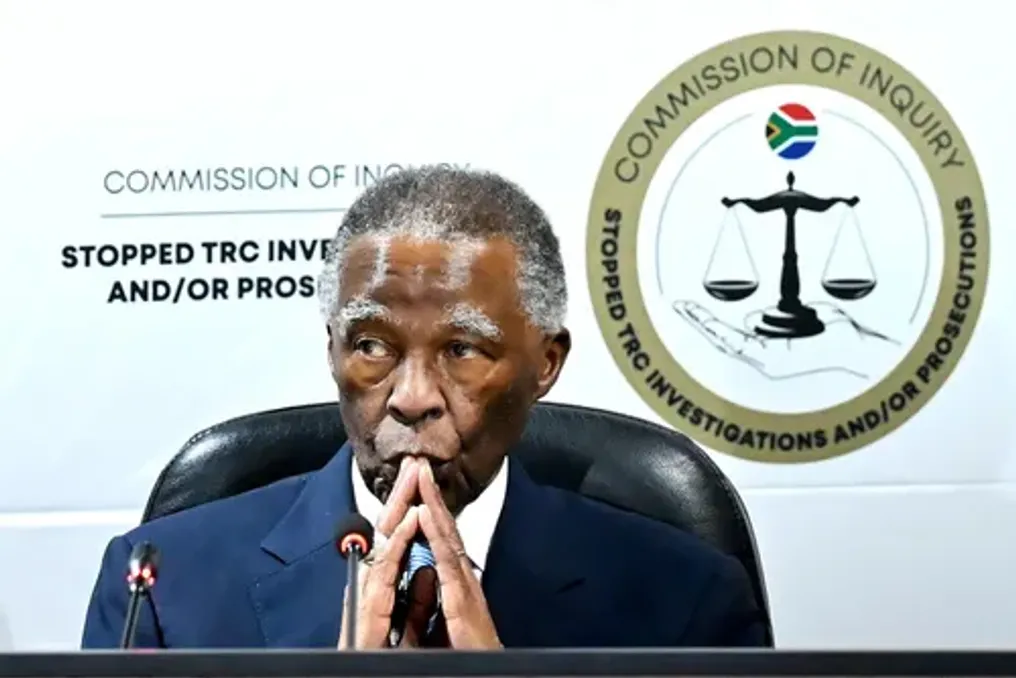
During his appearance before the Khampepe Commission investigating delays in the Truth and Reconciliation Commission's (TRC) judicial processes, Mbeki rightly spoke out against the mockery of white lawyer Paul Hoffman.
Mbeki, a politician with an intellectual background, successfully countered the obvious racial bias directed at him, supported by his wife Zanele Mbeki. However, to the author's disappointment, he refrained from a decisive confrontation with entrenched racism in democratic South Africa, which explains the subsequent trend on social media.
Mbeki's appearance before the Khampepe Commission was painful for several reasons. It was so because the former president acted as many South African political elites do: they avoid speaking the hard truth in pursuit of 'building a new society.'
Addressing the commission chairperson, retired judge Cisi Khampepe, Mbeki sharply reflected what many Black South Africans discuss in informal settings such as barbecues, family dinners, evening gatherings with friends, and radio shows. Questions about white supremacy in the so-called new South Africa are a relevant topic in taxis, buses, elevator lobbies, villages, townships, and suburbs, especially given the personal experiences of many Black victims of racism.
Mbeki's sharp remark to Lawyer Hoffman, who had previously aggressively questioned him about his past role, served as a microcosm of the imperfect racial relations in South Africa that have persisted for over 30 years since the start of our nascent democracy.
Mbeki stated that Lawyer Hoffman's line of questioning was conducted in a completely 'patronizing manner.' He noted that the white lawyer displayed traits that the author would call white supremacy. Mbeki commented on Lawyer Hoffman with the following words: 'He is very arrogant... I raise this question, Chairperson, I don't know what can be done about it. Perhaps there is no way to change Mr. Hoffman. He has a special attitude, very arrogant, very condescending, and he speaks about all this offensively. I hope we all understand what we are trying to do to build a new society. And perhaps we will have to make special efforts to remove what has become ingrained in us.'
Mbeki's bewilderment and irritated posture were evident in his attempt to reproach Lawyer Hoffman. The author uses the word 'attempt' because the former president did not achieve complete success nor bring the matter to a conclusion to resolve the most important factor that continues to impede South Africa's progress toward an ideal future of social cohesion and harmonious coexistence of all races.
The author expresses dissatisfaction with the former president, whom he respects highly, when he told the commission chairperson: 'I don't know what can be done about it.'
Mbeki should know that racism, outlawed with the fall of apartheid in the early 1990s, is punishable by law. Mbeki and many comrades from the liberation movement spent decades in exile and on Robben Island fighting for a South Africa free from racism. In April 1994, everyone thought they had succeeded when Mandela became the first democratically elected president. Mbeki succeeded Mandela in 1999, and under his leadership, the economy prospered for almost two terms.
Despite economic prosperity, South Africa's structural problems and complex challenges continued to manifest: the rich got richer, and the poor got poorer. This was Mbeki's economic dilemma: how could a government with a majority Black population lift the previously disadvantaged majority out of the mire of extreme poverty and create better life chances for them, especially for the poorest?
Until the end of his term, Mbeki consistently complained about South Africa, which seemed to have two different economies: one white and prosperous, the other Black and sluggish.
Mbeki should have assessed Lawyer Hoffman against this situation, which he knew and understood perfectly. He should not have played the role, but played the ball. He should have reminded Lawyer Hoffman to behave better. While Mbeki was born and raised under apartheid, Lawyer Hoffman is fully aware of the white privileges he enjoyed during apartheid—a form of political governance based on the oppression of one race by another due to skin color. There is no worse form of hatred. And that is why Mbeki should have reminded Lawyer Hoffman to behave better. The pain of oppression never completely disappears; it just lies low and reacts too quickly to the slightest provocation.
By addressing the commission chairperson, Mbeki should never have said: 'I don't know what can be done about it.' As a former president, he knows all spheres of government and should have proposed what needed to be done. This tendency of leaders to evade direct answers instead of speaking plainly unintentionally perpetuates the attitude of racial prejudice among some previously and still privileged members of our 'most unequal society in the world.'
On a human level, Mbeki deserves great praise for the sincere sympathy shown to the weeping Lawyer Hoffman after he spoke about the suicide of his 34-year-old daughter. Mbeki demonstrated Ubuntu-Botho, a core characteristic that makes us a special nation, and qualities that we all need, continuing to strive for a new society based on equality not only on paper but also in practice. I do not know Lawyer Hoffman and have never met him. Nevertheless, I express my deepest sympathy to him and his family regarding their tragic loss. As a practicing Christian, I pray for strength for the entire Hoffman family. However, no failures should cause us to become worse.