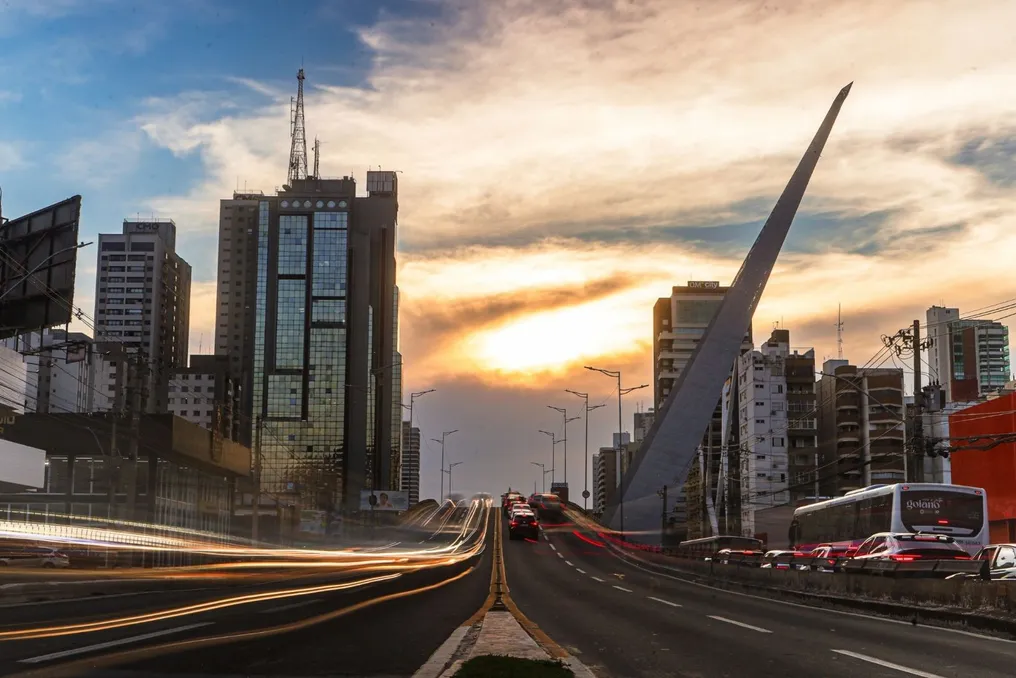
Goiânia evolved from a planned city of fewer than 50,000 inhabitants, focused on being the new political-administrative seat of Goiás, into a capital with a robust and diversified economy, housing an estimated population of 1.5 million residents according to the IBGE. The city's economic trajectory over its 93 years involved notable socioeconomic changes, consolidating it as a reference in industry and the real estate market. Experts and residents have analyzed the paths taken in this process.
Adriana Sousa, president of the Regional Council of Economics of Goiás (Corecon-GO), summarized the nine decades of the capital, explaining that initially, the main economic drivers were the city's construction, the installation of public administration, and commerce. Subsequently, the construction of Brasília and the expansion of highways in the Center-West, along with the diversification of agriculture, attracted numerous companies and investments to the region.
Data from the Brazilian Institute of Geography and Statistics (IBGE) demonstrate the various economic vocations acquired by the city, refuting the idea that its Gross Domestic Product (GDP) is limited to agribusiness. A Continuous National Household Sample Survey (Pnad), referring to the second quarter of 2026, details the distribution of the employed population: 24% work in services and commerce, 18.3% are in sciences and intellectual professions, 12% are technicians and high school professionals, 11.7% are skilled workers, laborers, and construction artisans, and 9.8% belong to elementary occupations.
Commerce, which constitutes the largest group of workers, has undergone major changes, according to João Oliveira Ramos Neto, a history professor at the Federal Institute of Goiás (IFG). He recalls that in the 1990s, the center of Goiânia was extremely busy, with Bosque dos Buritis as the reference point, as parks like Vaca Brava and Flamboyant did not yet exist, and people went downtown to access services, commerce, and leisure.
Old records, such as advertisements from March 21, 1953, on Avenida Goiás, show the development of commerce in the Central Sector, while Senac advertised typing courses two years earlier on the same avenue. Helia Gonçalves, executive superintendent of the Chamber of Shopkeepers (CDL) of Goiânia, adds that besides the center, the Campinas Sector was a relevant commercial hub. With urban advancement, new poles emerged, such as the Region of 44, focused on fashion and garment manufacturing, and shopping centers spread throughout the neighborhoods.
José Ronaldo Alves Leite, a 59-year-old merchant, testifies to these changes. He started his wire mesh store in the Aeroviário Sector in 1988. He recounts facing initial difficulties with registration and material purchase but overcame the challenges of the time. He observes that the economy, both of the capital and the country, has changed profoundly, citing high inflation at the end of the 1980s, which was only controlled with the Real Plan in the following decade. Operationally, he compares sales from 1988, made via printed lists and landline telephone, with current methods using the internet, WhatsApp, and social media.
Despite commercial expansion, José Ronaldo's store remains in the same location, but other merchants have relocated. According to Helia Gonçalves, the decentralization of commerce was driven by population growth, real estate expansion, urban mobility, and consumers' search for greater convenience and proximity.
A milestone of this decentralization was the inauguration of Shopping Flamboyant in Jardim Goiás in 1980 and 1981. Later, other large centers, such as Goiânia Shopping in Setor Bueno in 1995, reinforced the trend of bringing commerce closer to residential and working areas.
Food Commerce
Supermarkets also illustrate significant transformations in the daily lives of Goiânia residents. Augusto Almeida, superintendent of the Goiás Supermarkets Association (Agos), reports that in the early decades, supply was managed by small grocery stores, warehouses, fairs, and assisted sales, where the attendant selected items requested by the customer. Only in the 1950s did supermarkets adopt the current model of open shelves and direct consumer choice.
In the 1970s, Goiânia received major chains such as Marcos, Moreira, Passe Bem, Alô Brasil, and Pirineus. Sirlei Antônio do Couto, president of Agos, attributes the constant change of these chains to the inherent dynamism of the sector, mentioning the transformation of family businesses into large chains and the alteration of brands and business groups.
In the same decade of the 1970s, wholesale chains arrived in Brazil. In Goiânia, however, this model only solidified more recently, combining with traditional retail to give rise to the concept of 'atacarejo'. Augusto Almeida explains that the advance of atacarejo in Goiás was strengthened in recent decades, accompanying urban expansion, the professionalization of food distribution, and the growth of regional and national networks.
The Strength of Industry
Goiânia's industry has diversified into various segments, ranging from food to machinery, equipment, and clothing. André Rocha, president of the Federation of Industries of the State of Goiás (Fieg), highlights the strong food production, including the dairy and meatpacking sectors. He emphasizes that the main meatpacking plant of the JBS group, currently the world's largest producer of animal protein, is located in Goiânia, in the Northwest region.
Rocha also draws attention to the fashion industry, linked to the well-known Region 44, which, according to the Business Advisory of Region Rua 44 (AER44), is the second largest apparel and fashion distribution hub in Brazil, boasting over 13,000 points of sale. The president of Fieg states that the fashion industry—which includes footwear, garments, and cosmetics—is a very strong and growing sector.
The civil construction sector is another indicator of industrial strength. Old streets with only houses and ground-floor establishments have given way to imposing buildings, many with more than 20 floors. Edson Roberto Vieira, IBGE superintendent in Goiás, relates this growth to the acceleration of the real estate market, driven by the financial flow generated by agribusiness. Vieira explains that many rural landowners, both within and outside the state, invest in the Goiânia real estate market, resulting in many luxury property launches, whose demand comes from agricultural income.
The Vibrant Real Estate Market
The analysis by the IBGE superintendent is supported by the statement of Felipe Melazzo, president of the Association of Real Estate Companies of Goiás (Ademi-GO), who points out that a large part of the investment in the sector is linked to agricultural activities. Melazzo affirms that the interaction between the real estate incorporation market and agribusiness is essential for the virtuous cycle of sustainable economic growth of the state's GDP.
According to Ademi, the real estate market in Goiás is the third largest in Brazil, with significant prominence for the capital. This segment contributes more than 10% of Goiânia's municipal revenue, and the construction industry alone represents 20% of the industrial workforce. To reach this level, the city overcame initial problems from its foundation. Melazzo details that although Goiânia has a modern and innovative urban layout, the initial occupation occurred marginally to the original design due to a lack of infrastructure, something that also happened in the 1930s, when there was little credit and a strong state presence in combating irregular occupations.