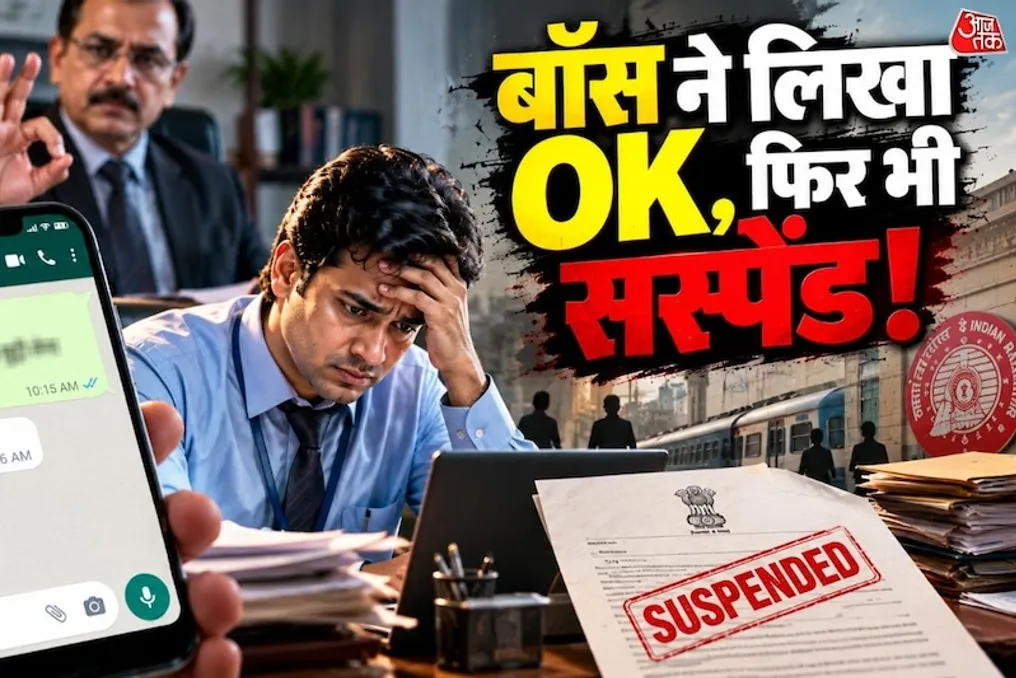
Many employees contact their supervisors via WhatsApp to request leave. Upon receiving an 'OK' reply from the manager, they assume the leave has been approved. However, the question arises: can a simple 'OK' on WhatsApp be considered official leave permission? This issue was raised in connection with the case of a railway employee.
The employee claimed that his senior supervisor had given consent for an additional two-day leave through WhatsApp. Nevertheless, when he returned from vacation, he was suspended from work. He was later also transferred to another position. The employee challenged this decision, but the tribunal rejected his petition.
The tribunal ruled that an 'OK' received on WhatsApp is not, by itself, irrefutable proof that the leave was officially approved.
This incident involves Priya Ranjan Kumar, an employee of the North Central Railway who worked in Prayagraj. According to the employee, he took three days of leave from July 14 to July 16, 2025, to visit his native village. He then messaged his senior supervisor on WhatsApp to extend the leave for July 17 and 18. The employee claimed that the supervisor replied 'OK', which he interpreted as permission for the extra two days off. He also informed another supervisor about this over the phone. However, the railway administration stated that the responsibility for approving the leave during that period lay with another employee. According to the railway, following established procedures was necessary for official leave approval.
The employee stated that when he returned to work on July 21, 2025, he was suspended. Four days later, on July 25, he was transferred from Prayagraj to Fatehpur. Then, on July 31, he was served with a charge sheet related to disciplinary action. The employee appealed his transfer, arguing that the actions against him and the transfer were due to the leave dispute. On the other hand, the railway explained the transfer by stating that a new reception and booking office was being developed at the Fatehpur railway station, and staff were required to work there. The railway cited this administrative necessity as the reason for the transfer.
The Central Administrative Tribunal (CAT) in Allahabad stated during the hearing that an 'OK' received on WhatsApp is not sufficient evidence that the competent authority approved the leave. A competent authority is an employee authorized to approve leave according to the rules. The railway side argued that the relevant employee was undergoing training at the time, and another employee with approval authority was handling the department's affairs. The railway also noted that the established official procedure for obtaining leave was not followed.
After considering the railway's arguments, the tribunal concluded that the employee could not prove solely based on the WhatsApp 'OK' that his extended leave had been officially approved.
The employee also claimed that his transfer was not due to routine administrative necessity but was intended as retaliation. However, the railway informed the tribunal that staff were needed for the new booking office in Fatehpur, and the transfer was made for this specific reason. The tribunal accepted this argument from the railway because no convincing evidence was presented that the purpose of the transfer was to punish the employee. Subsequently, the tribunal dismissed the employee's petition on October 7, 2026, upholding the transfer decision.
This case is important for employees who rely solely on WhatsApp messages when extending or obtaining leave approval. Even if a manager replies 'OK', it does not always signify official leave approval, especially if the responding employee lacks the authority to grant leave. Therefore, before extending leave, it is crucial to ensure that the permission is granted by the correct person and that established office procedures are followed. It is also advisable to check approval records in official systems such as the HMRS portal.