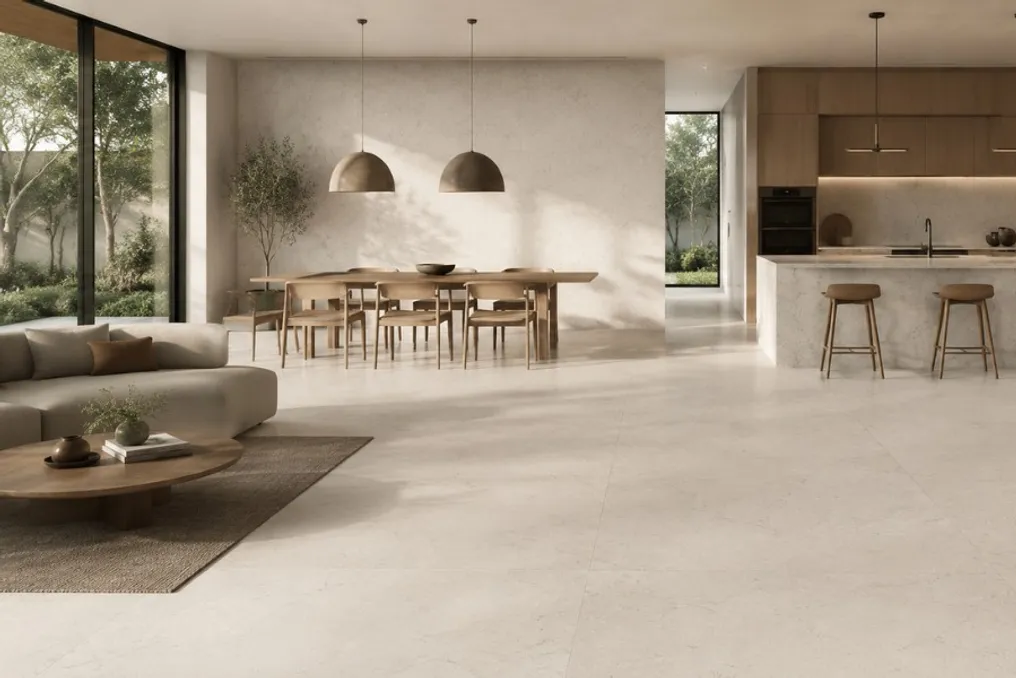
The growing demand for environments that establish a greater connection with natural elements has influenced various design decisions, from color selection to the materials used in residential coverings. In this context, stones are being reinterpreted, expanding their presence beyond floors and countertops to now include walls, panels, facades, and outdoor areas.
This expansion has enabled a wider range of patterns and finishes. Materials such as quartzite, travertine, limestone, and rocks with a more rustic appearance serve as models for coverings with very varied characteristics. While some stand out due to strong veins and color contrast, others display straighter designs, delicate tones, or more prominent textures. Understanding these distinctions is crucial for defining the role the surface will play in the project, whether as a central element or as a base for the other components of the space.
The Neolithic Natural 120x120 line, produced by Roca Cerámica, exemplifies a more expressive approach to this universe. This collection is inspired by the changes caused by the passage of time on rocks, incorporating marks and veins that give dynamism to the surface. In larger formats, the pattern gains space to manifest with less interference from joints, allowing it to be applied to floors, walls, panels, and other interior surfaces.
In contrast, travertine presents a different aesthetic. Its typically more linear designs, along with its tonal variations, result in a softer reading surface. This characteristic allows stone references to be used in adjacent environments without exactly replicating the same impact, enabling the choice between a more striking or a more subtle language according to the proposal.
The Navona Natural ABS 120x120, from Roca Cerámica, was conceived with inspiration from Italian travertine marble and demonstrates how this reference can be used in outdoor areas. Its ABS version has a specific finish for such locations and low water absorption, allowing its installation on balconies and other spaces exposed to climatic conditions. Furthermore, the tone and design of the surface facilitate harmonization with wood, vegetation, and landscaping elements.
At Vilarejo stores, the physical comparison of pieces in different sizes helps in perceiving details that are not always visible in photos or small samples. The proximity of the surfaces, the observation of the designs, and the evaluation of the finishes help better understand how each reference can contribute to the composition before the final decision on the material.
Although quartzite, travertine, limestone, or a rougher stone may derive from the same natural source, each tells a distinct narrative within an environment. It is this diversity that has expanded the use of stones in architecture, opening paths to take them from the floor to the walls and from the interior to the exterior of the building.