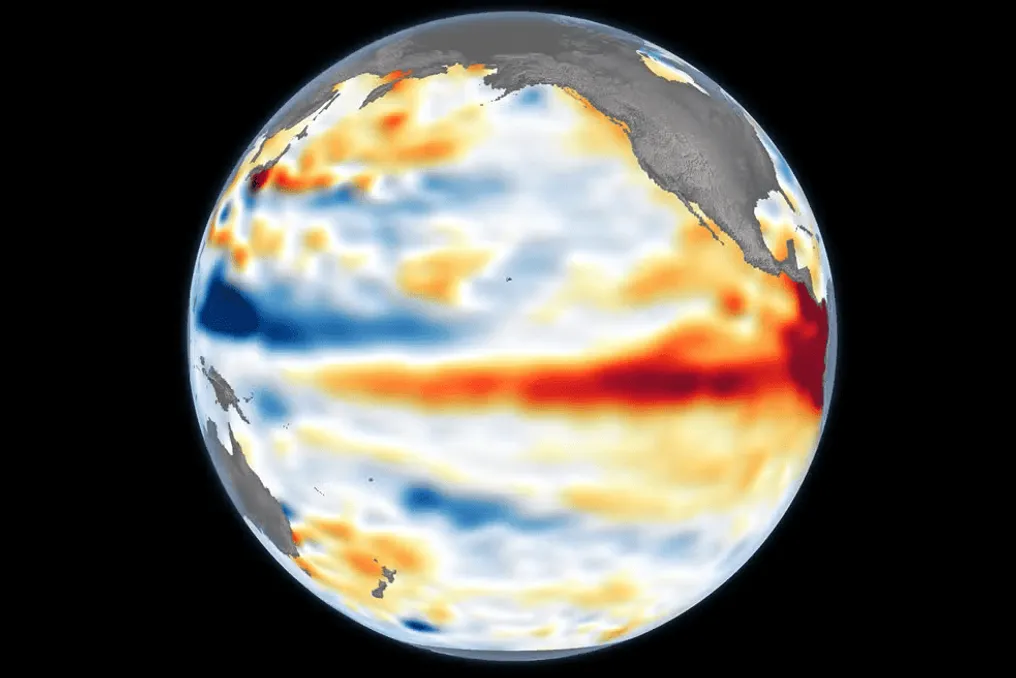
Scientists have identified a method capable of determining the reliability of El Niño and La Niña forecasts with a horizon of up to one year. This new discovery has the potential to improve warnings about extreme weather events, granting more time for communities and authorities to prepare against droughts, floods, and other environmental consequences.
The study, published in the scientific journal Science Advances this Friday (23), analyzed a set of over 7,500 historical forecasts generated by climate models from nine countries. The researchers concluded that the conditions observed in the Pacific Ocean at the time a forecast begins significantly affect its accuracy in subsequent months.
The most relevant finding demonstrated that forecasts initiated under La Niña conditions maintained a good level of performance, even when attempting to anticipate the behavior of the climate system for an entire year. In contrast, those forecasts that began under neutral conditions proved considerably less reliable.
El Niño and La Niña represent opposite phases of the phenomenon known as the El Niño-Southern Oscillation (ENSO), a natural climate pattern linked to variations in the sea surface temperatures of the tropical Pacific. These changes impact atmospheric circulation, potentially altering rainfall and temperature patterns in various parts of the globe.
Although these events generally peak around December and can be predicted with certainty about six months in advance, projecting them over longer periods remains a scientific challenge.
The research indicates that monitoring the initial state of the ocean helps distinguish between forecasts with a higher chance of being correct and those that require greater caution. According to Mandy Freund, a co-author of the study and a researcher at the University of Melbourne (Australia), the stable performance of forecasts initiated during La Niña suggests that these circumstances make the tropical Pacific system more predictable over the following year.
The ability to anticipate these phenomena with greater certainty can assist governments, emergency services, and populations in planning preventive actions, organizing resources, and mitigating risks. However, scientists emphasize that there are still steps to complete before this discovery can be directly implemented in daily forecasts, although the study already offers a path to refine alert systems and increase preparation time for seasonal climate changes.