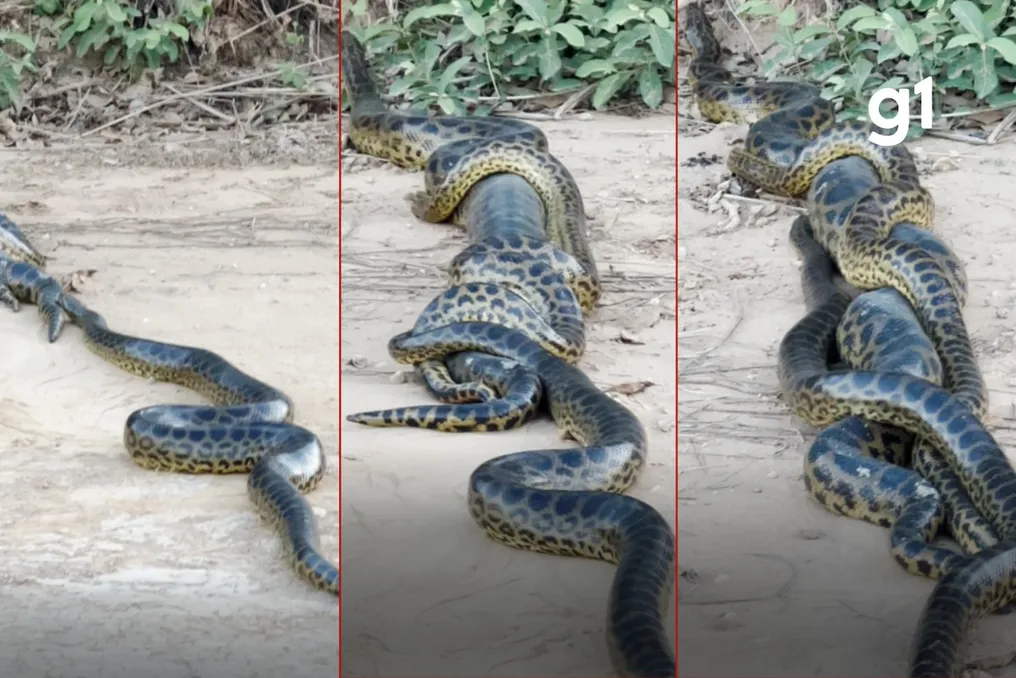
Three anacondas intertwined during mating impressed tourists traveling along the Transpantaneira—a road connecting Poconé with the settlement of Porto Jofre in the state of Mato Grosso.
This incident was recorded in recent weeks by Peruvian tour guide Lorenzo Cauana, who was accompanying a couple from the Netherlands and a young Australian woman.
The video shows one of the snakes crossing the road toward two others that were already intertwined, joining what is known as the 'anaconda bouquet.'
According to Lorenzo, the group was in a vehicle when they noticed the animals. Although encounters with animals crossing the Transpantaneira are part of the routine excursions, he noted that he had never seen such a scene, even after many years working as a guide, including in the Amazon.
He recounted: 'It's normal to see animals crossing the road, so we always drive at 20, 30, maximum 40 km/h. When we saw the anaconda, we slowed down to watch. One of them returned to the thicket, and I thought I lost the footage, but it came back onto the road, and to our surprise, another appeared that was mating with it.'
Initially, Lorenzo assumed he was seeing a mother with offspring. However, continuing to observe, he realized the mating behavior. The surprise intensified when a third anaconda emerged from the forest and joined the other two.
He concluded: 'It was a unique experience that I will never forget.'
It was noted that female anacondas can reach lengths of 6 to 7 meters, while males rarely exceed 2 meters.
Why do snakes form 'bouquets'?
The formation of groups of intertwined snakes can occur during the breeding season. In a recent interview, biologist Angelica Gomes da Silva explained that females release pheromones capable of attracting several males.
When multiple animals compete for the opportunity to mate with the same female, so-called 'snake bouquets' or 'mating bouquets' can form.
The biologist also advised not to disturb the animals, even if they are displaying potential reproductive behavior. Approaching them can trigger a defensive reaction and affect the species' natural behavior.
Reproduction and offspring
According to Luiz Eduardo, females are capable of producing about 30–40 offspring from the semen of different males. Another interesting fact is the lack of parental care among snakes.
He explained: 'After the anaconda lays eggs, it leaves; no one cares for them. They usually produce many offspring so that at least one can grow to adulthood. The only groups that care for their young are mammals and birds.'
He added that the large number of offspring is due to the absence of such care. Since there is no parental supervision, many offspring are born to increase the chance of at least one surviving to adulthood. He compared this to humans, whom he called 'the best parent in nature'; humans usually give birth to one offspring because the level of care is high, and the chance of survival is greater.