Mid-size pickup trucks are increasingly resembling passenger cars for drivers, but their main focus remains cargo transport. The structure, built with a chassis separate from the body, gives these vehicles superior resistance compared to monocoque models.
In Brazil, legislation requires a pickup truck to have a minimum load capacity of 1 ton to use a diesel engine, and all mid-size models sold in the country exceed this requirement. For a fair comparison, models with a double cab and automatic transmission were selected, as these are standard configurations in all mid-size pickups available on the market.
Models with Highest Load Capacity
The JAC Hunter is pointed out as the mid-size pickup with the highest load capacity available in Brazil. The version sold in the country uses the reinforced chassis from the electric edition, combined with a 2.0 diesel engine, achieving a capacity of 1,400 kg. This value surpasses competitors by 296 kg compared to the second-place model, although it is notable that the running of this model is quite severe.
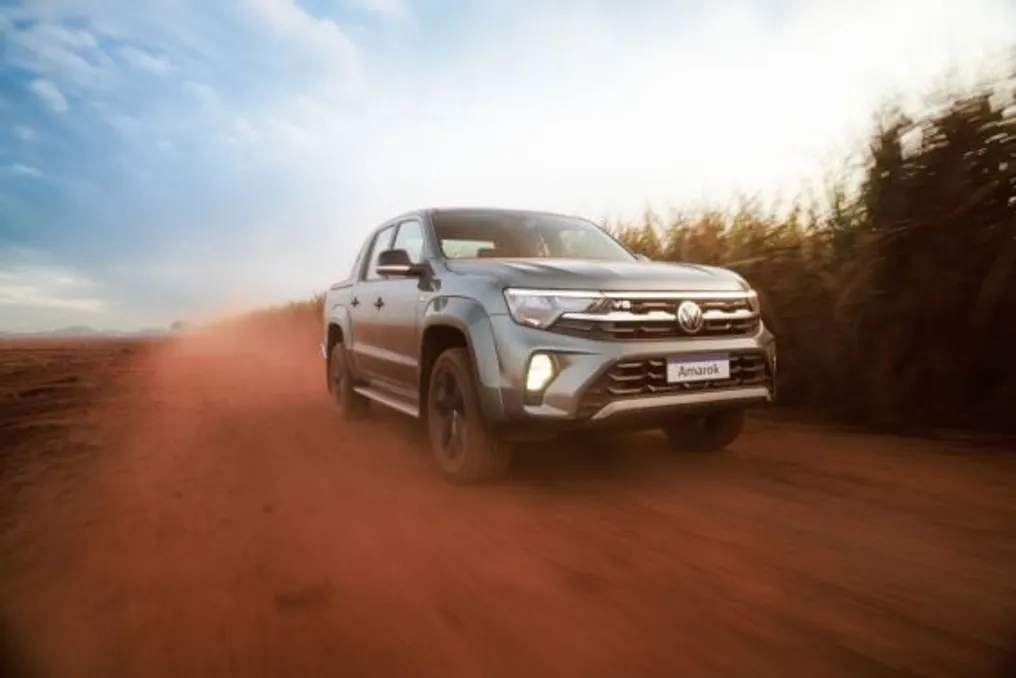
The Volkswagen Amarok, despite being near the end of its line, still stands out in aspects such as performance, handling, and load capacity. This mid-sized Volkswagen vehicle can carry 1,104 kg while maintaining comfort, providing the driver with a sensation similar to that of a sedan.
The Chevrolet S10 received an update in 2024, incorporating a more comfortable suspension adjustment. This improvement did not affect its load capacity, which is established as the third largest in the national market.
Another model praised for its level of comfort is the Ford Ranger. This vehicle is seen as a standard in technology, features a competent V6 engine, and supports up to 1,023 kg of payload.
The Fiat Titano attracts attention by having a slightly larger size than the other mid-size pickups. In weight tests, it registers a capacity for 1,020 kg of load.
The Ram Dakota shares mechanics, chassis, body panels, and other components with the Fiat Titano, presenting identical technical specifications in both performance and load capacity.
The GWM Poer P30 was launched in Brazil with local production, offering good equipment and competitive prices. In terms of work, it slightly exceeds the 1-ton mark.
The Kia Tasman is among the last mid-size pickups on the list exceeding the 1,000 kg required by law for diesel engines. This model had a recent debut and presents a controversial design, but it is pleasing in terms of interior experience and mechanical assembly.
There is a triple tie between three mid-size pickups that can support exactly 1 ton. The Mitsubishi Triton can carry 1 ton in all its versions, including the GL model, which uses four springs on the rear axle, unlike the three used in the more expensive versions.
The Foton Tunland, a little-discussed Chinese mid-size pickup, has dimensions comparable to large North American pickups. However, it only supports 1 ton, and its performance is below the segment average.
The Toyota Hilux leads the mid-size pickup segment, recognized for its mechanical durability. Double cab models with automatic transmission reach a capacity of 1 ton when loaded.
Finally, the BYD Shark is the only generalist mid-size pickup in Brazil that does not use a diesel engine; it is a gasoline plug-in hybrid model. Due to its considerable weight even empty, its load capacity is limited to 790 kg to stay within the Gross Vehicle Weight (GVW) of 3.5 tons.