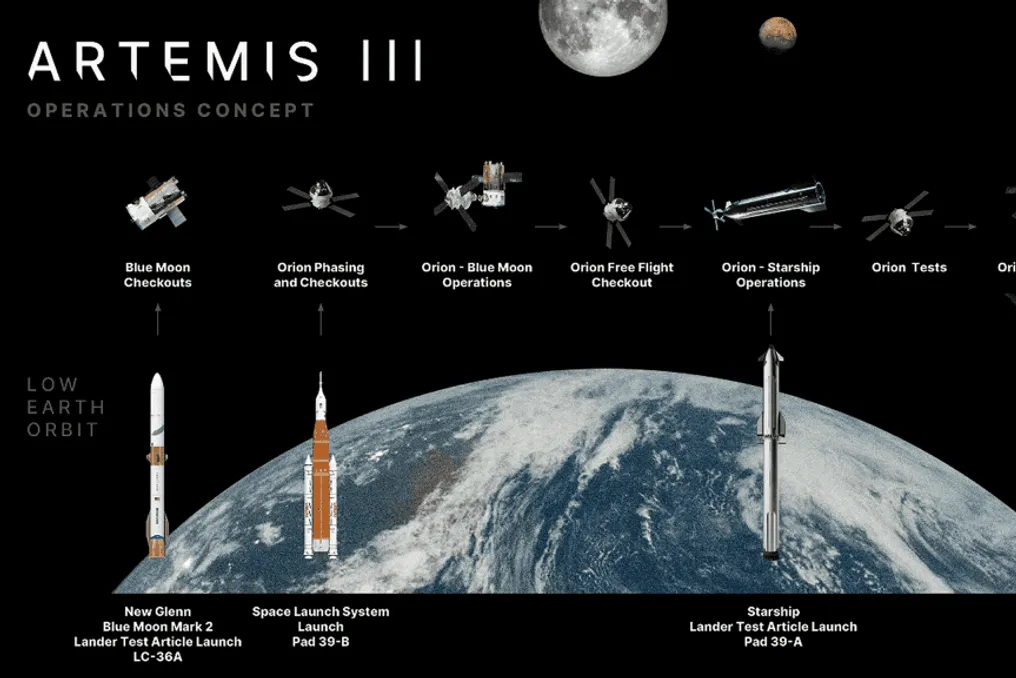
NASA confirmed this Friday (23rd) its commitment to returning astronauts to the lunar surface in 2028, detailing the subsequent stages of the Artemis program. During a press conference held at the Kennedy Space Center in Florida, USA, agency administrator Jared Isaacman also made provocative comments about the space history of the two countries, the US and China.
The presentation, titled Artemis Acceleration, focused on preparations for the Artemis 3 mission, scheduled for 2027, and the efforts required to achieve Artemis 4, which is expected to bring crew members back to the lunar surface. NASA expressed its intention to accelerate work to ensure compliance with this return-to-the-Moon timeline.
Isaacman commented that China achieved its equivalent of the 'John Glenn moment,' meaning its first crewed orbital spaceflight, only 23 years ago, referring to 2003. In contrast, he pointed out that the United States had already won the first space race, conducting six crewed landings on the Moon and completing 113 missions with the Space Shuttle before the first Chinese crewed flight.
Despite this, Isaacman acknowledged the significant advancement of the Chinese space program since then, mentioning that it now encompasses hundreds of satellites intended for communication, Earth observation, and military purposes.
This statement comes amid the competition between Washington and Beijing for supremacy in lunar exploration. While China plans to conduct its own crewed lunar landing by 2030, the United States aims to return to the lunar surface before that deadline.
The goal of sending people back to the Moon is linked to Artemis 4, planned for 2028. This mission will use the SLS rocket and the Orion capsule to transport the crew to the lunar area, where the transition to a commercial lander will occur. The selection of the landing system will depend on the development of the lunar modules and the results obtained during Artemis 3. Companies such as SpaceX and Blue Origin are developing their own solutions for transport between lunar orbit and the surface.
If the schedule is met, Artemis 4 will represent the return of humans to the lunar surface for the first time since the Apollo 17 mission, which took place in December 1972. The Artemis program integrates the United States' plans to expand its presence on the Moon and prepare for future crewed missions to Mars. Furthermore, NASA aims to establish a sustainable human presence on the Moon through progressively more complex missions.