On the anniversary of Manaus' 357th birthday, the Rio Negro continues to be a vital source for the city despite all transformations. A complex system is in place to draw water from the river and deliver it to the taps of over 2.2 million people, and this system is currently facing its greatest challenges due to climate change.
The history of this system is told by people who work daily to maintain it, such as Simone Santos, who serves as a supervisor of electromechanical maintenance at Águas de Manaus. He has been in the basic sanitation sector for ten years. Before joining this concessionaire company, he worked as a welder after gaining experience at the Mane Garrincha stadium in Brasília and various industrial plants.
Simone recalls: 'I never worked in the sanitation sector before. Previously, I was just someone who drank water but didn't know where it came from or how it was produced.' His curiosity about understanding the entire water journey, from intake to tap, prompted him to stay and grow with the company precisely when the system was undergoing its most serious test.
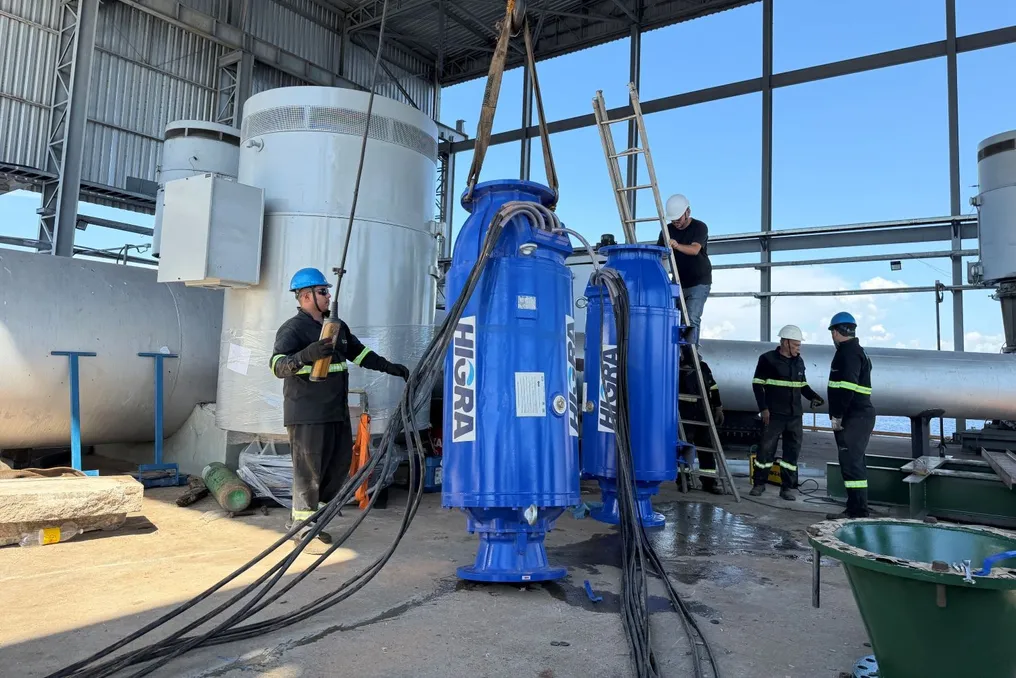
In 2024, Manaus experienced the harshest drought in the last 120 years, when the Rio Negro level dropped to 12.11 meters. To allow the city to pass through the period of low water levels without compromising water supply, unprecedented solutions had to be developed, such as lowering the pumps used for water intake. Of the sixteen vertical pumps installed in the river, thirteen were lowered during a complex operation involving divers and specialized equipment operating on structures some dating back to the 1960s.
This project became a turning point for Simone, who wanted to contribute and ended up leading this effort. The work, which lasted about five months, included a technical study that showed that the efficiency of amphibious pumps, used for draining flooded cities during the flooding in Rio Grande do Sul that year, could be applied in reverse in Manaus—for drawing water from the river during the receding level.
He summarizes: 'This solution was born for the drought but was ultimately integrated into our system. It was a project that succeeded so well that it provided supply to other areas facing emergencies.' He also added that this work served as a model for what was developed this year during the drought, when the concessionaire acquired two more amphibious pumps to strengthen water intake in Ponta das Lajesh, which supplies the East and part of the North zones.
The structure attracted the attention of even the manufacturer, and employees from other concessionaire companies visit the factory to study this project. Simone shares: 'For outsiders, it was an innovative piece of work, with a reliable supply structure that had to be completely adapted in this extreme scenario. We have a lot of experience sharing with other companies that want to understand how this work was done.' He also noted that this operation marked a new step in his professional life: 'I started viewing the project not only as a way to perform welding work but also as an opportunity to learn what I could achieve professionally, and that helped save Manaus in some way.'
The 2024 drought represents one of the latest challenges for Manaus' water supply. However, to understand how much the system has changed over time, one must look further back into the past. Fifty years ago, in the capital's sanitation sector, engineer Jalma Sobrinho closely monitored the transformation of structures and the increase in water intake capacity.
He recounts that the Ponta do Ismael station was designed for a flow rate of 1.8 cubic meters per second. 'PDI operates at approximately 5-6 cubic meters per second. At the beginning of the last century, intake was carried out by gravity and depended on high river levels. Today, floating structures and planning are required because the river is dropping more than before,' he notes.
Jalma reminds that the logic has always been to pre-treat the water from the river before purification. 'Water from the Rio Negro contains many organic substances and suspended solids, as well as a very low pH level. For a reaction to occur, we need to raise the pH,' he explains.
Among the numerous changes remain traces of those who started it all. A 1909 plaque still stands at Ponta do Ismael, marking Manaós Improvements, a British company that implemented the city's first modern water supply system. Designer Anderson Oliveira, who has worked in Manaus sanitation since 1996, adds to this story: 'We also had boilers, some English-type pumps, but they were quickly replaced. These iron structures remain strong.'
Since 2018, Águas de Manaus has been transforming the sanitation of the Amazonian capital. In eight years, the city has achieved universal water supply for more than 2 million people. Now, this process is being repeated for the sanitary sewage system, which serves 42% of the population and must also be universalized in less than 10 years. This change is built upon the support of successful past initiatives and takes into account innovative directions that allow for the delivery of a complete sanitation system to vulnerable areas.