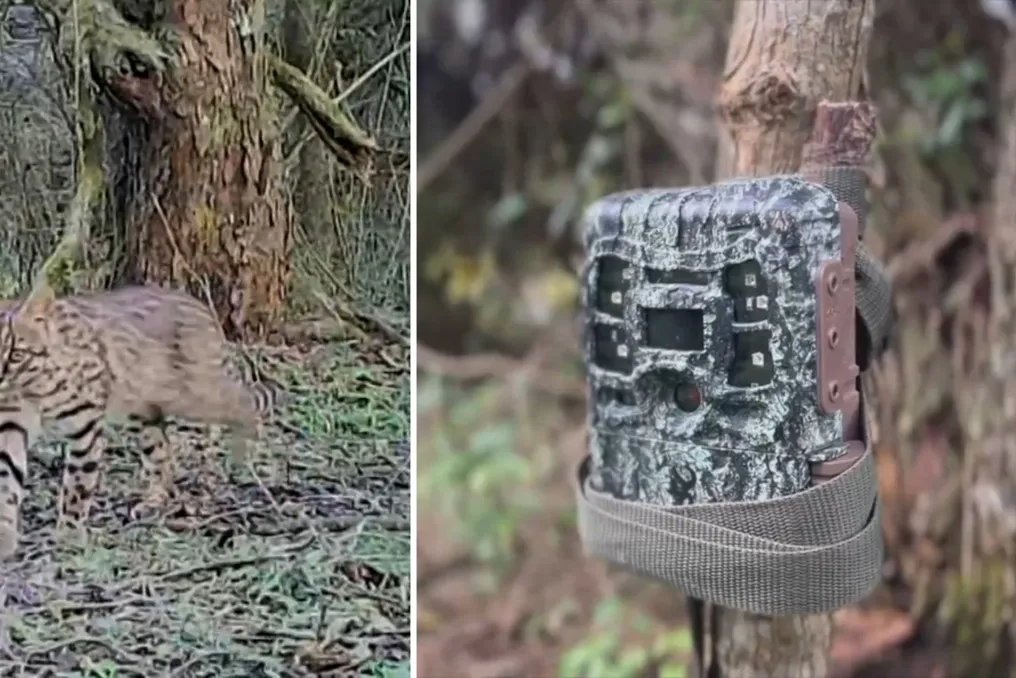
Researchers from the Federal University of Rio Grande do Sul (UFRGS) installed 18 camera traps in the Espinilho State Park, located in Bara-du-Quaraí, to monitor wildlife and identify predator species characteristic of the Gaucho Pampas that are endangered.
The cameras were distributed with an interval of about one kilometer from each other and operate based on motion sensors. Thanks to infrared technology, the equipment records images even at night, without using a flash.
The recordings have already captured various species inhabiting this protected area, including the spotted tapir, raccoon, grassart-do-campo, grassart-do-mato, emu, otter, and a family of capybaras. Images of a large black forest cat were also captured.
This monitoring is part of the Pampas Predators Project, developed by UFRGS researchers. To install and collect the equipment, teams traverse fields and areas of dense vegetation.
According to postgraduate student Mariana Guimarães Xavier da Costa, 18 cameras were installed in the park to determine the species present in the region. She noted: 'We put them here to understand a bit what species are found.'
In addition to revealing animal habits, the collected recordings can contribute to studying reproductive behavior and species distribution. One of the main goals of the research is to confirm the presence of predators inhabiting the biome. According to the project, at least four species may be found in this area.
Currently, the cameras have not recorded the Pampas palm cat. According to scientific researcher and professor Flávia Pereira Tirelli, this species depends on the preservation of local grasslands for survival.
She emphasized: 'The Pampas palm cat is a species that needs pastures. Therefore, things like soy or rice, monocultures throughout the region, are very harmful to a species that needs grassland to survive. And the park here is an area that can protect such species.'
Espinilho State Park, influenced by Argentine Espinilho, is home to an ecosystem considered rare in the state of Rio Grande do Sul. According to the area manager, Bruno Carvalho Fernandes, the territory retains signs of an environment that was previously more widespread in the state.
In addition to academic research, the data collected within the project will be transferred to the park administration to guide conservation strategies. Flávia Pereira Tirelli stated: 'We are also transferring this database to the park because this way managers, staff, and state officials can know where critically important species are, such as the Pampas palm cat, and how local protection can be carried out for this species.'