Following the previous analysis, this chapter focuses on other sports vehicles, both manufactured and imported, that were introduced in Brazil during the period between 2007 and 2017, a decade marked by the diversity of automotive with sporty characteristics.
It is essential to contextualize this period due to the opening of imports, which generated a similar scenario. In 1990, the Collor government authorized the importation of cars (forbidden since 1976), applying a high tariff of 85% on the Import Tax. In June 1993, this rate was significantly reduced to 35%, facilitating the entry of more compact models, not only luxury or renowned sports ones, but also stimulating the arrival of generalist foreign brands focused on more accessible segments, including small Japanese and French sports cars. Later, in September 1994, the tax fell even further to 20%, coinciding with the currency conversion to the Real, which initially had parity with the dollar.
This tax reduction was extremely beneficial for importers, resulting in an avalanche of vehicles of various origins and types in the country. It was possible to acquire a brand new Alfa Romeo 164 for the same price as a new Chevrolet Omega CD, even though they were cars for distinct audiences. In 1990, the Italian Alfa Romeo was quoted at about US$ 130,000.00, and this discount margin benefited almost all vehicles in this early open market.
However, the fiscal benefit negatively impacted the trade balance, as the country began importing much more than it exported in the sector, harming the national industry already established for decades. For this reason, at the beginning of 1995, the tariff returned to rise to 35%, reaching 70% from March, with the objective of controlling the outflow of dollars.
This brief economic and political overview serves to explain the approach of this material: while imported options in the nineties were varied and attractive, they presented fiscal instability, causing prices to fluctuate greatly, and the availability of cars depended directly on governmental decisions. A little later, with the official imports sector more mature and new factories installed in Brazil, it becomes fairer to evaluate the true sports cars available to the consumer.
Peugeot 208 GT (2017-2019)
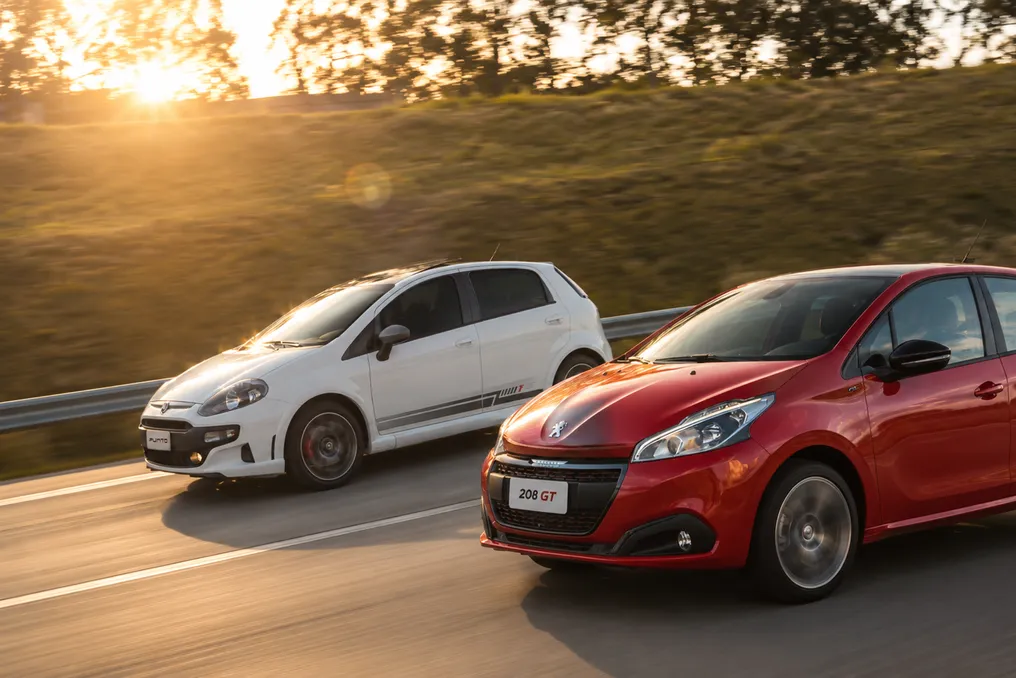
The Peugeot 208 GT is a highly sought-after model by readers, deserving special mention. There has always been an enthusiastic public for small Peugeots, and the GTI acronym was also relevant to the brand (as well as Volkswagen, which introduced it in the Golf in 1976). Even the most conventional models possessed dynamic and vibrant behavior. When the 206 arrived in Brazil, its cornering performance attracted as much attention as its modern and innovative design; it was agile and responsive on asphalt, and on dirt roads, its free rear axle provided fun and surprises to unsuspecting drivers. Regardless of the engine, the 1.0 16v worked with great vigor, the 1.6 8v was economical and smooth, and the 1.6 16v pleased the more hurried. In the WRC, the small 206 achieved two consecutive titles, elevating the vehicle's image.
After many years, this discreet sporting vein materialized in the 208 GT, launched in 2017. The significant advance occurred with the incorporation of the 1.6 THP FLEX engine (PSA/BMW), originating from the 2008 compact SUV/crossover. This powerful turbo engine, combined with a manual transmission, was unusual for the proposal and gained notoriety on the Acelerados channel when used by former Brazilian F1 pilots in speed tests. Although sharing the same platform, the 208 differed from the 2008, presenting visual improvements with an exclusive front bumper, 17-inch wheels, and a rear spoiler. The dual exhaust outlet signaled the more powerful engine (173 hp at 6,000 rpm with ethanol), and its performance figures were impressive: 0 to 100 km/h in 7.6 seconds and a top speed of 220 km/h, surpassing direct competitors such as the Sandero R.S. (more affordable) and the Suzuki Swift Sport (slightly more expensive).
It behaved similarly to the current Pulse Abarth, but offered the advantage of involving the driver in a more fun process due to the need for manual shifts. The set was completed by a small steering wheel, raised dashboard, powerful engine, and an elegant body, in addition to a suspension tuned for greater firmness and precision on an already solid base.
Although it was a car that would be desired by many, it had a short lifespan, lasting only two years. Currently, there is a 208 GT in 2026, but it follows the line with the 1.0 engine and automatic transmission from Fiat, without the special character of the first GT. If it had a manual transmission, it would at least better emulate the original, being more accessible and easier to maintain. However, the preference for three pedals has decreased currently.
Citroën DS3 2012-2017
The Citroën DS3 could be seen as an 'imperfect twin' of the Peugeot 208 GT, if both were simultaneously available on the market. When the DS3 stopped being imported, its successors had to settle for a car from the same group, with a similar engine and commitments. Due to the modest commercial success of the Peugeot, there was no total acceptance, as Peugeot and Citroën consumers, at least in past decades, had distinct perceptions.
The idea of a 'twin' is just a simplified marketing attempt, because, besides the engine, there was little similarity between the two sports cars. The DS3 maintained elements of the eccentricity characteristic of the original brand: floating roof over a two-door body, configurable pillars, and a vast range of interior and exterior finishes (including thematic stickers), making it bolder and more emotional than the more balanced 208. In a notable comparison on the Top Gear channel, the DS3 was pejoratively nicknamed 'sports shoe', and its extravagant colors and open personality likely fueled such a comment.
As the first model of the premium 'DS' line from Citroën in Brazil, this import had high aspirations, competing in the expensive and restricted niche of vehicles like the Mini Cooper and the Audi A1. The A1, in turn, had a limited presence in the country, selling little and still facing reservations due to its DSG automatic gearbox. The Mini Cooper was at a higher level in power, finish, and exclusivity, which made the French car even more attractive as a compact, beautiful, and powerful sports alternative.
The DS3 was a remarkable vehicle in itself, without needing external help due to the lack of similar alternatives at the same price. Its 1.6-liter THP engine had the capacity to generate torque at low RPMs and perform well at high RPMs, without depending on a small turbo that could restrict a similar-sized engine. With a six-speed gearbox—manual with satisfying and precise shifts, well-designed lever, and appropriately sized steering wheel—and front seats that functioned as true sports seats, wide and with excellent lateral support, the driving experience of a DS3 was pleasurable.
Its 165 hp were enough to challenge even the Fiat 500 Abarth, a smaller and lighter sports car. The thrust and liveliness of the engine brought smiles to the driver, and its grip on the asphalt was exemplary. It is regrettable the current absence of such cars at reasonable prices, around half the cost of a Type R or Yaris GR. The DS3 stopped being imported in 2017, and seeing it on the streets is a rare event; the remaining examples have often been modified, enhancing what was already excellent.
VW Fusca TSI (2013-2016)
During the retro wave of the early millennium, the New Beetle was one of the most popular models (in terms of price and impact) to arrive in Brazil, a country with a rich tradition of over 3 million Beetles. Like the original Beetle, most versions of the New Beetle did not have a sporty profile; it was a calm car, with a plant pot theme on the dashboard and a friendly appearance, as under its unusual body was a Golf IV. Therefore, there was no rear-wheel drive nor real risk in curves above the speed limit or common sense. The car behaved like a normal Golf within appropriate limits, and it is unlikely that anyone took it to extremes, given its gentle look.
Three years after the end of production in 2010, the New Beetle was renamed 'Fusca' in Brazil in its third generation, and the story changed drastically. Built on the PQ35 platform—the same used by the Golf and various VW and Audi compacts and mid-size cars—it incorporated an emblematic component of the Wolfsburg house: the two-liter TSI engine (direct injection turbo), responsible for the robust and constant performance of the Golf GTI and Jetta GLI. There was a departure from modest engine economy, as this version was created to accelerate the enthusiasm of Brazilian enthusiasts, configuring a 'Fuscão 1600S' of the new millennium, with 200 hp and performance capable of competing with the Audi A3 and Mini Cooper, surpassing most sports cars of the time.
The design also underwent changes, abandoning the traits of the original Beetle and seeking a resemblance to the Porsche 911. Rounded shapes gave way to more defined lines, the roof became lower, and the A-pillar straighter. Internally, it lost some of the air, lighting, and visibility of its predecessor, but this was compensated by a more compact, sporty, and luxurious cockpit. The windshield was not as far from the driver as in the original Beetle, and the ergonomics were improved with seats and controls more focused on function than aesthetics. The large accelerator pedal, the complete dashboard, and a good-grip steering wheel helped the driver get into the speed mood.
With the DSG transmission, the feeling was similar to that of the Golf GTI: fast and precise, facilitating difficult overtakes and accelerating well. The distinctive interior of the Golf conveyed the impression of driving something unique. The exhaust noises, the easily accessible power and torque, the precise steering, and an agile and stable platform on the roads, all wrapped up in an inspired look, appealed to those looking to escape the monotony of traditional sports cars. Perhaps the best feature was the possibility of combining the two-liter turbo engine with a six-speed manual gearbox, an exclusive privilege of VW, not offered in the Golf or Jetta. Although I never drove this specific configuration, one wonders about the enormous potential for fun of a manual Fusca TSI.