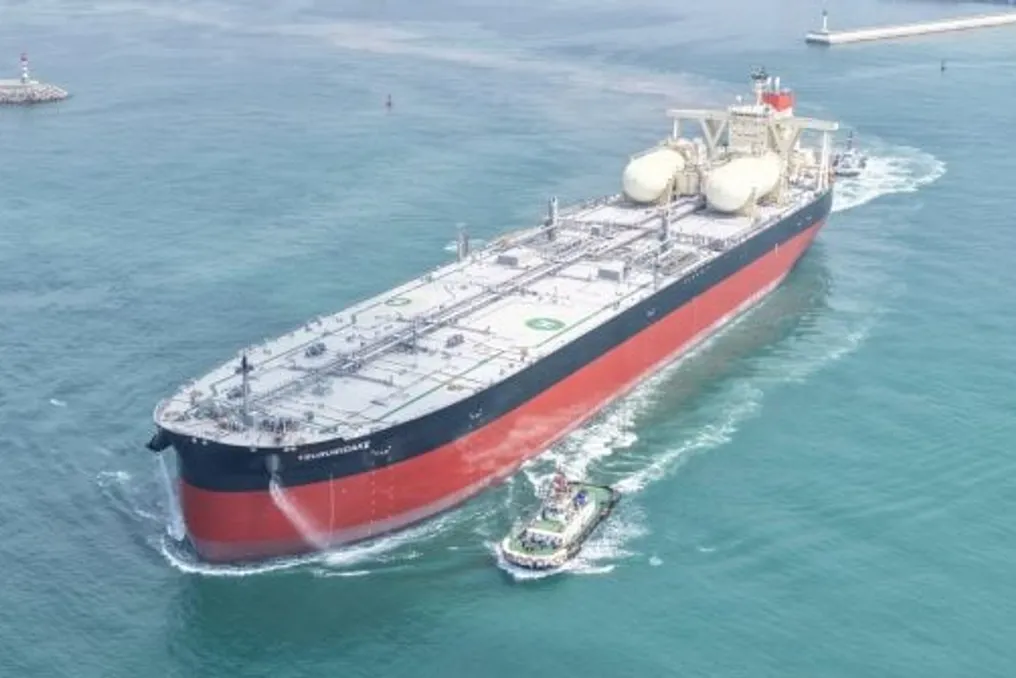
Kawasaki delivers 340-meter oil tanker powered by liquefied natural gas
Read more
AutoPapo
autopapo.com.br

Kawasaki delivers 340-meter oil tanker powered by liquefied natural gas

Kawasaki Heavy Industries, the Japanese conglomerate that owns the motorcycle manufacturer of the same name, has completed the delivery of a large oil tanker capable of operating using natural gas. This ship, named Tsurugidake, is the group's fourth Very Large Crude Carrier (VLCC) to be powered by liquefied natural gas (LNG).

The delivery ceremony took place on October 14th, and the vessel was transferred to the shipping company Sequoia Navigation. The handover was conducted at the shipyard maintained by Kawasaki in partnership with the Chinese company Cosco, located in Dalian, China.

With dimensions of 339.50 meters in length—equivalent to more than three football fields side by side—the ship has holds with a capacity to store 352,151 cubic meters, which corresponds to approximately 2.2 million barrels of oil.

In terms of design, the hull was modified with a redesigned bow, replacing the conventional bow bulb, aiming to reduce wave resistance. The main engine, characterized by low speed and extremely long stroke, operates in conjunction with a large diameter propeller to optimize fuel consumption.

The engine, manufactured by MAN, has seven cylinders and a displacement capacity of about 13 thousand liters, and it is dual-fuel. It can use LNG or low sulfur fuel oil (LSFO). Each piston in this engine measures 80 cm in diameter and travels 3.72 meters inside the cylinder.

According to information provided by Kawasaki, the use of LNG results in significant emission reductions: carbon dioxide ($ ext{CO}_2$) decreases by between 25% and 30%, nitrogen oxides ($ ext{NOx}$) drop by about 85%, and sulfur oxides ($ ext{SOx}$) are completely eliminated when compared to engines running on heavy fuel oil.

Additionally, the ship is equipped with scrubbers installed in the exhaust of the engine and generators. These devices remove sulfur, allowing the use of conventional oil to remain compliant with current regulations since 2020, which contributes to reducing operational fuel costs.

The Tsurugidake meets the requirements of Phase 3 of the Energy Efficiency Design Index (EEDI), an international standard that stipulates that tankers ordered from 2025 must show a 30% reduction in $ ext{CO}_2$ emissions compared to Phase 0. The ship sails at an approximate speed of 15.45 knots (28.6 km/h), has a crew of 37 people, and flies the flag of Panama.

In Brazil, Kawasaki participated as a partner, holding 30% of the Enseada do Paraguaçu shipyard, located in Bahia. This shipyard was established with the purpose of building survey vessels for the pre-salt layer and was affected by the crisis known as Seven Brazil.
Similar stories

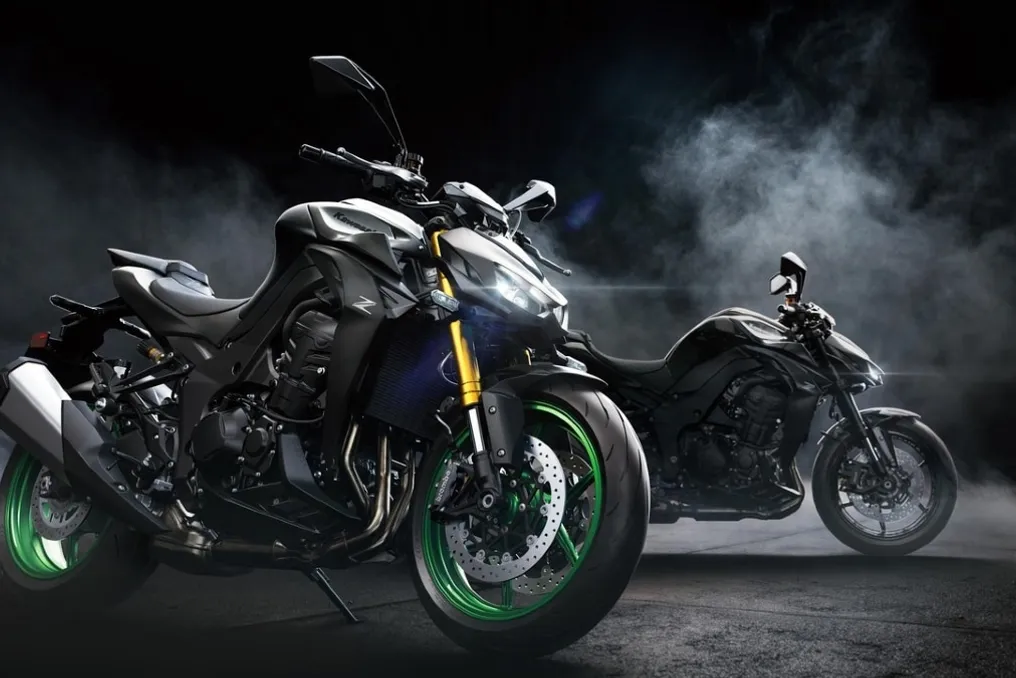
Kawasaki Z1100 updated and presented in India with powerful engine and modern features
Read more
www.aajtak.in

Kawasaki Z1100 updated and presented in India with powerful engine and modern features

Kawasaki has released an updated version of its powerful streetfighter motorcycle, the Z1100, in the Indian market, which is aimed at superbike enthusiasts. The company has not made significant changes to the design, engine technical specifications, or pricing policy of the new release.

The motorcycle remains available for 12.79 lakh Indian rupees, including exterior costs. The new Kawasaki Z1100 variant is presented in a single color—Ebony/Metallic Carbon Grey. Despite the lack of new technical improvements or features compared to the previous model, the introduction of new graphic elements or color options could give the bike a fresh look.

The Kawasaki Z1100 uses a liquid-cooled, four-cylinder inline engine with a displacement of 1099 cubic centimeters. This engine is capable of generating 136 hp and 113 Nm of torque. It is worth noting that this same engine is used in the updated touring motorcycle, the Versys 1100, although there it is offered with slightly less power and torque. In the Versys 1100, the engine produces 135 hp and 112 Nm. Such power levels are typically seen in compact cars sold in the Indian market.

Structurally, the Kawasaki Z1100 is equipped with a tubular diamond frame. The front suspension features a 41 mm diameter inverted (USD) fork with a travel of 120 mm. The rear is supported by a monoshock with back-linkage, featuring a travel of 136 mm. The front damping allows adjustment of compression and rebound, while the rear suspension allows setting of preload and rebound.

The braking system includes two 310 mm Brembo disc brakes in the front and one 260 mm disc brake in the rear. In terms of equipment, the Kawasaki Z1100 is fitted with a 5-inch TFT display. Additional features include a bidirectional quickshifter, cornering traction control, and dual-channel ABS. The traction control system has three levels, helping to maintain better control while riding.

The motorcycle also features cruise control and smartphone connectivity, making long journeys more comfortable and providing the rider with necessary information. The overall weight of the bike is about 220 kilograms, and the fuel tank capacity is 17 liters, which is quite advantageous for long trips. In the Indian market, the Kawasaki Z1100 competes with powerful models such as the Honda CB1000 Hornet SP, which is priced at 13.29 lakh rupees.

Popular