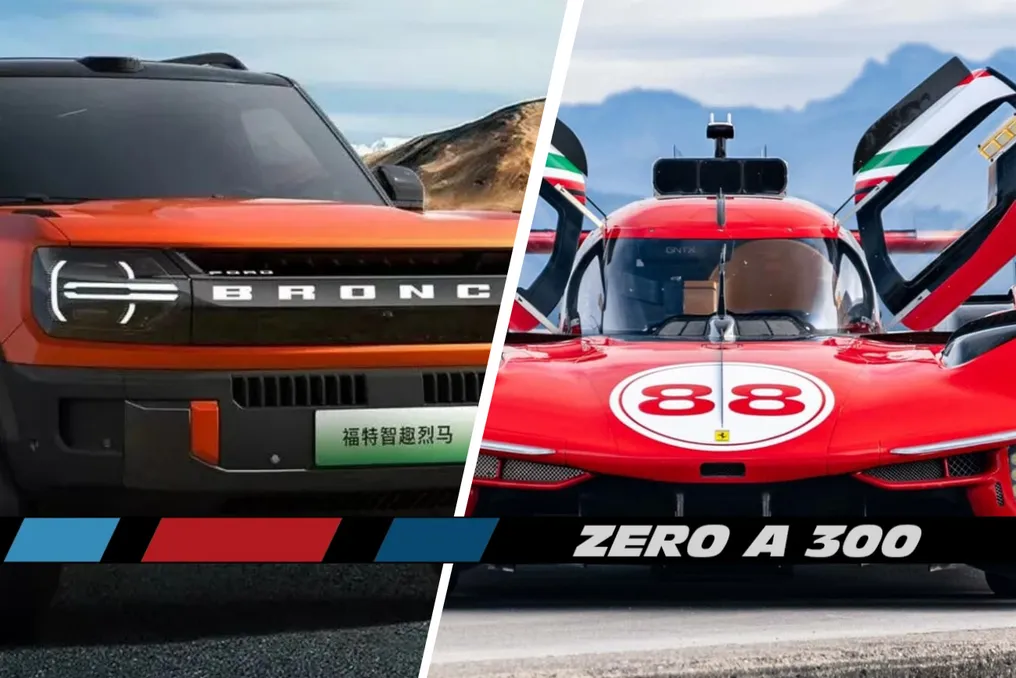
The Ford Bronco EREV, a Chinese-origin plug-in hybrid SUV, is scheduled to be launched in the Brazilian market in 2027. According to Autos Segredos, the manufacturer had already been evaluating the introduction of the vehicle to the country before making the final decision.
It is important to note that the Bronco EREV has distinct characteristics from the current Bronco models (which use the Ranger pickup chassis) and the Bronco Sport (which shares a base with the Maverick pickup). This new model was developed separately in collaboration with the Chinese company JMC, being designed from the outset to incorporate electrified propulsion systems.
Its mechanical system combines a four-cylinder turbo engine producing 150 hp and 24.5 kgfm, along with two electric motors (one on each axle). The combustion engine functions only as a generator for the 43.7 kWh battery, while traction is provided by the electric motors, which generate 422 hp and 60 kgfm of torque. This configuration allows it to reach 100 km/h in 5.8 seconds, and the combined range can reach 1,220 km under the Chinese CLTC standard.
With dimensions of 5.03 meters in length and a wheelbase close to three meters, the Bronco EREV is larger than the Bronco Sport. Although values have not yet been disclosed, its cost is expected to exceed the R$ 250,000 requested for the smaller model, given its unprecedented hybrid technology in the local market.
Modified Ferrari 499P goes to auction and could exceed R$ 40 million
A notable opportunity has arisen for Le Mans prototype enthusiasts: the auction house Christie will sell a Modified Ferrari 499P at its next event in Geneva, Switzerland. The required value to acquire this vehicle is around R$ 40 million.
The connection to Le Mans is substantial, as the Modified 499P is a variation of the prototype that won Ferrari at the 2023 24 Hours of Le Mans, marking the tenth Italian victory in the race and the first since 1965. In addition to maintaining a very similar look to the racing car, it shares the same mechanical package: a three-liter twin-turbo V6 plus a 272 hp electric motor.
Unlike the Hypercar prototype, which reached 680 hp, this Modificata achieves 706 hp, without being subject to FIA restrictions. It also features a 'push to pass' button that temporarily boosts power to 767 hp. The Christie example is practically new, having only been used in shakedown tests after leaving the factory. Whoever buys it will gain access to Ferrari's Sport Prototipi Clienti program, which offers specialized technical support.
Model Updates and Industry Criticisms
Volkswagen launched the 2027 line of the Polo, with the main change concentrated in the Track version, which now includes standard rear parking sensors. Additionally, the entry-level version received a new optional package for R$ 2,660, which includes touch-activated electric windows on all four doors and electric mirrors that fold down when reversing.
There were no significant aesthetic or mechanical changes in other versions. The Track and Robust variants continue to use the 1.0 naturally aspirated three-cylinder, 12-valve engine, producing 77 hp and 9.6 kgfm of torque with gasoline, or 84 hp and 10.3 kgfm with ethanol, always coupled with a five-speed manual transmission. The Sense and Highline versions use the 1.0 turbo flex TSI engine, which delivers 109 hp with gasoline and 116 hp with ethanol, maintaining 16.8 kgfm of torque, and uses a six-speed automatic transmission.
The prices of all versions have been readjusted, with increases ranging between R$ 300 and R$ 2,000. Specifically, Track and Sense went from R$ 96,690 to R$ 97,990; Polo Robust rose from R$ 112,990 to R$ 114,990; and the Polo Highline increased from R$ 138,690 to R$ 138,990.
Meanwhile, Nissan expressed concern over the growing volume of vehicle production in Brazil originating from imported kits from China. Ricardo Gondo, President of Nissan Brazil, pointed out that a large part of the growth in national production in 2026 comes from CKD and SKD operations, which use partially or fully disassembled vehicles with little local manufacturing.
Gondo detailed that although Brazilian production grew by 8.7% between January and September 2026, this number drops to just 2.5% if vehicles assembled from imported kits are excluded. Anfavea data corroborates this, indicating that about 123,000 of the 173,000 extra units produced compared to 2025 are the result of CKD and SKD assemblies, representing more than 70% of the production increase. The problem lies in the fact that these operations require fewer national components, reducing the activity of the local auto parts industry, since the complete sets are imported.
Despite the criticism, Gondo mentioned that Nissan is studying production via CKD or SKD, depending on industrial policies and government incentives. He assured that the Kicks and Kait models will continue to be manufactured normally at the Resende, Rio de Janeiro unit. In contrast, the Nissan factory in Resende saw its production increase by 29.5% in the same period, reaching 65,640 vehicles, while exports grew by 145%, with a goal of reaching 90,000 units by the end of the year.
Honda Racing Launches Preparation Parts for Street Cars
Honda Racing Corporation (HRC), Honda's competition arm, will begin marketing preparation parts intended for street cars. After announcing plans in 2024 and displaying a prepared Prelude at the Tokyo Auto Salon earlier this year, Honda confirmed that it will present its first line of components at the SEMA Show in November, with sales starting in March 2027, initially in the United States (facilitating import to Brazil).
The HRC Performance Parts catalog will include parts for the Civic Type R, Acura Integra Type S, and the Passport and Pilot SUVs. For the two sports cars, HRC developed 19-inch forged aluminum wheels in collaboration with the Italian company 2elle-engineering, supplier of the wheels for the Acura ARX-06 endurance. Each wheel weighs only 9.4 kg, representing a reduction of approximately 10 kg of unsprung mass compared to the original, in addition to being half an inch wider and having been tested at the Nürburgring.
At SEMA, Honda will also display prototypes of future items, such as adjustable suspensions, camber plates, Brembo brakes with six-piston calipers, and short shifter levers, although these are still in the development phase. All parts will be sold through Honda and Acura dealerships, and through the online store in the US. Prices and the possibility of expanding the HRC Performance Parts line to other markets have not yet been announced.
Toyota Proposes Recognizing Combustion Vehicles as Zero Emission in Europe
Toyota presented a proposal to the European Union aiming for combustion engine cars to be classified as zero-emission vehicles, provided they are exclusively fueled with renewable fuels. This suggestion was made amid discussions to relax the CO2 emission targets set for 2035.
The idea is to create a new homologation category called VEEF (Vehicles running Exclusively on Eligible Fuels). This classification would allow vehicles using only biofuels and renewable synthetic fuels to be categorized as zero emission. However, this does not imply the absence of exhaust emissions; the proposal focuses on considering emissions throughout the entire fuel life cycle, including its production, and not just what is expelled.
For this to happen, the fuels must meet the sustainability criteria defined by European legislation. Toyota is already testing this viability, participating in a pilot project in Spain with BMW, Bosch, and Repsol, using about 20 Toyota, Lexus, BMW, and Mini vehicles fueled with the renewable gasoline Nexa 95, derived from organic waste. These cars are conventional models, without mechanical modifications.
Bosch developed the Digital Fuel Twin system to monitor the exclusive use of renewable fuel, cross-referencing data from vehicles, gas stations, and refueling transactions. Furthermore, Toyota advocates for reducing the European 2035 target from 100% to 90% cut in average CO2 emissions of new cars, proposing that the remaining 10% be compensated by the use of low-carbon steel and renewable fuels. For 2030, the company suggests that meeting the targets be evaluated over a five-year period (2028 to 2032), allowing for annual compensation.
According to Toyota, electric vehicles should represent about 45% of European sales in 2030, a level lower than the more than 55% estimated to meet current targets. For this reason, the company also requests periodic revisions of the targets if infrastructure and demand do not evolve as planned. Currently, the recognition of VEEF vehicles remains a proposal from Toyota, not a rule approved by the European Union.