Long before figures like Cleopatra, Nefertiti, or Hatshepsut assumed power, there are indications that a woman might have led ancient Egyptian civilization. Discoveries related to Meretneith, who lived over five thousand years ago, point to the possibility that she was one of the first leaders after the unification of Egypt, during the First Dynasty period.
When archaeologists located Meretneith's tomb in the late nineteenth century, signs of her importance were already present. The tomb was richly decorated with artifacts made of stone, ivory, and copper, characterizing it as a place worthy of pharaohs. Her name, which means 'beloved of Neith,' makes a direct allusion to one of the most revered deities of Ancient Egypt.
Meretneith's tomb also contained a stela, a stone plaque engraved with hieroglyphic texts. However, unlike the tombs of other kings found in the same location, hers lacked a crucial element: the symbol known as the serekh. This design was used to identify the pharaoh at the time of his death, meaning who held command over the people.
Due to this absence, many scholars considered that Meretneith did not possess the same level of power as male rulers. However, there is evidence suggesting that she might have exercised some form of influence, such as being responsible for treasury functions.
These findings, along with the items found in her burial site and the location of her burial in a royal necropolis in the sacred city of Abydos, on the banks of the Nile, led previous researchers to speculate that she ruled in partnership with a man named Djer, or that she acted as a temporary regent for a period.
Djer was the third monarch of the First Dynasty of Egypt, a period that spanned from 3100 BC to 2890 BC, centuries before the construction of the famous pyramids. The exact relationship between Meretneith and him remains uncertain: it is possible that he was her father, that she was the wife of his son Djet, or that she served as regent for Den, Djet's son, while he was still too young to rule alone.
For decades, Meretneith's role generated intense debate among specialists and remained unclear. Recently, a new perspective has emerged: it is plausible that her tomb did indeed possess a serekh, a symbol used to identify pharaohs, but that it was lost after the initial archaeological investigations.
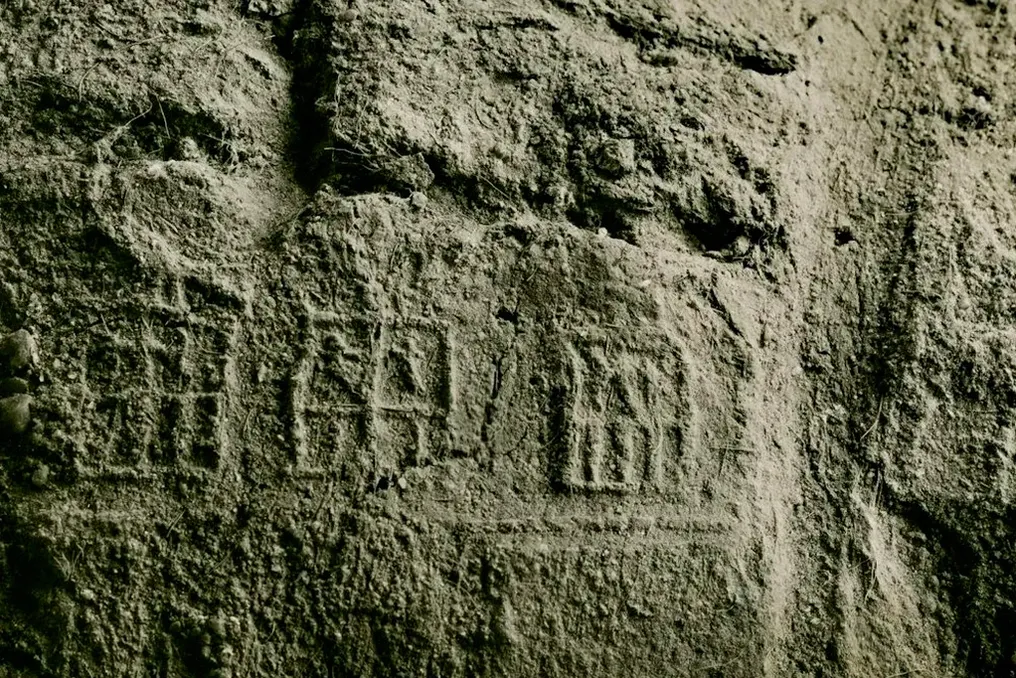
To better understand this history, it is necessary to go back to the 1940s. In Saqqara, one of Egypt's most notable archaeological sites, archaeologist William B. Emery discovered 13 clay pieces near the opening of a funerary well. According to him, these objects resembled postage stamps and featured four serekhs.
Emery identified two serekhs as belonging to Djer and proposed that the other two would be from Meretneith. For him, this constituted proof that she was a ruler of Egypt. In an article published in 1954, he attached a black and white photograph of one of these clay seals. However, the low quality of the image prevented most researchers from accepting the theory that Meretneith was queen.
To complicate the investigation, all 13 clay seals, as well as the original photo plate, were lost. Currently, their whereabouts are unknown. The only remaining evidence was the black and white photograph, which served as the basis for the current study, where researchers applied various techniques for digital enhancement of the image and revelation of additional details. The team succeeded in making the hieroglyphs present on the seals clearer.
The images revealed that the second serekh contains the representation of the goddess Neith, who, in Egyptian mythology, is seen as a creative force of the universe and goddess of war. This detail is significant because Neith is a symbol that no male ruler in history has used, indicating that that serekh probably belonged to a woman—Meretneith. For the researchers, this discovery points out that Meretneith held complete royal authority in Ancient Egypt at some point. The research was formally published in Prague Egyptological Studies.