Openserve and Huawei test readiness of state housing for fiber optic connection in KZN
Read more
TechCentral
techcentral.co.za

Openserve and Huawei test readiness of state housing for fiber optic connection in KZN

Openserve, Huawei, and the KwaZulu-Natal government are working on laying fiber optic channels in 405 state houses currently under construction in Empangeni. This project is viewed as a demonstration of the concept of creating housing that is initially ready for connection to fiber optic networks. Fiber optic services have not yet been activated.

The project started last Friday at the Phase 1A mega-housing complex in the uMhlathuze municipality. It uses a 'pipe and box' method to place physical fiber optic infrastructure parallel to the construction of homes, roads, water supply systems, and electricity supply. This complex is part of an integrated housing development program, which is a mixed-income housing scheme implemented by the state.

KwaZulu-Natal Governor Thamsanqa Ntuli stated in his announcement that while this concept demonstration itself does not provide fiber optic services, it creates the necessary physical foundation for future connectivity.

Huawei provides technical support, assists in implementing the program, and facilitates knowledge transfer. In turn, Openserve, Telkom's wholesale infrastructure division, is responsible for network planning and infrastructure. Pearl Shrimpton, Head of Corporate and Government Sector Relations at Openserve, noted: 'We are building this right, we are measuring it openly, and we will share what we learn with our government partners so that the country can make decisions based on facts, not assumptions.'

Partners did not disclose information regarding the cost of preliminary connection per house compared to installing fiber optics later when the houses are connected, nor did they specify which operator will provide the services or how much residents will have to pay.

Huawei South Africa Vice President Charles Cheng expressed a desire for this approach to become 'standard national policy, integrated into municipal building codes and the national housing strategy across South Africa.'

This call came amid efforts by Communications Minister Solly Malatsi to accelerate network deployment through Icasa, aligning with a political direction that recognizes that differences in municipal processes and levies slow down the implementation process.


Similar stories

Huawei's AI Agent Xiaoyi Work First Uses openPangu-2.1-Pro Model to Enhance HarmonyOS Tasks
Read more
pandaily.com

Huawei's AI Agent Xiaoyi Work First Uses openPangu-2.1-Pro Model to Enhance HarmonyOS Tasks

Huawei's AI agent, Xiaoyi Work, has become the first product to integrate openPangu-2.1-Pro—a new version of the company's open Pangu model family. This was revealed following testing conducted by the publication IT Home on November 5. The application states that this model is intended to improve tasks within the HarmonyOS operating system.

The appearance of this model occurred several days after Huawei Cloud announced on November 1 that it would cease sales of the openPangu-2.0-Flash and openPangu-2.0-Pro models on November 6, decommissioning them by midnight on November 30. At the time, Huawei reported plans for new openPangu models that would be rolled out gradually.

Details about the openPangu-2.1-Pro model have not yet been published by Huawei. There is no public information regarding the number of parameters, active parameters, context length, or training data used. The model has not been officially released, and IT Home concluded that it is a very new development available exclusively within Xiaoyi Work. For comparison, its predecessor, openPangu-2.0-Pro, was introduced earlier this year with a total of 505 billion parameters, 180 billion sparsely activated parameters, and a 512K context window, trained entirely on Ascend NPU.

Xiaoyi Work is positioned as an AI assistant for performing office, coding, and creative tasks on HarmonyOS devices, including phones, tablets, and PCs, and also features a Windows client. The user sets a goal for the agent, and it breaks down the task into stages, calls necessary tools, and performs the work, providing the user with visible progress and key checkpoints for verification. Tasks can be executed either on a cloud PC or a local computer, while the phone can monitor the process running on a connected PC.

According to a review from InfoQ China, this product was developed jointly by Huawei's Xiaoyi team and the openJiuwen community of open agents. The service is in beta and is paid. New users receive 1000 free AI credits for 31 days; after that, the basic plan costs 49 yuan per month with automatic renewal, and the standard plan costs 199 yuan per month. Supported scenarios include market analysis, document processing, slide creation, data analysis, content generation, and code development.

The first openPangu-2.1 model appeared within the agent product, rather than on the cloud model marketplace, with its stated focus being agent tasks on HarmonyOS devices. Huawei has not specified when openPangu-2.1-Pro will be officially released or if it will be available through Huawei Cloud MaaS.

China Telecom, YOFC, and ZTE Demonstrate Bidirectional 800G Transmission over Over 1007 km Fiber Optic Cable
Read more
pandaily.com

China Telecom, YOFC, and ZTE Demonstrate Bidirectional 800G Transmission over Over 1007 km Fiber Optic Cable

The research institutes of China Telecom, YOFC, and ZTE have completed the implementation of what they call the world's first real-time bidirectional data transmission over fiber optic cable spanning over 1000 kilometers, as announced by the China Telecom Research Institute on November 2, according to sources IT Home and C114.

On a line measuring 1007.48 km, the partners achieved a speed of 800 Gbps per wavelength using PCS-16QAM modulation in the extended C+L band, transmitting signals in both directions through a single optical fiber cable, resulting in a total capacity of 128 Tbps. These three organizations collaborated as joint builders of a national key laboratory.

The partners reported three significant achievements. This experiment set a record for the longest single-point, non-loop real-time data transmission over fiber optic cable while maintaining a loss margin of at least 3 dB on each segment and an Optical Signal-to-Noise Ratio (OSNR) margin of at least 3 dB for system operation. Furthermore, it became the first real-time bidirectional transmission over a single optical fiber line at the 1000 km scale.

Although reflections reduced the OSNR by between 0.5 dB and 4 dB, the team believes this proves the feasibility of long-haul bidirectional operations. Finally, the longest fiber optic line in the extended C+L band free from gas line absorption was constructed.

The last point concerns an issue specific to this technology. Since light in hollow-core fiber passes through gas rather than solid glass, traces of carbon dioxide and carbon monoxide in the core can absorb certain wavelengths and degrade transmission. To solve this problem, the team improved the manufacturing process to eliminate these absorption lines across the entire extended C+L band.

Regarding equipment, the partners eschewed high-power amplifiers and used commercial amplifiers with standard output power, matched to the fiber loss profile, to achieve optimal performance from a fully loaded 800G system. Light pre-equalization at the transmitter level maintained channel stability across the entire band. The team also developed an end-to-end model of the impact of reflections and intermodal interference on the line and tested an extreme scenario where part of the band failed without detecting any performance loss.

Operators are most interested in latency. Light in hollow-core fiber travels almost at the speed of a vacuum, approximately 30% faster than in traditional glass fiber, saving about 1.5 milliseconds in each direction over a 1000 km route. The announcement did not specify the measured latency value. Until now, hollow-core fiber in China has mainly been used for short connections, such as between data centers in Chunwei, Ningxia, whereas computing clusters in the west are often more than 1000 km away from demand in the east. China Telecom stated that the result provides a practical technical basis for creating high-capacity, long-distance, and low-latency backbone networks based on fiber optic cable.

Abu Dhabi to build network of seven bridges connecting Ramkhan and Jubail islands to E12 highway
Read more
www.khaleejtimes.com

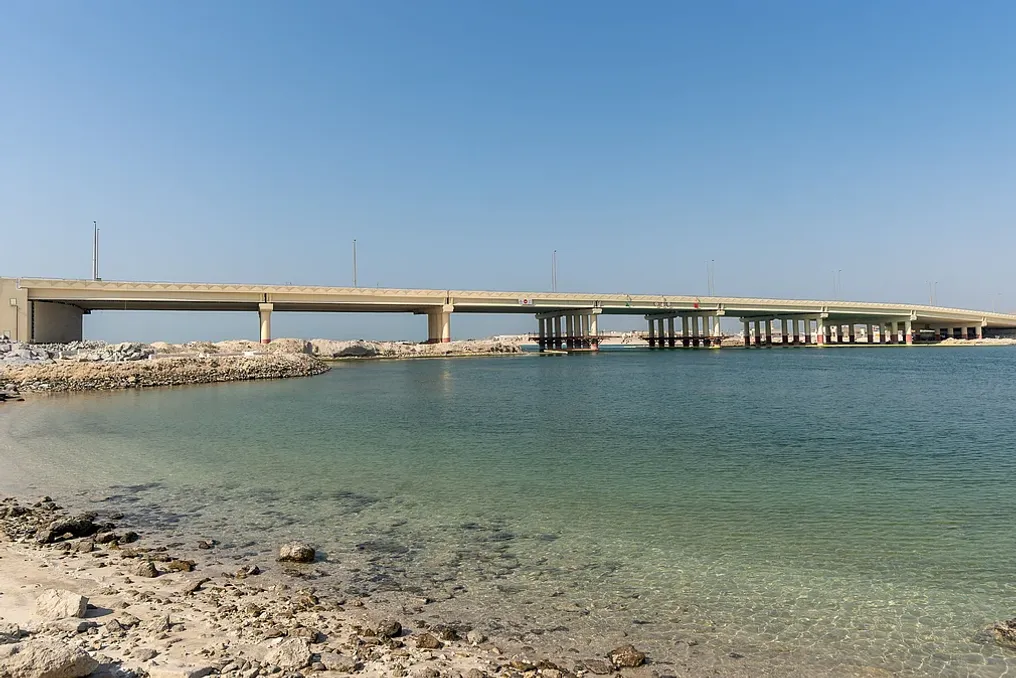
Abu Dhabi to build network of seven bridges connecting Ramkhan and Jubail islands to E12 highway

The Department of Municipalities and Transport of Abu Dhabi (DMT) has announced the implementation of a project to construct a network of seven bridges. This network is intended to connect Ramkhan and Jubail islands to Sheikh Khalifa bin Zayed Highway (E12). This infrastructure is planned to be commissioned in the second quarter of 2027.

The total area of the project exceeds 166,000 square meters, and its estimated cost is valued at 872 million dirhams. The complex includes three tunnels, as well as a system of ramps, roads, and communication corridors, which is designed to increase road capacity and ease movement in the area.

Authorities emphasized that the new project aligns with the principles of sustainable development. It involves the use of energy-efficient LED lighting to reduce energy consumption and light pollution. Furthermore, DMT reported that approximately 90 percent of construction waste, equivalent to over 2200 tons, will be recycled during construction.

Aisa Mubarak Al Mazroui, Director General for Infrastructure Development at DMT, noted that this project is an integral part of Abu Dhabi's expanding transport system. He stated that the initiative 'ensures access to Ramkhan and Jubail islands while opening up new areas for development and economic opportunities.' He added that this step demonstrates DMT's strategic approach to creating integrated, livable communities that contribute to improving the quality of life and supporting the emirate's rapid growth.

This announcement is part of a broader infrastructure development program being implemented by DMT this year. In March 2026, the department completed the opening of two sea bridges connecting Al Reem Island to the E12 highway, at a cost of 450 million dirhams. Previously, DMT also carried out a large-scale road modernization over 13 kilometers in Mussafah, including the construction of two new bridges connecting the industrial zone with Mohammed Bin Zayed City.

Popular