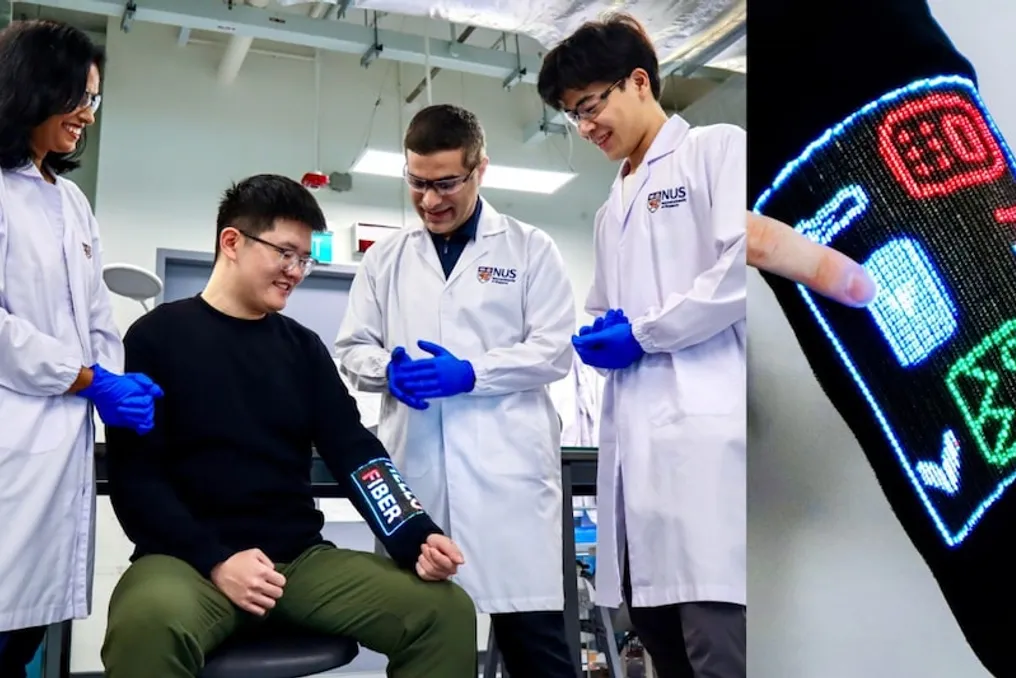
Imagine being able to check body temperature, view videos, or use a calculator without taking your phone out of your pocket. This is now becoming a reality thanks to a new invention. Scientists from the National University of Singapore (NUS) have created a sensor sleeve insert that can be easily woven into clothing, transforming ordinary fabric into a digital interface.
This smart prototype is capable of displaying images and videos, responding to touch, and connecting wirelessly to other devices. Notably, after 50 cycles of washing in a machine, its brightness and touch sensitivity remained unchanged.
The research, published in the prestigious journal 'Nature' on October 21, 2026, describes a flexible textile display made from specially developed electronic fibers. The researchers claim this is the first sensor screen in the world integrated directly into fabric.
Unlike traditional screens, this does not use rigid panels; instead, the electronic components are embedded within the fibers, allowing them to be easily woven into clothing. The team, led by Assistant Professor Tural Khudayev, created a screen measuring 168 mm in length and 105 mm in width using 54-pixel fibers. This display has a resolution of 96x54 pixels and can refresh at a rate of 30 frames per second.
When this fiber is pressed, the sensor layer is activated, the system detects the point of contact, and the corresponding pixel begins to light up.
The capabilities of this prototype are not limited to displaying images. It can play videos, function as a calculator, show photo galleries, act as a compass, receive voice commands, and receive photos via Bluetooth. Furthermore, the researchers added a microphone, speaker, and various sensors capable of measuring temperature, movement, light level, and magnetic direction.
A specifically installed temperature sensor under the sleeve can measure body temperature and display it on the screen, making this technology potentially revolutionary for future health monitoring.
The main challenge when working with flexible electronics is that the fabric undergoes bending, stretching, and regular washing, which hinders the durability of fragile components. However, the NUS team demonstrated that their smart sleeve insert maintained its original excellent condition even after 50 washes with detergent. Moreover, it withstood 1000 bends within a 5 mm radius without any damage. The fabric remains as elastic and breathable as regular clothing.
Although this technology is currently at the research prototype stage and will not replace smartphones yet, the team's next goal is to improve screen resolution and integrate artificial intelligence. The success of these efforts could lead to clothing becoming not just an item of apparel, but a direct screen and sensor for our digital lives.