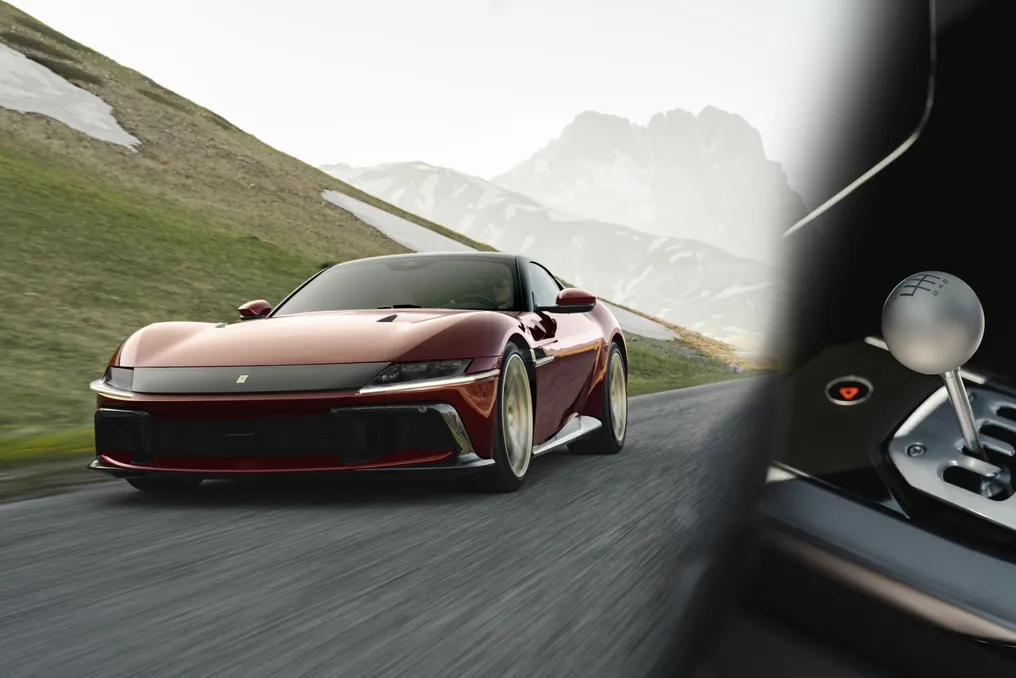
Ferrari has launched the 12Cilindri Manuale, a version of the supercar that, despite its name, does not feature a traditional manual gearbox. This model incorporates the same dual-clutch transmission as the standard 12Cilindri but allows the driver to shift gears using an H-shaped lever and a clutch pedal. These elements are linked to an arrangement of solenoids and Hall effect sensors, simulating not only the operation of a manual gearbox but also the sensation of abrupt shifts, RPM variations, and even the possibility of the car 'stalling' if the clutch point is miscalculated.
The comparison made with tattoo machines illustrates the difference: a real manual gearbox would be analogous to a coil machine, while the Ferrari's system resembles a rotary or pen machine. However, while all tattoo machines are legitimate and leave permanent marks, the 12Cilindri Manuale uses the dual-clutch gearbox to simulate a manual transmission, pretending to be something it is not, although it possesses an automatic mode that reveals its true nature.
International press had the opportunity to test the vehicle at the Balocco Proving Ground near Milan, allowing for analysis of reviews on whether Ferrari's invention is convincing.
Reinventing the Turing Test
In the early 20th century, Ferrari attempted to discourage the purchase of three-pedal models, directing customers from the 360 Modena, F430, or 550/575M towards the automated 'F1' gearbox, associated with Formula 1 marketing, warning that the manual gearbox would decrease resale value. However, the market proved otherwise: currently, a manual F430 is worth double its 'F1' version, and rare editions, such as the few manual 599 GTBs, reach very high values.
Given this growth and demand for nostalgia, the Italian brand decided to act but faced a technical and philosophical challenge. Developing a physical manual gearbox capable of handling the 819 hp and 70 kgfm of the 6.5-liter rear-mounted naturally aspirated V12 would require abandoning the transaxle integrated with the electronic differential, the torque vectoring system, and the traction control—vital features for the car's usability and fun. Furthermore, Maranello engineering did not accept the mechanical risk of a driver missing a downshift in an engine capable of reaching 9,500 rpm.
The solution found was the Manuale By-Wire system. The eight-speed dual-clutch gearbox, developed in collaboration with Magna, remains on the rear axle, but the lever on the dashboard (with its classic 48mm aluminum knob) and the clutch pedal operate without a physical connection to the transmission. Sensors send data to the electronic control unit, while actuators and pneumatic pistons generate resistance in the lever when engaging. In manual mode, only the first six gears are accessible; the seventh and eighth are exclusive to the automatic mode activated by a button on the dashboard.
If the goal was to replicate reality, the consensus among international press at Balocco was positive: Ferrari passed the 'Turing Test,' an experiment proposed by Alan Turing in 1950 to measure a machine's ability to exhibit intelligent behavior indistinguishable from human. Without knowing the trick, it would be difficult to notice the simulation. Richard Lane, from Autocar, commented on the refinement of the mechanism, where the machined steel lever uses a piston, spring, and eccentric rollers to faithfully imitate the weight and engagement feel of a mechanical gearbox, with an authentic metallic click. The control unit anticipates the lever movement, enabling direct downshifts from 6th to 2nd gear without failures in the dual-clutch system.
Chris Chilton, from Car Magazine, emphasized that Ferrari maintained the 'punishment' for driver errors. Releasing the clutch uncoordinated upon exiting causes real jerks, and stopping the vehicle without pressing the left pedal shuts off the ignition in a controlled manner, without damaging internal components. However, there is an invisible safeguard. As reported by Jared Gall in Car and Driver, if the driver attempts to engage a gear exceeding the 9,500 rpm limit, solenoids lock the lever mid-stroke, preventing damage without emitting sounds of worn gears. A company engineer explained that 'it educates the driver, but it doesn't hurt itself.'
Sport driving revealed peculiarities in the interaction of the gearbox with the 6.5-liter V12. Due to the light steering wheel of the 12Cilindri, designed for rapid RPM changes, the revolutions drop almost immediately when pressing the clutch. Mike Duff, from Road & Track, observed that this makes the punta-taco technique more challenging, as any stronger acceleration causes an exaggerated jump in RPM. In older models, the heavier steering wheel stabilized the RPM for a brief period, aiding in gear selection.
Curiously, Ferrari opted not to include an automatic throttle assistant to equalize RPM during downshifts, the so-called 'electronic punta-tacco.' Chris Chilton considered Ferrari's refusal an interesting paradox: 'They thought it would be 'too fake' and left it out. An interesting stance, given that fakery is central to the whole project.' Despite this, the journalist highlighted the emotion provided by the setup: 'Stretching in second up to 9,500 rpm, pressing the clutch, grabbing the lever, and hunting for the redline in third... the roar, the physical feeling, the satisfaction of getting it right are genuinely exciting.'
Despite its merits, the press pointed out two usability issues. First, a software limitation prevents switching from automatic to manual mode if the vehicle is above 70 km/h. If the driver is in automatic mode and wishes to downshift during an overtake, they must significantly reduce speed before the system illuminates the orange icon on the lever and allows the use of the three pedals. The second observation relates to the clutch pedal feel: although it has a well-calculated spring load, it lacks the organic tactile variation at the friction point compared to conventional hydraulic clutches. It is something that can be ignored and 'recalibrated,' but it is not a perfect recreation, something noticeable to those who have driven other Ferraris.
In terms of performance, the Manuale version is marginally slower than the standard 12Cilindri operated by the paddles behind the wheel. Test driver Raffaele de Simone acknowledged that a human operating the clutch and lever will never surpass the speed of the DCT's hydraulic actuators. Jared Gall quantified this performance loss: 'You will be slower than the paddle version. But you won't care. A few tenths of a second is a price worth paying for the rediscovered joy of operating a manual gear selector.'
Limited to 1,499 units—a number referencing the single displacement of the first 1947 Colombo V12 engine—the 12Cilindri Manuale requires ordering through the Tailor Made customization program and costs approximately US$ 670,000, representing an increase of nearly 50% over the conventional model. Although this is a high price for an electronic gimmick, the final verdict from specialized media suggests that Ferrari's invention is successful.
Appreciate or Conform?
Returning to the analogy of tattoo machines, the dispute between coil advocates and pen enthusiasts is an internal conflict. The average customer does not worry about the motor that moves the needle, as long as the line is firm and the design looks good on the skin; the ink is applied in the same way and the mark is permanent. In the automotive context, Ferrari's move transcends a mere niche preference, being a clear symptom of a trend.