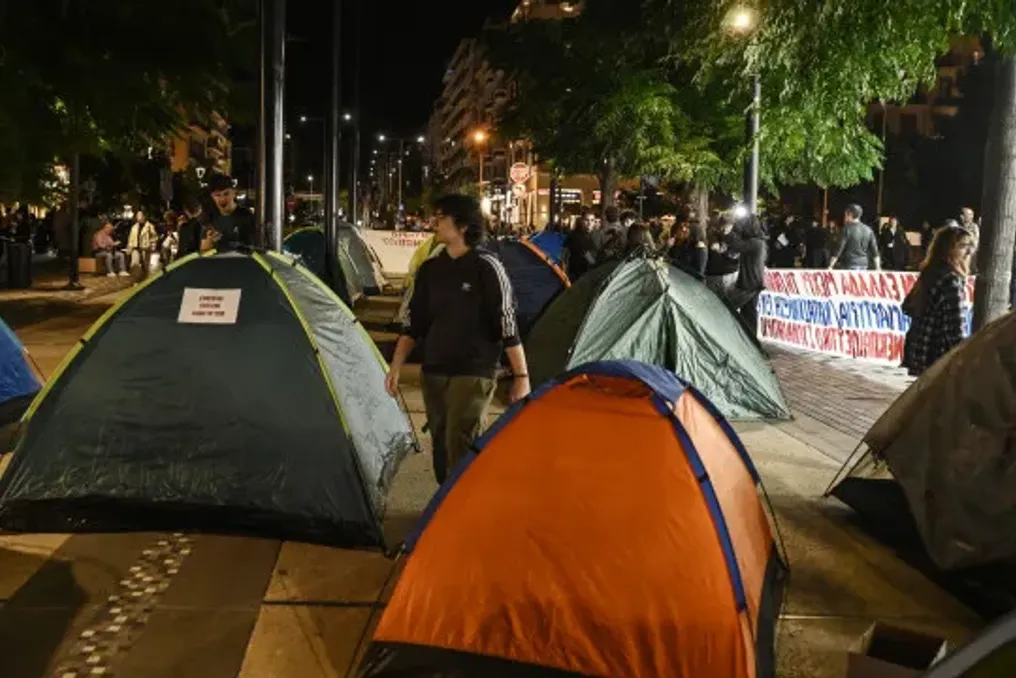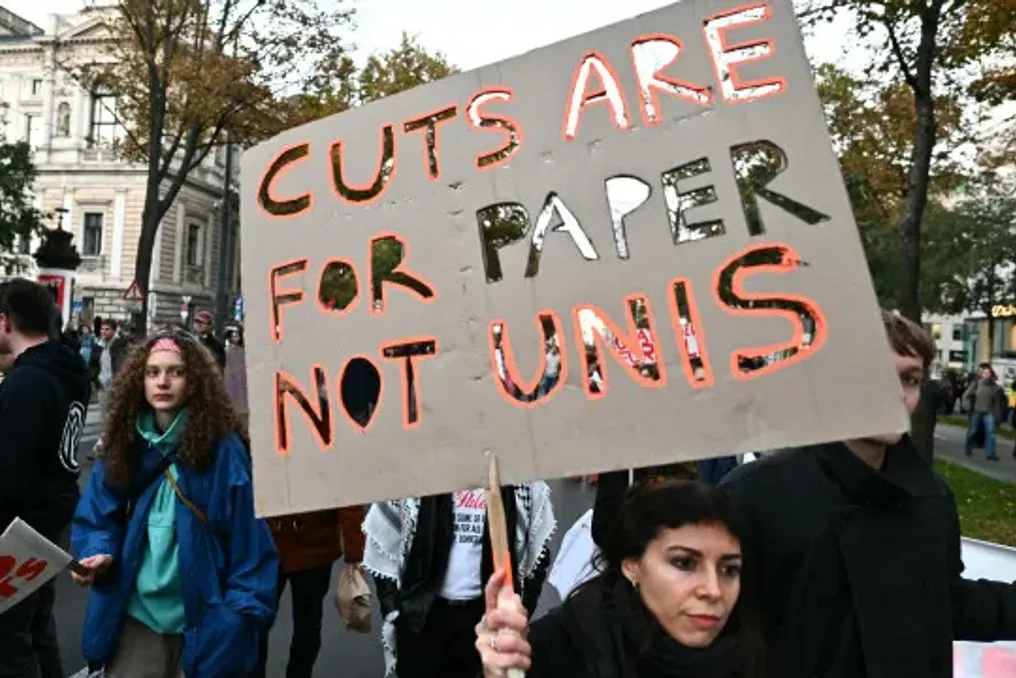
Tens of thousands of students took to the streets of Vienna today to protest planned job and service reductions in Austrian universities for the coming years. These cuts are attributed to the limited state budget allocated to this sector.
Placards held by around 30,000 university students bore slogans such as 'No Cuts,' 'Our Education is Our Future,' and 'Art is the Nervous System of Society.' The march proceeded along the central avenues of the Austrian capital amidst the sound of drums and a strong police presence.
The protest was organized by the Austrian Students' Union (ÖH) under the slogan 'Red Alert: Save the Universities.' The action condemns a budget deficit of 2 billion euros over the three-year period 2028–2030.
The Austrian government, which is a coalition of conservatives, social democrats, and liberals, approved a budget of 16 billion euros to finance the country's 23 public universities serving a population of nine million during this period.
The Conference of Austrian Universities (uniko) indicated that this amount of funds is virtually identical to the current allocation and does not account for overall inflation or salary increases until 2030.
Rectors warned that the lack of resources will force them to cut one in ten positions, and they also predict serious reductions in teaching, research, and medical care in university hospitals.
The ÖH emphasized in its appeal that '2 billion euros are missing, which will have devastating consequences for education, student support, and working conditions,' adding that 'the federal government has until October 31st to improve the budget.'
Union representatives stated: 'We are applying pressure and demonstrating together that our future is non-negotiable.' The executive branch, seeking to reduce the state deficit, advocates for funding cuts, arguing that academic institutions have sufficient reserves to increase efficiency without compromising the quality of education.
Due to the excessive deficit procedure initiated by the European Union (EU), Austria is attempting to reduce the state deficit from 4.2% of GDP recorded in 2025 to 3% in the coming years. This is being achieved through a budgetary adjustment plan that includes unpopular measures to cut spending in almost all sectors except defense and security.