In October 2019, on an island in Guinea-Bissau, artist Ana Lira demonstrated her understanding of the artistic process by passing the camera to a ten-year-old girl named Menina, who appeared daily at the door of the house where the artist was staying. Through this gesture, the world began to be perceived through Menina's eyes, while Ana's eyes were freed to listen, feel, and continue creating.
This episode can be seen as a summary of her entire creative trajectory. Originally from Caruaru, Ana Lira has been creating works for over twenty years that blend photography, radio art, literature, and practices of black celebration. Her work has always revolved around one question: what life experience can I use as a driving force for self-expression?
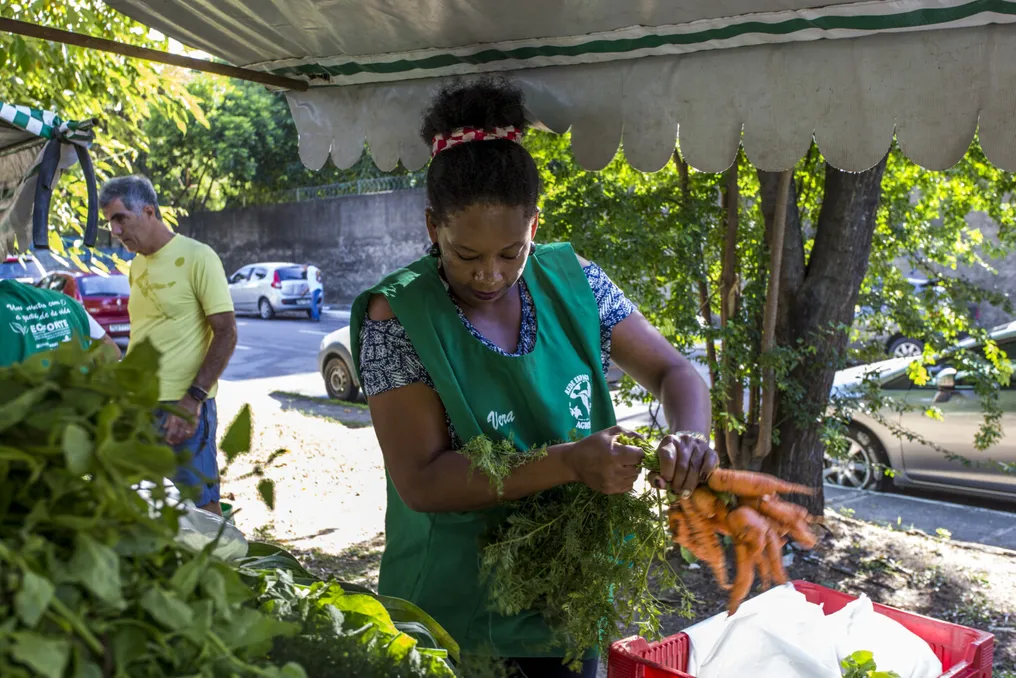
This question transformed into a method, and the method into works. This trajectory is what the Fliporto Arte exhibition highlights in its current issue. Ana arrives at the festival with complex projects such as Terrane (2015–2022), dedicated to the cistern women of Semiárido, and Chama (2017–present), which brought black DJs and sound artists into exhibition spaces during an era when this activity was often viewed merely as event animation. She also presents a new process developed with women from the agroecology field, where co-authorship is not a concept but an agreement.
In an interview, she shares her thoughts on what she learns when she stops creating, why the installation space also speaks, and the difference between listening and gathering information.
Ethical Aspects of Creating Narratives
When asked about the strong ethical component in creating images and narratives with other people, Ana Lira emphasized that the fundamental principle is the awareness of the encounter. Since the narrative in the presented work does not belong to her personally, she is obliged to respect the person with whom she is in dialogue. For example, in Numbra (2018-2021), she organized an experience where direct listening was central. She accepted nine people for a two-way exchange process, and each listening cycle turned into a 'patuas' integrated into the installation. This artwork requires respect for what each person decides to give.
Thus, by creating a narrative with others, she cannot impose her discourse, as if the only truth is the one she presents. There is a power dynamic in every dialogue, and it is necessary to understand all nuances to create a safe space for each participant's self-expression. If she notices that minimal conditions of integrity are missing for herself and for those participating in the creation of narratives, she assesses the possibility of pausing, restructuring, or concluding the process. When everything is adjusted and connections resume, she sees that the subsequent paths become more beautiful and profound.
Therefore, it is necessary to periodically review the internal dynamics of the works; she must be very aware of her own process and observe a lot. She observes and listens a lot. The pillars upon which her career is based are much more related to creating more comfortable conditions for our existence, so it is meaningless for her to work any other way or with an ethic that discredits those she works with. If she works, it must be for the good experience of everyone present.
Understanding Authorship in Collaborative Projects
When her works, such as Terrane, seem born from shared encounters and processes, how does she understand authorship in these projects? Does it remain individual or must it be collective?
This is a dynamic she has mastered over time, understanding the possibilities and choosing ways to build different forms of sharing. There are works where authorship is collective; there are works where authorship is divided at certain stages, and others where it is individual. For instance, Terrane (2015–2022) was registered in a competition as a narrative about cistern women, but she realized during the first meeting that it could not be done without their direct collaboration. Therefore, she removed her individual authorship from the body, wrapped it in beautiful fabric, and saved it for a future work where presence would be necessary. Instead, she incorporated co-authorship with the cistern women, built on agreements.
The artist's book and exhibition are signed as Ana Lira in dialogue with Claudia Oliveira, Luzia Simeus, and Lourdes da Silva—and the sale price of the books is also shared. In the case of Chama (2017–2022), authorship is collective. At every stage, participants receive joint credit because these are experiences in which sonic and celebratory narratives were built with the participation of people. Thus, for her, it is a collective work that she presents in her portfolio, without hiding any of the shared stages, because the entire work represents a sound-celebratory ecosystem.
In Nos Traquejos do Tempo (2022–ongoing), she conducted listening sessions parallel to the creation of radio art and sound pieces. In this case, although the authorship of the creative process belongs to her, she acknowledges the contributions of the listened-to artists and luthier-participants as guests; she also considers it fundamental to recognize the creative partnerships they form to create the technical parts of the works. The technical sheets of the works are sometimes more voluminous than the conceptual descriptions, and she includes them in her portfolio. She believes this is a matter of respect for those who work with her.
Incorporating Voices and Experiences
How does the process of incorporating voices and experiences happen in practice? What repeats in this regard throughout her works over many years?
What repeats is where it all begins: her creative processes start with questions, and along the way, she discovers experiences, places, and people who will collaborate with her to answer them. The questions of authorship and the inclusion of voices and experiences are formed in the weaving of encounters. Thus, she knows what prompts her to start the creative process, but what it will present as a result is a fusion over time and what it offers her.
She is not an artist with formulas, nor does she collect the formulas of other artists to include in her works. She creates methodologies based on what works in her experience and what she discovers by doing, feeling, listening, and walking. She may include similar elements in different works if it makes sense, but she never starts a work with this thought.
For example, she created radio art in Chama (2017–ongoing), in Nos traquejos do Tempo (2022–ongoing), in Guianças Sonoras (2023–ongoing), in Nos embalos da tamarineira, mamãe eu vou caciquear! (2023), and in Ginga Dança (2025). If you listen to five works, each has a different structure, even if radio art is involved in them. They follow different logics of structure, organization, and narrative methodologies, as some works are individual or included in installations; others are experiences dependent on relationships with participants; others are sound plays created in artistic partnerships or collective works. Thus, the daily experience of developing a work directs how, where, and how the inclusion of voices will occur—and she coordinates all of this with each partnership. Presence, the creating body, enjoying the process, allowing dilemmas to achieve results, is required.
Her main task today is to incorporate space as the voice of the works. There were works she created that offered spatial readings, but she did not like the final aesthetic result. Therefore, she seeks advice from partners regarding structural changes or adjustments that can make the works more powerful. Unlike how artists usually submit works to other specialists to solve spatial problems, she is always in the dilemma of how to explain that in the case of her installations, the space itself is the work. It also speaks, vibrates, resonates the pathways of the work, not just the objects or people who might participate in the experiences.
She has no problem with dismantling, re-discussing, and reworking until the most accurate rhythm is achieved, as this is also part of the path of the work. This is a path she reviews, cares for, and studies again to reach places where the experience of the works will truly be good for her and for the people.
Influence of Collaboration Networks
Projects such as Avise que está tudo bem also mobilize networks of collaboration and circulation. How do these networks (affective, territorial, political) influence the final result of the works?
She might say that the work is what is materially presented, but her work is not limited only to the works. Or, more accurately, the final result is not only what is in the exhibition space. She always talks a lot with the people she works with. She listens, shows the results, asks how they felt, and transmutes this. Avise que está tudo bem (2022) is actually an artist's book in booklet format that goes with the digital photo book Terrane (2015–2022). This was a way of working with audio archives she recorded during the experiences of building cisterns between 2017 and 2018, and collecting structural discourses that did not fit into the field of images. It contains feelings discussed and shared in detail during the experiences.
These affective, territorial, and political networks manifest in various forms within the context of her works. The project Voto! | Não-Dito (2012–2019), for example, would never have existed without the movements of Recife artists around the collective films Projeto Torres Gêmeas and Eleições: Crise de Representação. Part of the group of participating artists in these actions, especially Marcelo Pedroso and Mariana Porto, was vital for her to maintain pressure in the face of the difficulties she faced over six years of creating this work.
The same happened with Chama (2017–ongoing), when the Mercosur Biennial was canceled due to the pandemic in 2020. Without the effective readiness of Marta Lopes, Oly Elhassan, Suelen Melo, and later Libra to continue research and actions in a different format, the project might not have produced the transformations it created, including the participation of amazing artists across ten stages. She mentions this individually, collectively, and within the circles themselves because Chama curated subjectivities and demands that were not yet present in contemporary art exhibitions in Brazil, especially in how they articulated by attracting black DJs and sound artists. It never had an aesthetic manifestation that she presented for the exhibition space, but it strongly influenced, including other collectives of black sounds, who began to perceive their work as true creativity, poetry, and heritage, rather than just a distraction for the public, as is often the case at many events in the country.
Today, many female artists are transferring creative processes from the realm of the disco and black celebration practices into exhibition spaces. She is very happy that the movement they created, together with various others worldwide, has contributed to these creations being perceived as they deserve. This evokes strong emotions in her. Over these 20 years of her journey, she has made some works whose aesthetic results did not meet expectations due to political changes, institutional interference, budget fluctuations, and other factors affecting art circles. Nevertheless, the creative process was incredible, and the collaboration networks helped her endure.