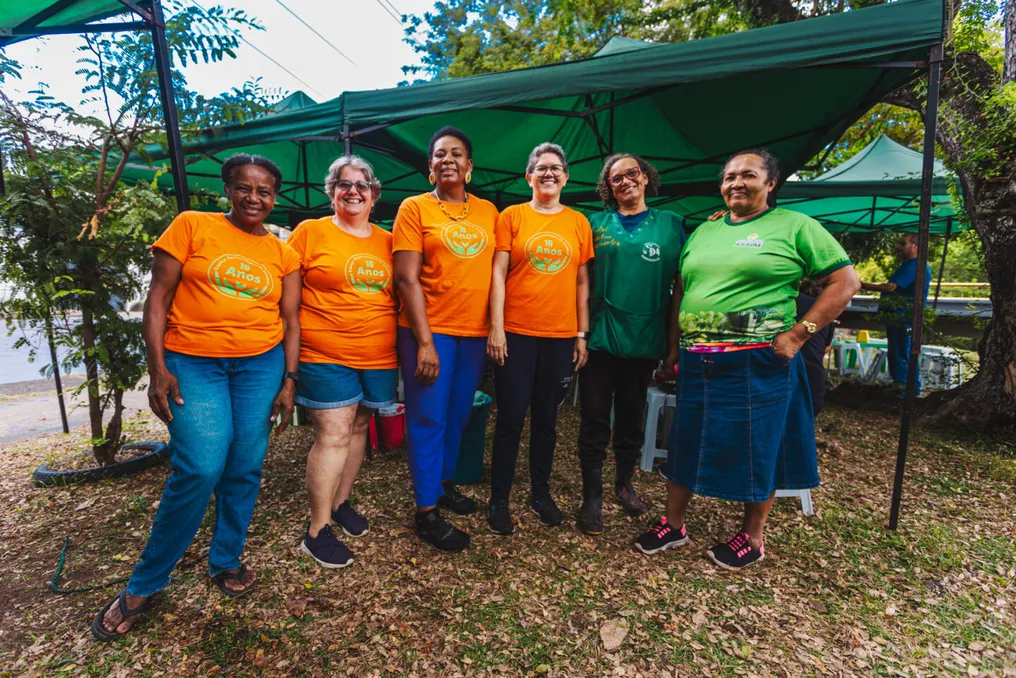
Cristina Petroni justified the delay in her responses by saying that they tend to postpone tasks and lose track of time. This philosophical reflection permeates the work of Cristina Petroni, associated with Sítio Sete Estrelas, and Vera Silva, from Sítio Machado, as well as the creative process developed in partnership with the artist Ana Lira.
In the context of agroecological practice, Cristina emphasizes the importance of respecting the natural rhythm, stating that 'nothing is forced' and that 'the cycles of crops are complete, uniform.' This observation transcends specific cultures such as maxixe, jerimum, and lettuce.
Initially, Vera and Cristina did not immediately understand the work proposal brought by Ana Lira, and this adaptation period reinforced the refusal to rush the process. The perceived objective was not to create a work about the agroecological farming families, but rather to offer 'another opportunity for city people to know the work of agroecological farming families.'
A work made with them
There is a recurring risk in projects of this nature: the external artist only harvests what interests them, represents it, and withdraws, relegating participants to mere backdrops. Vera and Cristina anticipated and avoided this danger, demonstrating distrust regarding the term 'representation.'
When asked what would make the work honest, Vera Silva stated that it should expose 'the truth of our daily lives,' encompassing care for the land, food culture, and the effort of rural men and women, in addition to 'the political struggle for a dignified life in the countryside.' Cristina Petroni was even more emphatic, insisting that it must be clear that 'real food, clean, without exploitation, is accessible to everyone,' considering everything else as mere decoration.
What distinguishes this collaboration is that Ana Lira is not introducing a non-existent collective; she is finding a group that already has an established collective. The agroecology practiced by the two co-authors constitutes, before any artistic production, a shared method of decision-making. Vera affirms that 'decisions are collective' and that 'consensus is always sought, never unilateral.'
Cristina details this internal functioning: in the cultivation areas, 'all work is defined by all family members, without exception'; and at the fairs, 'listening to the entire collective, the majority prevails.' Those who already share the definition of what to plant, when to harvest, and how to market do not need to learn to share authorship of a work; this knowledge already exists. The real challenge lies in the art, which must correspond to an organization that precedes it.
Vera summarizes this dynamic by stating that 'politics is shared,' emphasizing that the process is one of joint construction, not singular decision-making. This idea reflects the very essence of agroecology. The strength of Ana Lira's work may lie in not separating these two aspects, allowing the method of the land to influence the method of the work.
The final question that every work must address is purpose. Cristina defines this objective precisely: the launch will take place at Fliporto, near the Setúbal Agroecological Space. Her desire is not for the public merely to admire the piece, but for them to be led to visit the fair. She hopes people will attend, dialogue with the farmers, and understand 'a little about the process of those who grow their own food.'
For Cristina, the work will only be considered honest if it provokes action: if someone, after seeing it, walks the few meters separating the art from the stall where genuine, exploitation-free, and accessible food is being sold. Thus, nothing will be forced, fulfilling the principle of 'respecting, ultimately, the time of things.'