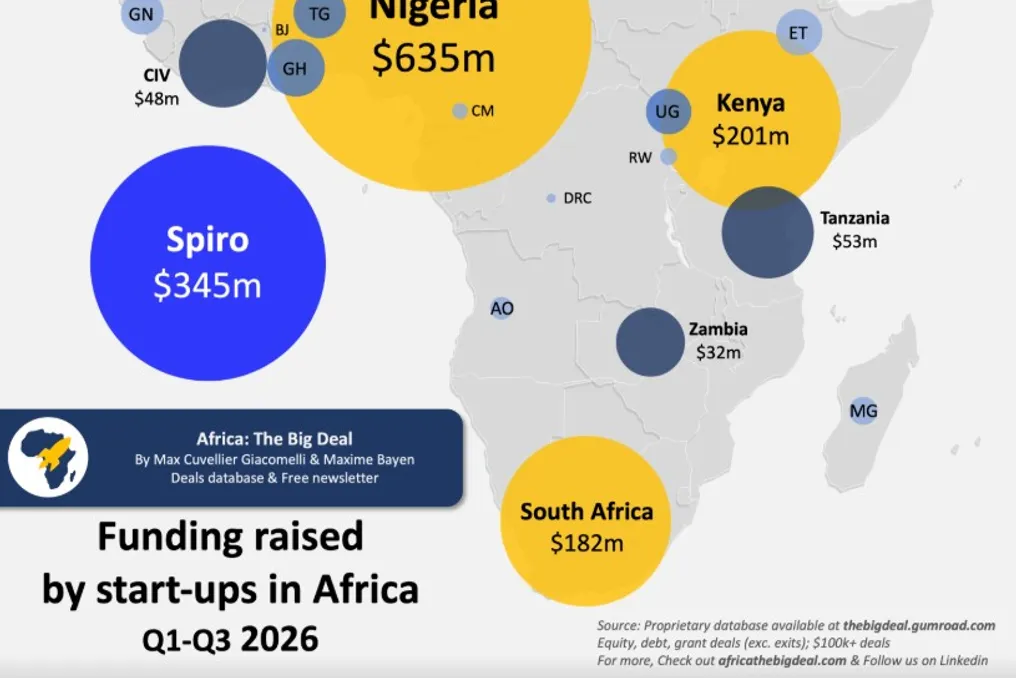
Despite Nigeria remaining the most populous country in Africa, Kenya and Egypt attracted venture capital over the last three years. However, the situation has drastically changed: by the end of the third quarter, Nigerian startups once again took the top spot in Africa, raising an impressive $635 million.
This achievement goes far beyond a minor success, as it demonstrates a return of venture capital to the country. The funding secured in the first three quarters more than doubled the $247 million attracted during the same period last year.
According to Africa: The Big Deal, Nigerian startups raised $635 million in the first three months, taking the leading position. This sudden influx of funds is not random; investors are directing large investments exclusively into proven companies with serious growth momentum.
Four specific companies accounted for 69% of the total national volume, representing an increase of $440 million. Mobile finance giant Moove led this list, securing an impressive $250 million. Fintech giant Flutterwave followed, attracting $100 million despite ongoing market adjustments.
Among the leaders were e-commerce veteran Jumia, which raised $50 million, and the crypto infrastructure platform Yellow Card, which received $40 million. This proves that late-stage growth capital is still actively being utilized in Africa.
This capital inflow demands close attention from everyone involved in creating, investing, or simply observing the African tech ecosystem. This is not just a statistical anomaly but a signal of a massive geographical and sectoral shift across the continent. The era of easy money has ended, giving way to calculated bets on large companies.
One of the most unexpected turns in the 2026 funding narrative is what venture capitalists are actually acquiring. For almost seven years, fintech was the undisputed leader of African venture capital. But now the situation has changed: logistics and transport enterprises have aggressively taken this position.
Across the continent, mobility startups attracted a colossal $780 million in just nine months, accounting for 36% of all venture funding, while fintech dropped to 35%. This shift fundamentally changes the approach to launching startups. Thanks to large rounds from companies like Moove and the electric mobility player Spiro, there is an active drive to solve complex problems related to infrastructure and physical mobility.
Nigeria's financial resurgence looks even more significant when viewed in the broader picture. While Lagos celebrates its successes, other major tech hubs are experiencing a severe shortage of venture capital. Kenya faced a sharp 73% year-on-year decline, raising only $201 million. South Africa also showed weak results, losing 58% of the previous volume and receiving a modest $182 million. Only Egypt managed to hold its ground, attracting a respectable $445 million.
Accounting for 37% of all funding by country on the continent, Nigeria has effectively re-centered the African tech dialogue. The message to the world is crystal clear: the Giant of Africa has awakened and is fiercely writing the next chapter of the continent's digital revolution.