Experts emphasized that artificial intelligence is capable of helping patients better understand their health status and prepare for doctor's visits, but final medical decisions must be made by qualified specialists.
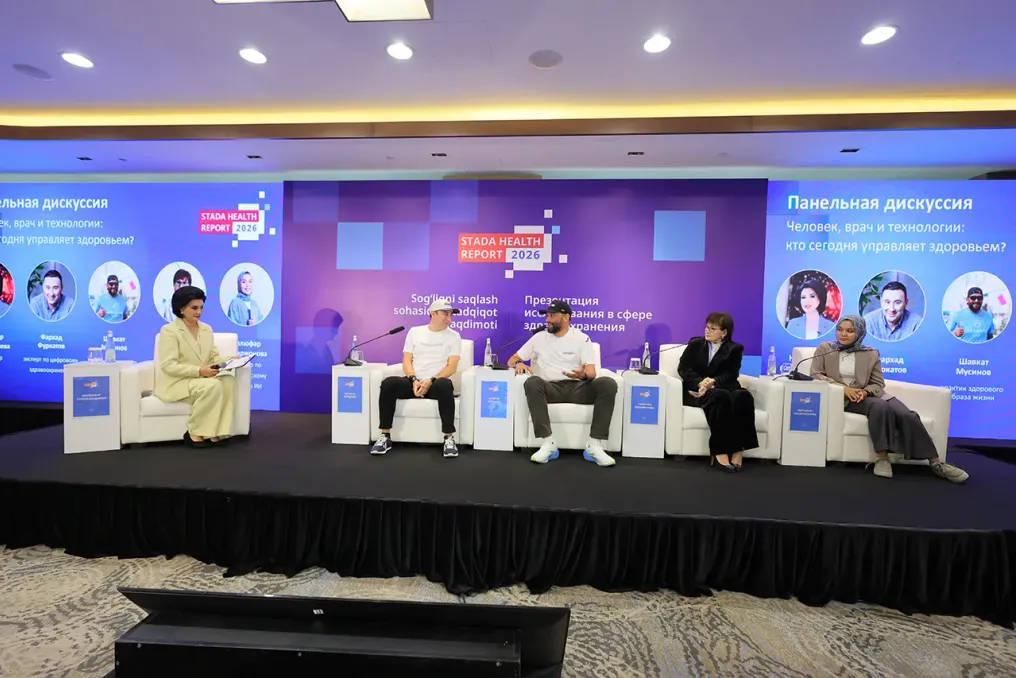
The discussion took place in Tashkent, Uzbekistan, during the presentation of the STADA Health Report for 2026. Participants included Gulnara Jambekova, Deputy Director for Research of the International Center of Molecular Allergology of the Academy of Sciences of Uzbekistan and Professor at Tashkent State Medical University; Nilufar Nosirjonova, Director of Strategic Development of Artificial Intelligence and Machine Learning at Sino AI; Shavkat Musinov, Uzbekistan Champion and healthy lifestyle practitioner; and digital healthcare expert Farid Furkatov.
According to the STADA Health Report for 2026, 55% of Uzbekistan's residents consult artificial intelligence regarding health issues. Another 45% considered replacing a doctor's visit with an AI consultation under certain circumstances, although 75% still prefer an in-person appointment with a doctor. Furthermore, 92% of respondents admitted to self-medicating in at least one situation.
Jambekova highlighted premature discontinuation of treatment for chronic diseases, especially bronchial asthma, as one of the main risks of self-medication. Patients, feeling improvement, stop taking medication. By the time they seek another doctor's appointment, the previous treatment regimen may be ineffective, requiring revision and intensification of therapy.
Several reasons exist for this behavior. Sometimes doctors lack time for a full explanation of the treatment, while patients may face financial difficulties in continuing therapy or travel problems for appointments. Some also harbor distrust towards prescribed medications or believe their condition is more serious than the diagnosis indicates.
In such cases, according to Jambekova, a personal conversation is crucial to reassure patients, explain the treatment, and establish a partnership. She stressed that artificial intelligence cannot replace such interaction. It was also noted that patients are increasingly coming for consultations with interpretations of their symptoms and test results generated by AI.
Nosirjonova warned that chatbots, especially free models, tend to agree with users. If a person asks about the need for antibiotics, the model might simply confirm a decision they have already made. She called this a model failure.
According to her, a good AI tool should be guided by three principles. First, it should not automatically agree with the user but should ask clarifying questions, such as about the patient's temperature or symptom duration. Second, it should help people understand what is happening without making decisions for them. Third, it should recognize 'red flags' and recommend seeking urgent medical help if dangerous symptoms appear. She added that no model is one hundred percent accurate.
Nosirjonova defined two main areas of AI application: understanding and decision support. AI can patiently explain medical information, repeat explanations as many times as needed, and help prepare for a doctor's visit. However, 'decision-making is always the doctor's job,' she stated. Medical chatbots differ from general models because they rely on verified, regularly updated sources and undergo testing with medical professionals, whereas general models can generate false information.
Language barriers also pose a problem. Models are predominantly trained on English-language material, while Uzbek data is limited, which reduces the accuracy of responses in Uzbek. Nosirjonova advised users to provide as much detail as possible when asking questions, noting: 'A detailed question leads to a detailed answer.'
The study showed that 49% of Uzbekistan's residents explain self-medication based on their own experience and knowledge of what helps them. Moreover, 22% reported negative experiences with self-medication, more than double the average in 20 surveyed countries (9%).
Jambekova believes that self-help is appropriate in certain situations. For example, staying home with a viral respiratory infection may be preferable to waiting in a doctor's queue, as it reduces the risk of infecting others. People aware of their allergies can take anti-allergic drugs independently. Nevertheless, she cautioned that anaphylaxis is a medical emergency where every second counts, and taking risks is unacceptable.
Commenting on the 22% figure, Nosirjonova noted that it demonstrates the need to use AI to improve understanding, not to make medical decisions.
Musinov advised people to pay close attention to their body's signals. If slight discomfort occurs during exercise, the intensity should be reduced, for instance, by replacing running with a slow walk. If symptoms persist or recur, a specialist consultation is necessary.
According to the survey, 44% of respondents named obesity and unhealthy lifestyle as one of the country's main healthcare problems, ranking second after environmental factors. The study revealed that 16% of respondents undergo all available preventive medical check-ups, and another 36% undergo some of them.
Musinov noted that people often seek medical help only after a problem becomes serious, even though prevention is simpler. He added that habit formation takes 21 days. Although people often use AI to create training plans, it cannot replace a coach. After a session, AI cannot offer the personal motivation that is a strong stimulus for many people.
Regarding nutrition, Musinov pointed out that local cuisine is often high in calories, and people are insufficiently active, which makes preventing weight gain difficult without regular physical activity. He emphasized that the social environment promotes maintaining healthy habits: 'Our environment changes us.' When a coach or friends are waiting for someone on a morning run, skipping it becomes harder.
Musinov started running in 2019 after participating in an international half marathon in Samarkand. Today, his friends and former classmates also run and serve as role models for their children. He views the growing number of race participants as a sign of strengthening interest in a healthy lifestyle.
Jambekova agreed that healthy habits are primarily formed within families and called for raising the level of sanitary education, including school education.
The study showed that 89% of Uzbekistan's residents use at least one tool to monitor their health, and 25% use mobile health applications. Experts agreed that such data is useful but requires careful interpretation.
Jambekova warned against complete trust in wearable device readings. A gadget might show normal indicators, but consuming certain foods before physical activity can trigger anaphylaxis, which the device cannot predict.
Musinov mentioned that his team's coach monitors athletes' sleep and morning well-being. Before competitions, athletes follow an eight-hour sleep regime for three days. Furkatov stated that digital services should help people quickly obtain primary health information and direct them to a doctor if serious symptoms arise. He added that smartwatches and mobile applications combining sleep and activity data help in making more informed decisions. His team also uses gamification to encourage physical activity by organizing competitions and joint sessions.
Experts also discussed the security of medical data. Furkatov noted that it is too late to focus solely on concerns about data collection; the priority should be mastering the proper use of services and carefully checking what information is transmitted and to whom. Nosirjonova highlighted the lack of transparency as a serious problem, noting that users often do not know who has access to their data.
In conclusion, participants concluded that AI can be a useful tool for understanding health problems, but it cannot replace a doctor. Final medical decisions must remain with qualified specialists.