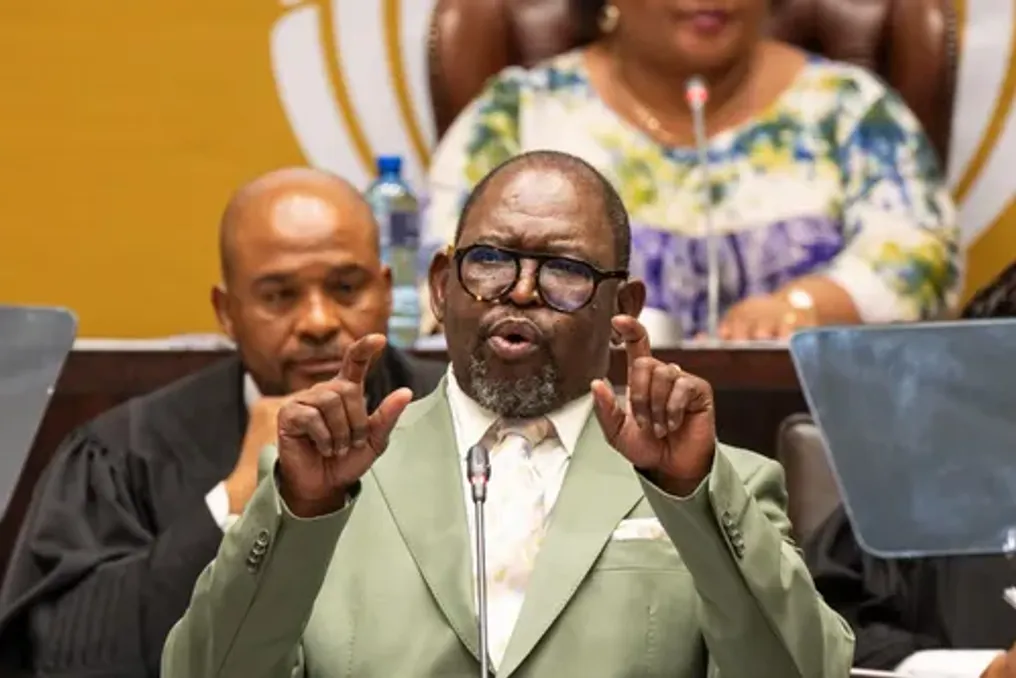
Finance Minister Enoch Godongwana presented a series of encouraging news to South Africans yesterday: the national debt has stabilized, tax collection exceeded expectations, and the budget deficit is shrinking. These achievements come after many years of deteriorating public finances due to weak economic growth, corruption, rising debt, and constant bailout demands.
However, another picture is hidden within the same Medium-Term Budget Policy Statement: economic growth is slowing compared to Treasury forecasts, the unemployment rate remains extremely high, and state institutions continue to struggle to translate significant financial allocations into functioning infrastructure and reliable services. Although financial indicators are improving, the real experience of millions of South African citizens looks much less optimistic.
Nevertheless, the importance of fiscal stability cannot be denied, as a government unable to manage its finances ultimately loses the ability to fulfill its development obligations. The more the country borrows, the more funds go towards servicing that debt, leaving less for healthcare, education, social protection, and infrastructure. Prosperity cannot be achieved by accumulating unsustainable debt, but simple budget balancing does not guarantee well-being either.
The key distinction that must be considered in Godongwana's latest statement is that while the Treasury is making progress in restoring the state's financial position, the government's ability to transform this progress into a stronger economy and improved quality of life for the population remains far from convincing.
Healthier finances, but where is the growth?
The Minister reported that the national debt stabilized at 78.4% of GDP in the 2025/26 fiscal year. Further strengthening of the primary budget surplus is expected, meaning revenues will exceed expenditures before interest payments. This year's deficit was also revised downwards, and gross tax revenue is forecast to exceed the February estimate by 17.1 billion rand.
These improvements have economic value as they can reduce borrowing pressure, support investor confidence, and ultimately free up resources that would otherwise be spent on debt repayment. The proposed Fiscal Anchor Act, designed to strengthen discipline and accountability in future budgets, is also a valuable step, provided sufficient flexibility is maintained for changing economic conditions.
Nonetheless, it is important to avoid confusing financial stabilization with economic recovery. The Treasury lowered the growth forecast for 2026 from 1.6% to 1.2%, and by 2029, the economy is projected to grow by only 2%. These are extremely modest targets for a country facing South Africa's characteristic level of unemployment. According to Statistics South Africa data for the second quarter, the official unemployment rate stood at 33.6%, corresponding to approximately 8.5 million unemployed people.
An economy expanding at such a pace cannot reasonably provide employment for millions of unemployed people, let alone young people entering the labor market annually. While improving fiscal ratios are welcome, these ratios offer little comfort to someone who has been searching for work for years.
There is another reason for caution regarding the optimism surrounding increased revenue. The Treasury acknowledges that a significant part of the unexpected tax increase is due to rising commodity prices, particularly revenue linked to mining. These receipts may be temporary. A favorable movement in international commodity markets is welcome, but it cannot be taken as proof that South Africa has suddenly acquired a stronger and more diversified productive economy.
We have encountered similar situations before: commodity cycles boosted revenues, easing fiscal pressure, and giving the government a reprieve. Then prices changed, and the underlying weaknesses of the economy reappeared. The current test is how we use this respite.
We spend billions. What do we get in return?
Perhaps the most alarming admission in yesterday's statement related to infrastructure spending. Between the 2017/18 and 2023/24 fiscal years, the national government disbursed 887 billion rand through targeted infrastructure grants. This is a massive amount of public funds. However, a Treasury review showed that although most funds were spent, projects were often delayed, left incomplete, or failed to deliver the expected benefits.
This means that for years, the government cited infrastructure allocations and spending as evidence of its commitment to development. Yet, its own review now confirms that spending money does not necessarily lead to the creation of the infrastructure promised to communities. A budget can be fully expended while the anticipated public benefit remains unachieved. Accounting records may reflect expenditure, but the community is still waiting for a working water system, a completed road, or a usable public facility.
This touches upon the core of the governance crisis in South Africa. We have become remarkably adept at measuring inputs while paying insufficient attention to outcomes. Departments are evaluated based on spending metrics, institutions celebrate the allocation of additional resources, and politicians enthusiastically announce projects. Meanwhile, far less attention is paid to whether these projects are completed on time, function properly, and provide long-term economic benefit.
A positive point is the Treasury's intention to reform infrastructure grants and enhance accountability. The creation of an Infrastructure Finance and Implementation Agency, alongside efforts to improve project preparation and attract private investment, also offers potentially useful mechanisms for improving implementation quality. However, any new institution, funding mechanism, or infrastructure project will be ineffective if fundamental problems in project management, procurement, technical competence, and accountability are not resolved.
The country does not need more impressive infrastructure announcements; it needs completed and functioning infrastructure. A similar contradiction is observed in the additional medium-term savings of 38.1 billion rand identified by the Treasury. Some of these relate to reducing duplication of functions, administrative inefficiency, and social grant fraud. These are reasonable goals, provided the projected savings materialize.
However, 7.8 billion rand is being reallocated from the human housing development grant due to program inefficiency, mismanagement, and rent-seeking. It is deeply worrying to present this as fiscal savings without addressing what it says about the state's capacity to provide housing. Of course, continuing to pour money into a dysfunctional program would be irresponsible. The Treasury is right to intervene where public resources are wasted. But households expecting government-supported housing have not disappeared just because the program cannot spend money effectively. Financial allocation may be reduced, but the social obligation remains.
Fiscal discipline cannot replace a capable state
Godongwana's statement also acknowledged the pressure on households and local services. A temporary reduction in fuel excise duty will provide some relief from rising transport costs. Additional resources have been allocated to provincial health and education budgets, and municipalities will receive an extra 21.8 billion rand through the equitable share of local government in the medium term.
Targeted allocations for child nutrition and measures to strengthen responses to gender-based violence, including funding for additional social workers, are also planned. These are valuable interventions in a country where poverty, violence, and unequal access to basic services remain deeply entrenched problems.
However, the effectiveness of these commitments depends on institutions outside the National Treasury. The provincial department of education, which cannot effectively fill teacher vacancies, will not automatically improve learning outcomes just because of additional funding. A municipality whose financial management is compromised by political interference will not restore its water infrastructure simply because its equitable share has increased.
The Treasury itself acknowledged the scale of the municipal problem, including widespread weaknesses in financial and operational performance. This is particularly relevant ahead of local government elections. Political parties will soon fight for control over municipalities whose financial and administrative difficulties cannot be solved merely by campaign promises or coalition agreements.
The problem is not simply a lack of money in the government; a large part of the public sector struggles with the effective use of the funds it receives. This complicates the inevitable confrontation between those demanding higher public spending and those insisting on fiscal prudence. South Africa needs both responsible spending and sufficient investment in its development agenda. Aimless budget cuts can weaken already struggling services, while increasing allocations without addressing institutional dysfunction only finances the continuation of failures.
Neither approach alone offers a credible development strategy. The Treasury reports that about 60% of non-interest expenditure goes to social protection, including healthcare, education, social development, and basic services for poor households. This is a substantial redistributive commitment that cannot be ignored. However, social protection must ultimately be judged by the quality and reliability of what citizens receive, not just the amount allocated by the government. There is little comfort in hearing that money has been allocated for water if your taps remain dry. And an education budget does not necessarily yield the expected benefits when students attend schools without adequate learning materials.
These are failures of state administration with serious economic consequences. They undermine household welfare, increase costs for businesses, and deepen inequality between those who can afford alternatives and those who are entirely dependent on state aid. The uncomfortable truth is that wealthier South Africans can often insulate themselves from state failures by acquiring backup power, water storage, private medical care, security, and alternative education. Poor households cannot do this. When the state fails, the burden falls heaviest on those least able to avoid its shortcomings.
The true measure of economic progress
There is a temptation to view yesterday's statement as another clash between proponents of Treasury fiscal discipline and those who believe the government should spend more aggressively to stimulate growth. This view is too narrow. South Africa's economic problems cannot be solved by fiscal policy alone. Sustainable growth requires private investment, functioning infrastructure, expanded production capacity, a suitably skilled workforce, and competent governance institutions.
It also requires the government to more carefully distinguish between expenditures supporting essential social obligations and investments expanding the country's future economic potential. Both aspects have their place, but neither can perpetually compensate for a lack of growth. The danger is that we might be satisfied with the language of fiscal recovery while simultaneously lowering our expectations for economic progress.