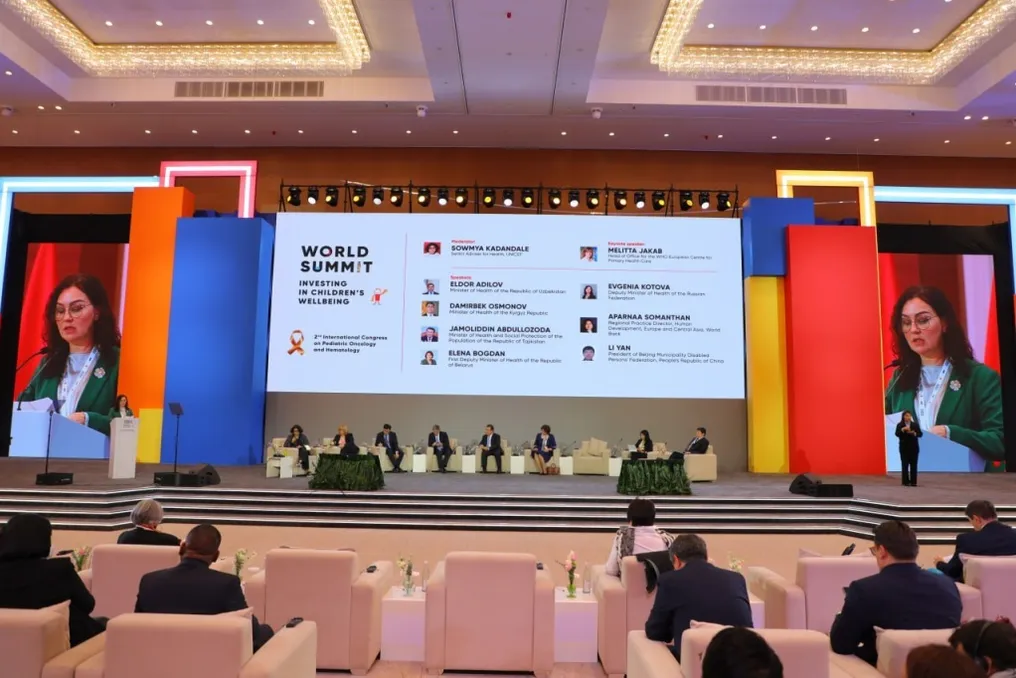
The question of how to make medical care more comfortable for children and adolescents was a topic of discussion at the World Summit on Child Well-being held in Samarkand. Summit participants, including representatives from Russia and Belarus, shared experiences using adolescent centers, conducting school medical examinations, and operating crisis lines. Furthermore, a proposal was put forward to introduce preventive check-ups using mobile clinics.
Belarusian Approaches to Working with Adolescents
Elena Bogdan, Deputy Minister of Health of Belarus, reported that thanks to support from UNICEF and UNFPA, over 60 centers focused on youth and adolescents operate in the country. Specialists trained in the specifics of communicating with young people work in these centers. The 'peer teaches peer' method is also used, where peers exchange information.
According to Elena Bogdan, it is critically important that medical staff know how to build a dialogue with the teenager themselves. This skill is especially valuable during adolescence when young people face issues of physical and psychological health, relationships, and self-determination, and may find it difficult to discuss these topics with parents or other adults present. Proper doctor training allows the teenager to ask their pressing question and receive qualified support.
Belarus is also taking steps to reduce anxiety levels when younger children visit polyclinics. Special zones have been created in large pediatric medical institutions where safety issues are discussed with children in a playful manner. Elena Bogdan gave the example of pediatric dental offices equipped with screens showing cartoons to distract during appointments, noting that play contributes to a calmer perception of medical staff.
Integrating Medicine into the School Environment
Another effective method is conducting preventive check-ups in places where children spend most of their time. Evgenia Kotova, Deputy Minister of Health of Russia, spoke about the development of medical care in schools and preschool institutions. This format eliminates the need for parents to constantly take time off work and separately schedule an appointment for their child.
Kotova emphasized that doctors go to the children, conducting a full examination program and conversation right where the child spends most of their time. At the same time, school medicine should not exist in isolation from the general healthcare system; medical workers in educational institutions are linked to polyclinics, which ensures coordination and necessary professional training.
Preventive check-ups cover key developmental stages: before starting school, before transitioning to subject-specific studies, and during adolescence. Thus, school medicine solves a dual task: simplifying access to prevention for families and integrating medical monitoring into the child's familiar environment.
Reproductive Health and Mental Health Support
The issue of teenagers seeking help regarding reproductive health was examined separately. Evgenia Kotova noted that young people often feel uncomfortable visiting facilities primarily oriented towards adults. In Russia, cabinets for protecting the reproductive health of children and youth are being opened in municipalities, aimed at reducing stigmatization and increasing the accessibility of care.
Furthermore, starting from the age of fifteen, preventive check-ups include consultation with an obstetrician-gynecologist for both girls and boys. This allows reproductive health issues to be discussed as part of routine care, rather than only after problems arise. For mental health support, round-the-clock crisis lines are also available in Russia. Evgenia Kotova explained that since the calls are not personalized, children do not feel embarrassed using these lines. Crisis lines serve as a source of support when it is difficult to talk to loved ones or consult a specialist in person, while complementing, but not replacing, medical care and family support.
The Idea of Mobile Clinics
During the discussion, it was proposed to create mobile clinics for conducting preventive check-ups. The essence of the idea is that specialized buses should come directly to schools, relieving parents of the need to independently organize their child's trip to the medical center. The author of this proposal noted that such buses could be designed in a way attractive to children to reduce fear of examination. The mobile model would also help simplify access to preventive care in remote regions.
A youth representative explained that if 'we, on the contrary, go to the school with these buses and conduct a preventive check-up,' the familiar environment and the opportunity to undergo the examination with classmates will help children feel more confident. However, it should be noted that mobile clinics were discussed only as a potential proposal; no information was presented at the session regarding launch timelines, funding, or specific plans for implementing this program.
General Principles for Improving Child Healthcare
The examples presented at the summit address various tasks. School medicine and mobile clinics aim to bring preventive care closer to children and simplify its receipt by families. Adolescent centers, reproductive health cabinets, and crisis lines provide additional channels for discussing topics that may be difficult for young people. The use of play elements in pediatric polyclinics helps reduce anxiety before medical procedures.
The main principle uniting all these initiatives is that the child healthcare system must consider not only medical needs but also the child's age, emotional state, and life circumstances. It is crucial that parents have the opportunity to provide necessary care in a timely manner, and that the children and adolescents themselves feel safe and calm enough to openly discuss their problems.