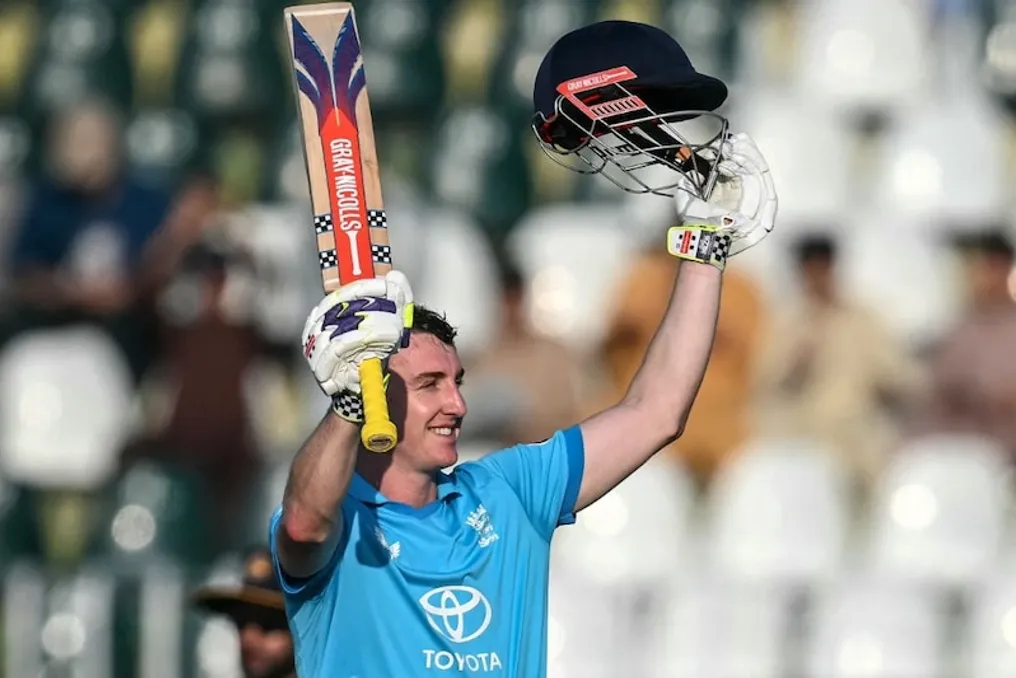
England captain Harry Brook set a historic record in the ODI format by completing a double century in just 114 balls during an ODI Tri-series match against Sri Lanka in Pakistan.
Thanks to his powerful batting, England managed to score an impressive total of 429 runs while losing four wickets in 50 overs. Furthermore, Brook became the first English player to reach a double century in ODIs and the second batsman, not starting at number one, to achieve such a feat in ODIs, succeeding Glenn Maxwell.
Previously, the record for the fastest double century in ODIs was held by Shubman Gill, who reached this milestone in 117 balls against West Indies at the Baraspara stadium in Guwahati this year.
On Thursday, October 22, 2026, in Rawalpindi, the Sri Lankan team won the auction and decided to start the game with a toss. Brook scored 202 runs off 116 balls, which included 21 fours and 10 sixes. He scored at an average rate of 174.13 and batted for 159 minutes. His double century became the fastest in ODI history.
England's innings started with Tom Banten and Ben Duckett. Banten scored 50 runs off 51 balls, including nine fours, but was dismissed by Dunith Wellalage. Duckett scored 29 runs off 39 balls and was also victimized by Wellalage. After England lost two wickets, having scored 85 runs, Joe Root and captain Harry Brook continued the innings.
Root contributed to the innings by scoring 69 runs off 66 balls, including eight fours, before being dismissed by Asitha Fernando. However, after Root's exit, Brook's aggressive style did not weaken. He continued to hit powerful shots against the Sri Lankan bowlers and ultimately completed his record double century. He was dismissed on the last ball of the match bowled by Janith Liyanage while attempting to play the ball towards backward point, but it was caught by Sahan Arachchige.
Willie Jackson also demonstrated an impressive performance, scoring 66 runs without getting out from 30 balls, using eight fours and three sixes, with a strike rate of 220. In the last five overs, England earned 78 runs, losing one wicket. A total of 13 extras were added to the innings, including one bye, one leg bye, two no-balls, and nine wides.
The final summary showed that the team scored 429/4 in 50 overs, with an average run rate of 8.58.
The Sri Lankan bowlers were under great pressure. Dunith Wellalage was the most successful, taking two wickets and conceding 56 runs in 10 overs. Asitha Fernando took one wicket, allowing the opponent 68 runs in 10 overs, and Janith Liyanage took one wicket, conceding 32 runs in two overs. Dilshan Madushanka conceded 89 runs in 10 overs without taking any wickets. Ashton Malanga spent 91 runs in 10 overs, and Dasun Shanaka gave away 74 runs in six overs, while Chamindu Mendis allowed 17 runs in two overs.
Brook's historic double century and Jackson's explosive batting helped England reach a total of 429 runs in the ODI.
In the overall ODI standings, India leads with 9 wins, followed by England with 8, South Africa with 8, Australia with 3, New Zealand with 2, Sri Lanka with 2, West Indies with 1, and Zimbabwe with 1.
Fastest ODI double century records (by balls): Harry Brook vs Sri Lanka in Rawalpindi in 2026 — 114; Shubman Gill vs West Indies in Guwahati in 2026 — 117; Ishan Kishan vs Bangladesh in Chattogram in 2022 — 126; Glenn Maxwell vs Afghanistan in Mumbai WS in 2023 — 128; Pathum Nissanka vs Afghanistan in Palakkad in 2024 — 136.
Highest individual scores for England in ODIs: 202 — Harry Brook vs Sri Lanka in Rawalpindi in 2026; 182 — Ben Stokes vs New Zealand in The Oval in 2023; 180 — Jason Roy vs Australia in Melbourne in 2018; 171 — Alex Hales vs Pakistan in Trent Bridge in 2016; 167* — Robin Smith vs Australia in Edgbaston in 1993.
England's squad for this match included: Tom Banten, Ben Duckett, Joe Root, Harry Brook (captain), Willie Jackson, Sam Curran, Jordan Cox, Jamie Overton, Liam Dawson, Gus Atkinson, Josh Tang. Sri Lanka's squad consisted of: Chamindu Mendis, Avishka Fernando, Kusal Mendis (captain), Pawan Ratnayake, Sahan Arachchige, Janith Liyanage, Dasun Shanaka, Dunith Wellalage, Ashton Malanga, Asitha Fernando, Dilshan Madushanka.