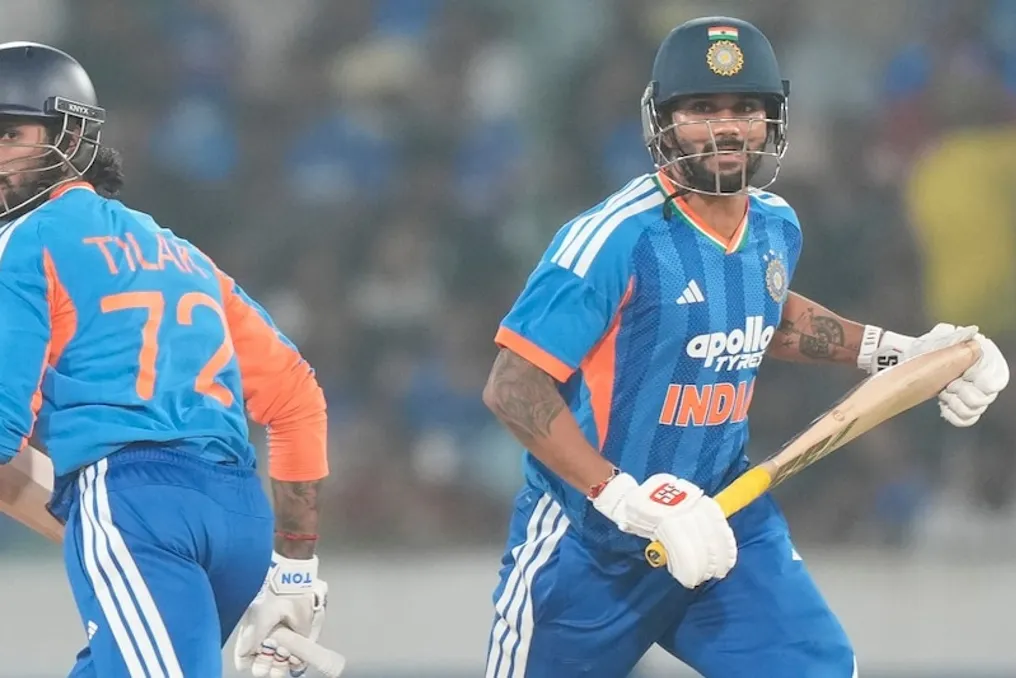
India won the first T20 match against New Zealand, achieving a target of 226 runs in 19.4 overs.
This victory was achieved not only through strong batting but also demonstrates the Indian team's aggressive approach to chasing targets, unafraid to take risks. Despite shortcomings in the bowling game, the batsmen managed to compensate for these weaknesses with their power.
India's strategy became clear: instead of restricting the opponent to a low score, the team found it more advantageous to surpass their total. However, such a tactic will only be effective if there are consistent high performances in the attack, as chasing a target of 225 runs every day will not be easy.
The target of 226 runs indicates that serious questions face the Indian bowling unit. Allowing over 200 runs in T20 itself is a signal that the strategy, length, and line of the delivery need improvement, especially towards the end of the match. Nevertheless, India's batting completely changed the course of the game.
By reaching 230/6, India proved that its batting does not depend solely on stars. The squad includes players capable of increasing aggression under the pressure of a difficult task.
This victory is more of a statement about batting strength than a success of bowling.
Sanjju Samson laid a solid foundation for the chase, scoring 67 runs off 33 balls, including eight fours and four sixes. His key contribution was preventing the pressure of a large score from overwhelming the Indian batting.
Samson showed from the beginning that simply preserving wickets is insufficient to achieve a target of 226 runs; maintaining tempo and putting pressure on the bowlers is necessary. His play allowed subsequent batsmen to play in a more open manner.
The performances of Shreyas Iyer with 42 runs and Naman Dira without getting out for 42 runs (off 15 balls) were important elements of this victory. Axar Patel also made a useful contribution of 24 runs.
The significance of these innings is not limited to the runs scored. When chasing a big score, the quick start of one batsman must be supported by others. This is where Shreyas and Naman played their role.
Naman's unbeaten knock was particularly crucial, as the match needed to be concluded even after approaching the target. India demonstrated that it has options to score runs at different stages of the match, winning in 19.4 overs.
Despite the brilliant victory, it is crucial to understand the other side of the coin. Reaching a target of 226 runs shows India's strength, but this does not allow for ignoring the bowling deficiencies.
India's aggressive strategy is its strength, but a truly strong team is one that can control the game with both batting and bowling. India has shown that a large score is an opportunity to attack, not a cause for fear.
However, to maintain this dominance in the series, the bowlers will have to raise their level. India's new T20 declaration is this: if you make 225, we will make 226. But true dominance will come when the ball rules over the opponent alongside the bat.