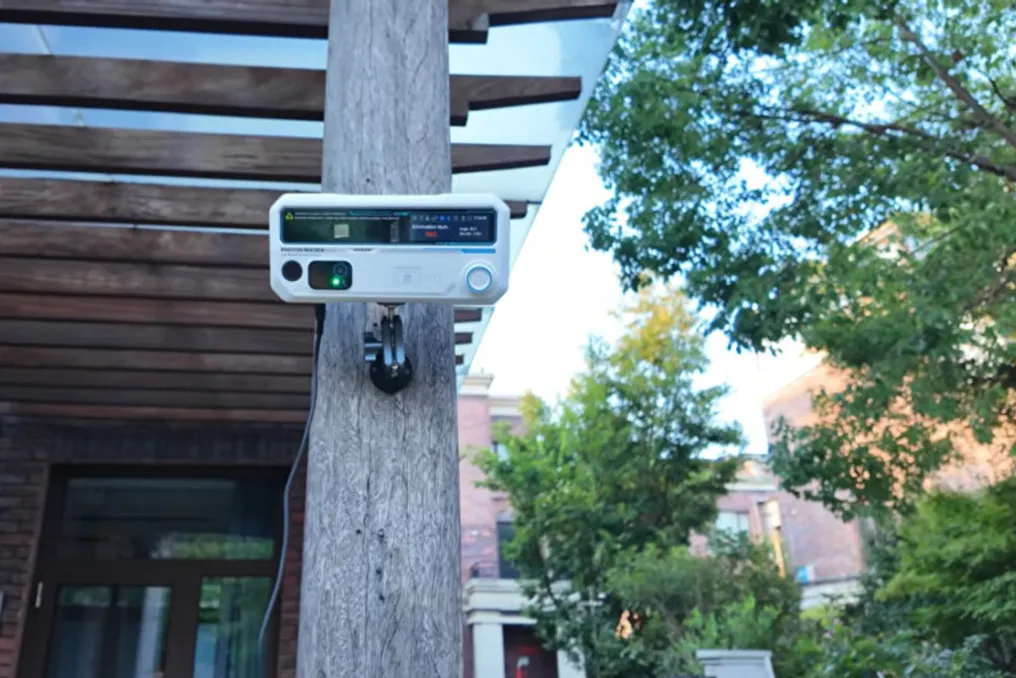
A Chinese startup has unveiled a $1,000 device (approximately 5,400 Brazilian reais) that uses artificial intelligence (AI) and a laser to detect and burn the wings of mosquitoes while they are flying. This equipment, created by Photon Matrix, employs sensor technologies similar to those used in self-driving cars to identify insects.
The company is already accepting pre-orders, but it still needs regulatory approval to sell the product in China, Europe, and the United States. Mass production is scheduled for the coming weeks.
The device is named the Laser Mosquito Air Defense System and operates based on LiDAR technology, which stands for Light Detection and Ranging. The system emits 100,000 extremely weak laser pulses per second to build a two-dimensional map of the area and track objects smaller than a pea.
Upon detecting a mosquito, the equipment activates a second laser aimed at its wings. Each pulse lasts only one-hundredth of a second, which, according to Wang Chuan, founder and CEO of Photon Matrix, is enough to burn the wings without causing severe damage to the rest of the insect's body.
However, the mosquito itself does not die instantly; after losing the ability to fly, it may take several hours or even days to die, Wang clarified.
The apparatus uses a Class IV laser, which is the most powerful category and is typically intended for industrial use. Such equipment can cause retinal damage in less than a second, making the protective mechanisms developed by the manufacturer particularly important.
The system integrates various functions to prevent accidental firing at people or animals. Device activation also depends on passing a 15-question safety test. One of these questions concerns the least suitable environment for installing the apparatus—the bathroom, due to humidity, confined space, and reflective surfaces. Only those who answer all questions correctly can register a fingerprint to unlock the equipment.
Ken Barat, a former laser safety specialist at Lawrence Berkeley National Laboratory and a participant in developing international technical standards for research lasers, believes that the protective mechanisms can make the device safe. However, he warns that a concentrated Class IV laser on such a small target can accumulate a large amount of energy in a limited area.
Photon Matrix previously tested less powerful Class III lasers, but they did not ensure reliable incapacitation of mosquitoes. The choice of a Class IV laser required limiting the duration of the pulses. According to Wang, this measure reduces the risk of eye damage but does not eliminate it entirely.
Photon Matrix, based in Changzhou, China, announced receiving 5,000 pre-orders and signing a contract with a manufacturer to produce the equipment. Wang also stated that he is seeking approvals in China, Europe, and the United States, and believes that Chinese approval is close.
In the United States, manufacturers will be able to begin selling the new laser devices after providing the necessary documentation to the Food and Drug Administration (FDA). However, Barat explained that this agency does not conduct product testing.
The idea of eliminating mosquitoes with lasers is not new. In 2010, the American company Intellectual Ventures presented a similar system but failed to bring it to large-scale commercial production.
For the next generation of the device, Wang plans to further reduce the pulse duration. It is expected that this change will allow the natural moisture in the eyes to absorb the laser energy before it reaches the retina.