The Minister of Industry, Mining and Trade emphasized during the signing of the memorandum of cooperation with the member states of Eurasia the necessity of full implementation of the free trade agreement, elimination of trade barriers, and expansion of transit interaction.
According to IRNA of the Ministry of Industry, Mining and Trade, Seyyed Mohammad Atabak called for the practical fulfillment of agreements, the liquidation of trade obstacles, and the maximum utilization of the potential of this agreement for the development of economic exchanges at the second meeting of the Joint Committee for the Implementation of the Free Trade Agreement between Iran and this union on Wednesday evening.
The Minister noted that for the full use of the benefits of free trade, transparency of import rules, timely exchange of statistical information, and the elimination of tariff and non-tariff barriers are necessary. He stressed the need to monitor issues related to vehicle processing fees, access of Iranian cement to the markets of union member states, as well as requirements for importing food products, stating Iran's readiness to participate in studying and eliminating these obstacles.
Furthermore, the Minister of Industry, Mining and Trade proposed transforming the agreements into specific executive plans with a clear schedule and definition of the responsibilities of each party. He also suggested that the secretariats of both parties create a mechanism for constant monitoring of the fulfillment of statements and present a report on the progress of measures at the next meeting of the Joint Committee.
He stated that the ongoing negotiations would be constructive and results-oriented, and the outcomes of the negotiations and agreements in specialized committees should serve as a basis for regular control over the fulfillment of obligations. The Minister expressed hope that the implementation of the agreements, by promoting the activities of traders and increasing trade turnover, will lead to the strengthening of economic cooperation between Iran and the Eurasian Economic Union, as well as enhance the positions of the parties in regional and international relations.
During the second meeting of the Joint Committee for the Implementation of the Free Trade Agreement between Iran and the Eurasian Economic Union, held under the auspices of the Ministry of Industry, Mining and Trade, decisions were presented on facilitating trade, developing economic cooperation, and eliminating existing barriers.
The committee included the minister responsible for trade of the Eurasian Economic Union, representatives of the Economic Commission, ambassadors, deputy ministers of the Ministry of Industry, Mining and Trade, representatives of the Iranian Trade Promotion Organization, Customs of the Islamic Republic of Iran, the Iranian Chamber of Commerce for Trade, Industry, Mining, and Agriculture, the Ministry of Transport and Urban Development, the Ministry of Agriculture, as well as the Iranian National Organization for Standardization and the Iranian Veterinary Organization.
Among the most important areas of this meeting were accelerating the creation of an electronic system for verifying the origin of goods, developing transit cooperation within the framework of the International North-South Corridor, and strengthening technical and sanitary cooperation related to trade.
It was also noted that the signing of the memorandum of understanding between the Business Council of the Eurasian Economic Union and the Iranian Chamber of Commerce for Trade, Industry, Mining, and Agriculture is a step towards strengthening ties between the private sector and expanding trade cooperation between the two parties.
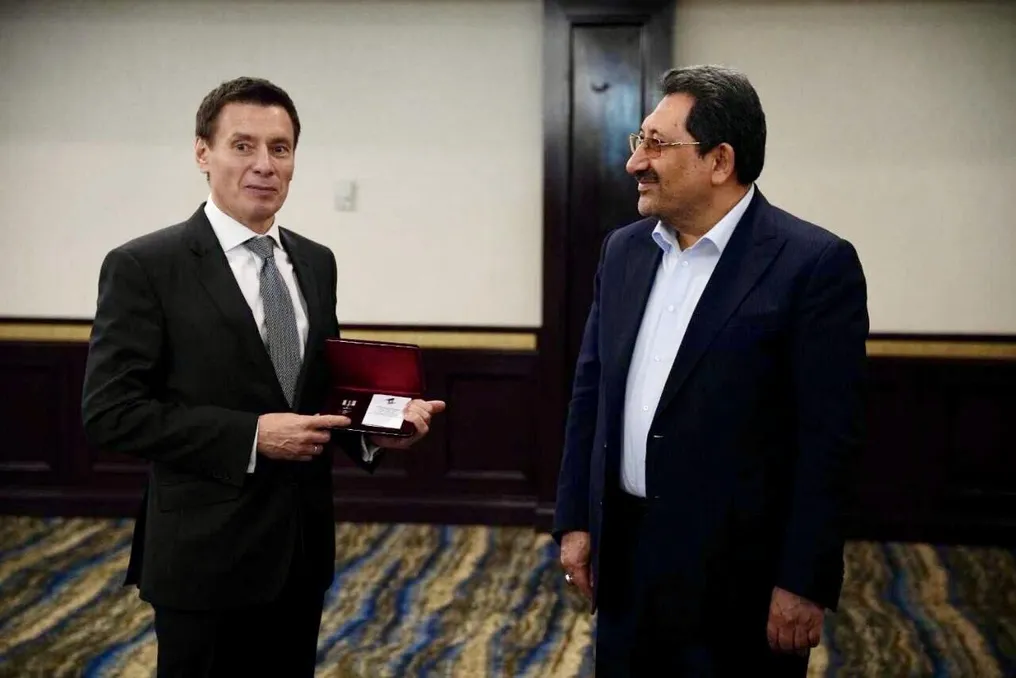
The highest honorary medal of the Eurasian Economic Union was awarded to Seyyed Mohammad Atabak, Minister of Industry, Mining and Trade of the Islamic Republic of Iran, by Andrey Slevnev, Minister of Trade of the Eurasian Economic Commission, in recognition of his effective efforts to develop and deepen Iran's economic relations with this union.
According to IRNA of the Ministry of Industry, Mining and Trade, this award was given for the measures and efforts of the Minister of Industry, Mining and Trade to expand economic cooperation, strengthen trade interactions, and develop relations of the Islamic Republic of Iran with the member states of the Eurasian Economic Union, which is carried out with the aim of utilizing mutual opportunities, promoting trade, and expanding economic ties between the parties.
Andrey Slednev, Minister of Trade of the Eurasian Economic Union, arrived in Tehran on Wednesday to participate in the second meeting of the Joint Committee for the Implementation of the Free Trade Agreement between Iran and the Eurasian Economic Union, as well as a meeting with Seyyed Mohammad Atabak, Minister of Industry, Mining and Trade, and other ambassadors of the member states, where they discussed proposals for facilitating trade, developing economic cooperation, and eliminating existing barriers.
On October 1, the head of the Iranian Trade Promotion Organization (TPO), in a meeting with the Minister of Trade of the Eurasian Economic Union, emphasized Iran's determination to expand and deepen trade relations and strengthen ties between the private sectors of the two parties, citing the growing trend of trade between Iran and the member states of the union.
According to the PR of the Iranian Trade Promotion Organization, Mohammad Ali Dehghan Dehnavi, in a meeting with Slevnev, commenting on the course of trade between the Islamic Republic of Iran and the member states of the Eurasian Economic Union, stated: 'Despite all difficulties and problems, trade statistics between Iran and the Eurasian Economic Union show an upward trend, which promises bright prospects for the future development of trade relations.'
The Deputy Minister of Industry, Mining and Trade, emphasizing the Islamic Republic of Iran's desire to expand trade ties with the member states of the Eurasian Economic Union, added: 'Iran has regular cooperation and trade relations with Russia and other union states, and we strive to make these ties deeper than before.'
Dehghan Dehnavi also expressed hope that the second meeting of the joint committee of Iran and the Eurasian Economic Union would take place in Tehran soon, adding: 'Holding this meeting in Tehran could be a suitable opportunity to strengthen ties between the private sectors of Iran and the member states of the union and form new economic and trade partnerships.'
The head of the Iranian Trade Promotion Organization also insisted on continuing consultations and using available opportunities to develop economic and trade cooperation between Iran and the member states of the Eurasian Economic Union.
It is worth noting that Dehghan Dehnavi visited Minsk to participate in the 19th meeting of the Joint Commission on Economic Cooperation between the Islamic Republic of Iran and the Republic of Belarus.
In addition, in mid-September, the Minister of Economy and Finance of Iran, positively assessing the results of his bilateral meetings with officials of the Eurasian Economic Union (EAEU), announced proposals such as establishing a basic currency to accelerate transactions and appointing special representatives to resolve obstacles facing bilateral trade.
According to IRNA, Seyyed Ali Madanizadeh informed reporters after separate meetings and discussions with the Chairman of the Executive Council and the Minister of Trade of the Eurasian Economic Commission at the union headquarters in Moscow: 'We had very good sessions.'
He stated: 'On behalf of Iran, we expressed our interest and readiness to expand relations and fully implement the free trade agreement with the Eurasian Economic Union, and that we are ready to cooperate with this union in various fields; the union officials, in turn, expressed their readiness and interest in expanding ties with our country.'
The Minister of Economy and Finance, mentioning the efforts of enemies of the Iranian people to incite economic war and block trade and financial channels, said: 'Evidently, thanks to God, these countries support Iran and our economy, and Iran has been able to maintain production and trade relations with countries in the most difficult conditions.' He added: 'The member states of the Eurasian Economic Union are equally committed to and interested in developing these relations.'
Continuing his agenda in Moscow for multilateral consultations, the Minister of Economy and Finance visited the headquarters of the Eurasian Economic Union and met with the Chairman of the Executive Council and the Minister of Trade to discuss accelerating bilateral trade.
Seyyed Ali Madanizadeh and Bakytzhan Sagintayev, Chairman of the Eurasian Economic Commission Council, emphasized their shared determination to expand cooperation during this meeting.
Before this meeting, the Minister of Economy and Finance held a separate session with Andrey Slevnev, the Minister responsible for trade of the Eurasian Economic Commission, and a group of union officials to review the progress of cooperation after the implementation of the free trade agreement. Slednev noted that the second meeting of the Iran-EAEU working group would take place in Tehran in the coming months and expressed hope for the continuation of the upward trend in bilateral trade.
The Iranian Ambassador to Russia, Kazem Jalali, and Mehdi Heidari, Deputy Minister of Economy and Head of the Iranian Organization for Investment, Economic and Technical Assistance, accompanied Madanizadeh during these meetings.
The free trade agreement between Iran and the Eurasian Economic Union came into force in May 2025 after the completion of legal procedures in the signatory countries, subsequently abolishing customs duties on 87% of goods in bilateral trade.
As part of this cooperation, the path for Iranian goods to the market of more than 180 million people in the union member states was simplified, and conversely, this opportunity is available to traders from five signatory countries when trading with Iran.
Russia, Belarus, Kazakhstan, Kyrgyzstan, and Armenia are members of the Eurasian Economic Union, while Iran holds observer status in the union.
The Eurasian Economic Union (EAEU) is a regional integration bloc in the post-Soviet space, created by a treaty signed in 2014 and launched on January 1, 2015. Its five members are Russia, Belarus, Kazakhstan, Kyrgyzstan, and Armenia, while Iran, Cuba, Moldova, and Uzbekistan hold observer status.
Modeled partly after the European Union, the EAEU aims to create a single internal market with the free movement of goods, services, capital, and labor. Its main tasks include improving living standards, ensuring sustainable economic development, and increasing the global competitiveness of member economies. The Union is governed by institutions such as the Supreme Eurasian Economic Council and the Eurasian Economic Commission. Although the EAEU has expanded external ties—particularly through the free trade agreement with Iran—internal integration remains uneven, with Russia dominating trade flows according to the 'hub and spoke' model. The bloc has set a long-term goal of becoming a self-sufficient and attractive macro-region by 2045.